Showing posts with label Palladio. Show all posts

Sunday, September 7, 2014

Italian Trip Diary -- Day #15 -- Venice

Wednesday, June 27, 2001, Venice:

After early breakfast at the hotel (the waitresses were arguing – it seemed to be the thing in Venice) we took out our street map (required knapsack material in Venice) and found our way to San Zanipoli (short for St. John & St. Paul in Venetian dialect – go figure) in the tranquil 'back country' of Venice where the canals are narrow and largely empty and the tourist crowds thin out noticeably.

The façade, which is incomplete, is in a vertical gothic style done in red brick with decorative elements in multi-colored marbles.  
Basilica di San Giovanni e Paolo a.k.a. San Zanipoli was begun in 1333.  It is dedicated to two
obscure Christian martyrs, not the two Apostles.  It is a Dominican preaching churches and the
burial place of 15 Doges of Venice.  Photo by Blomme-McClure.
Main door of San Zanipolo showing transition from finished marble surround and unfinished brick facade.
Photo by Blomme-McClure
Unfortunately the lovely tiled piazza in front of the church (where Katherine Hephurn fell into the canal in 'Summertime') was surrounded by scaffolding.  
Equestrian statue of Bartolomeo Colleoni by Andrea Verrocchio, bronze, 1486
 on Campo San Giovanni e Paolo.  Photo by Blomme-McClure 
The interior is in brick gothic with a semi-circle of lancet windows behind the altar.  
Interior of San Zanipolo has steel supporting cross beams.  Photo by Blomme-McClure
The Chapel of the Rosary on the left of the altar contains large paintings by Veronese. 
Monument of Pietro Mocenigo, Doge from 1474 to 1476, by Pietro Lombardo,
Istrian stone and marble, 1476-1481.  Photo by Blomme-McClure
There are numerous monuments and chapels dedicated to doges and other Venetian notables. 
Tryiptych in Chapel of St. Vincent Ferrier by Giovanni Bellini.  Photo by Blomme-McClure
The last chapel on the right aisle contains a notable triptych by Giovanni Bellini with St. Vincent Ferrier in the center flanked by St. Christopher and St. Sebastian (that perennial favorite of Italian painters and gays).
Triptych (detail) by Giovanni Bellini of 'St. Christopher, St. Vincent Ferrier, and St. Sebastian', oil on wood panel,
circa 1464.  Photo by Blomme McClure


By trial and error we made our way to Santa Maria dei Miracoli, a lovely small church set on a small serene campo beside a canal.  The multi-colored marble façade is composed of a bottom story with inset classical columns with a single middle door surmounted by a second story with five irregular arches supported on inset classical columns which is in turn surmounted by an enormous round arch punched with a large rose window surrounded by three smaller circular windows and two marble rosettes. 
Upper facade of Santa Maria dei Miracoli, a Venetian Renaissance gem, designed by Pietro Lombardo,
built from 1481 to 1489.  Photo by Blomme-McClure


Lower facade and entrance door of Santa Maria dei Miracoli.  The superimposed columns
and multi-colored marble are a feature of Venetian Renaissance architecture.  Photo by Blomme-McClure
It is a lovely and dynamic composition.  The interior with a single nave under the giant barrel vault is less remarkable.

From Campo dei Miracoli, we somehow made our way to another church, San Francesco della Vigna, which had some lovely art.  The main facade of the church was designed by Andrea Palladio in 1562.  
Main facade of San Francesco della Vigna, by Palladio, 1562.  Photo by Blomme-McClure
The rest of the exterior and interior of the church follows the designs of Jacobo Sansavino and was built between 1530 and 1554.
Nave and altar of San Francesco della Vigna, designed by Jacobo Sansavino.  Photo by Blomme-McClure
The church contains the Badoer-Giustinian Chapel with an altarpiece and side walls by Pietro Lombardo and his workshop that Sansavino salvaged from an earlier church on the sight.
'Saint Jerome (center) with St. Agnes, St. Michael, St. James, and St. Anthony' by Pietro Lombardo
and other members of the Lombardo family and workshop, marble, circa 1500-1530.
Photo by Blomme-McClure
Panels from the former choir screen were incorporated into the walls of the chapel.
Reliefs of Old Testament kings and prophets by the Lombardo workshop with angel heads by Sansavino, in an
adaptive reuse of the choir screen of the former church.  Photo by Blomme-McClure

Detail of relief of Job (I think) by Lombardo workshop with Sansavino angel head.
Photo by Blomme-McClure


Giovanni Bellini's 'Virgin and Child with Four Saints and Donator', oil on wood, circa 1507, 
in San Francesco della Vigna.  Photo by Blomme-McClure


'Last Supper of Christ' by Girolamo da Santacroce, circa 1540.  Photo by Blomme-McClure

After San Francesco della Vigna we found our way to lunch at a table along side the canal at Trattoria ai Greci (Castello 4988, Venezia)
George (in red) and Carl (in rose) canal-side at Trattoria ai Creci.  Photo by Blomme-McClure
with a view down the canal to the leaning tower of San Giorgio dei Greci which appeared to be about to fall into the canal.
San Giorgio dei Greci with leaning Campanile.  This Greek Orthodox church was permitted by
the pope in 1539 and was completed by 1550.  The bell tower was added in 1592.
Photo by Blomme-McClure

After lunch we walked across Venice to the Accademia Bridge, passing the church of San Zaccaria on the way.
Church of San Zaccaria built in the early Venetian Renaissance style between 1458 and 1515.
Photo by Blomme-McClure
 Actually, George stopped at a cyber-café on the Campo San Stefano for about an hour to catch up on e-mail (our Italian internet connection didn’t work in either Padua or Venice) while Doug and Carl went on ahead.  The Accademia Bridge is another of the three bridges over the Grand Canal.  Unlike the Rialto, it is a wooden structure with very little grace or special presence – it just gets you across the Canal and provides a great vantage point for looking up
View up the Grand Canal from the Accademia Bridge.  Photo by Blomme-McClure
and down the Canal.
View down the Grand Canal toward Santa Maria della Salute and the Dogana.
Photo by Blomme-McClure


The Accademia has a vast collection of (mostly) Venetian art.  The paintings are often very large – many were created to be altarpieces in churches and chapels.  All of the great Venetian artists – Titian, Veronese, Tintoretto, Bellini, Lotto – are represented, sometimes by great masterpieces.  Yet, it is fascinating how some paintings by lesser artists catch the eye and remain in memory, while those selected by curators and noted by guidebooks disappoint and become dim.

George caught up with us in the galleries, allowing Doug a chance to revisit some of the works with special appeal.

Emerging from the Accademia, we found a café along the canal for refreshments and then walked through the “left bank” or Dorsoduro to Santa Maria della Salute. 
Grand Canal facade of Santa Maria della Salute designed by Baldassare Longhena.
Photo by Blomme-McClure
This Baroque church was designed by Longhena, who won a competition to build a church to celebrate the deliverance of Venice from the plague (beating out Palladio).  The church is distinguished by a huge dome supported by large snail-like buttresses that rises above an octagonal base that sits at the top of an enormous staircase ascending from the Canal.
High Altar by Longhena is centered on a Byzantine 'Madonna and Child' from the 12th or 13th
century and is topped by a Baroque sculptural group of 'The Queen of Heaven Expelling the Plague'
from 1670 by Josse de Corte, a Flemish sculptor.  Photo by Blomme-McClure

 
Interior of Santa Maria della Salute.  Photo by C. Koivuniemi
The interior seems quite austere compared to the exuberant exterior, but has a distinct charm and is a treasure house of Baroque art (probably great, but seen through eyes saturated by the works in the Accademia). 
'Descent of the Holy Ghost' by Titian, oil on canvas, 1545.  Photo by Blomme-McClure
The geometric marble floor
Marble floor in Santa Maria della Salute.  Photo by C. Koivuniemi
serves to focus the observer to the center of the church under the great dome.
Dome on octagonal drum, Santa Maria della Salute.  Photo by Blomme-McClure

We took the vaporetto from the steps of La Salute back to San Marco and thence through the Piazza to our hotel.  That evening we had dinner outside at Ristorante Al Theatro (San Marco 1916, Venezia) which sits next to the site of Venice’s opera house, La Fenice.  La Fenice burned down several years ago and is now under reconstruction.  Apparently, there have been some previous attempts to rebuild it which have ended in corruption rather than construction.

We had delicious food and were amused watching confused tourists going by with maps – many were back several times during the course of the meal.  Venice is that sort of a place and part of the fun for us was getting lost and discovering new and interesting places.

Friday, August 22, 2014

Italian Trip Diary -- Day #13 -- Along the Brenta Canal from Padua to Venice

Monday, June 25, 2001 -- Padua to Venice along the Brenta Canal:

Unfortunately, our trip from Padua to Venice was set for Monday.  It is the day that most of the villas along the Brenta Canal are closed.  In fact, it is also the day that there are no boats on the Canal between Padua and Venice (the way we had originally intended to make the trip).  Nonetheless, we took the road along the Brenta Canal and saw some of the villas designed by Palladio and his followers – two up close.

The Brenta villas were built along the Canal by the Venetian nobility as retreats from the unhealthy summer climate in Venice.  Many were designed by Palladio, although others were completed much later in a neo-Palladian style.

We stopped at the Villa Pisani near Stra, which was supposed to be open on Monday.  Unfortunately, on that particular Monday it was closed to allow an arts and crafts show to be set up.  We had to content ourselves with a walk along the front façade and garden walls. 
Villa Pisani on the Brenta Canal, built in the early 18th century for the Venetian Doge, Alvise Pisani.
Photo by Blomme-McClure
It is a very large house with an imposing central pavilion designed in the Palladian style by Giralamo Frigimelica and Francesco Maria Preti.  The house was built for Alvise Pisani, who was named Doge of Venice in 1736.  In later centuries it was used by Napoleon and hosted Hitler's first conference with Mussolini in 1934.  
Central pavillion of Villa Pisani with George walking away after finding it was closed the day of our visit.
Photo by Blomme-McClure
Detail of Telamones (male Carytids) on the central pavilion of Villa Pisani.
Photo by C. Koiveneumi
There is a large stables on the opposite side of the formal gardens from the villa.  The gardens extend in both directions and include a Belvedere folly and a formal maze with a viewing gazebo above it.
Stables across the back lawn from the Villa Pisani.  Photo by Blomme-McClure
Folly arising from the center of the formal maze in the gardens of Villa Pisani.
Photo by Blomme-McClure
Day lilies surrounding classical statue along the wall of the stables at Villa Pisani.
Photo by Blomme-McClure
We passed several more villas as we drove along the canal toward Venice.  We detoured along a side canal to Mirano to see the Villa Morosini XXV Aprile, which is now a public library surrounded by a park.  The Palladian-style symmetrical two-story façade with pedimented loggia on the second floor in the central bay is quite lovely.  
Villa Morosini XXV Aprile in Mirano is now a library.  Photo by Blomme-McClure
 We ate lunch on the terrace of the River Pub across the street from the villa/library.

Returning to the Brenta Canal we continued driving toward Venice through an increasingly industrialized area.  To reach Venice by car, you cross the Venetian lagoon on a bridge parallel to the railroad tracks and arrive at a huge parking garage where the Hertz office is located.  While I finalized the papers to turn in the car, George and Carl negotiated with a porter to take our luggage to the hotel.  They decided that I would accompany the porter with the luggage while George and Carl would take the vaporetto to Piazza San Marco and walk to the hotel from there.

The Piazzale Roma and the adjacent train station comprise one of the biggest intermodal transportation hubs in the world.  Everything and everyone coming into Venice must switch from a land-based mode of transportation (train, bus, truck, car) to some form of water-based transportation (water taxi, gondola, vaporetto, freight boat, barge).  It is a bustling place where porters and longshoremen move the baggage and freight from one conveyance to another.

Our luggage and I were taken to the side of a canal where luggage from a bus (probably a tour group) was being loaded onto a freight boat.  After all of the bus luggage had been stacked on the boat, the porter loaded our luggage, the luggage cart and me onto the boat.  The porter and the driver hopped on and we were off down the canals toward the hotel.  
Grand Canal from the back of the freight boat with our luggage.  Photo by McClure
At some point, after negotiating several smaller canals and crossing the Grand Canal we got mixed up in a huge traffic jam of gondolas, water taxis and other freight boats.
Traffic jam on one of the narrower canals from the prow of the freight boat.  Photo by McClure
At the next 'corner' the porter decided that the land route would be faster than waiting to get to the 'water door' of our hotel.  He grabbed the cart and the bags and the driver and the porter hoisted me out of the boat.  Off we went through a maze of small alleyways until we arrived at the 'land entrance' of our hotel (Albergo Cavalletto e Doge Orseolo, San Marco 1107, Venezia, 0039 041 52 00 955, http://www.sanmarcohotels.com/cavalletto/).  I paid the porter the agreed upon 100,000IL for transporting me and the luggage to the hotel.  I was graciously received by the front desk staff and escorted to a lovely corner room on the third floor.

In the meantime, George and Carl took Vaporetto #81 (it turns out that there are several different routes and both local and express versions with this number) down the Giudecca Canal
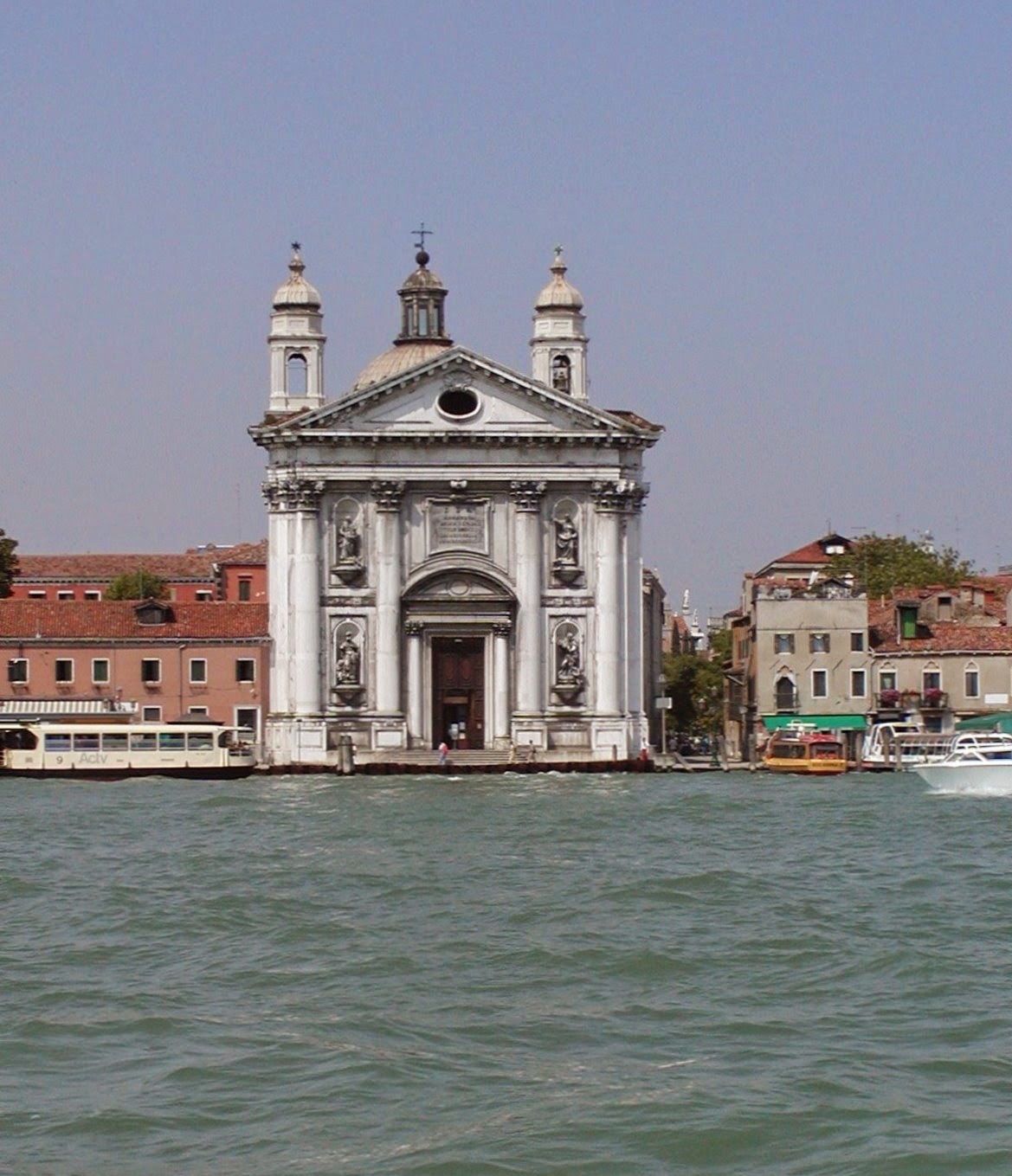
Gesuati (Church of St. Mary of the Rosary) on Giudecca Canal viewed from Vaporetto #81.
The church was designed by Giorgio Massari in the Palladian style and built between 1726 and 1743.  Photo by C. Koiveneumi

and around the Dogana to the San Marco stop.  
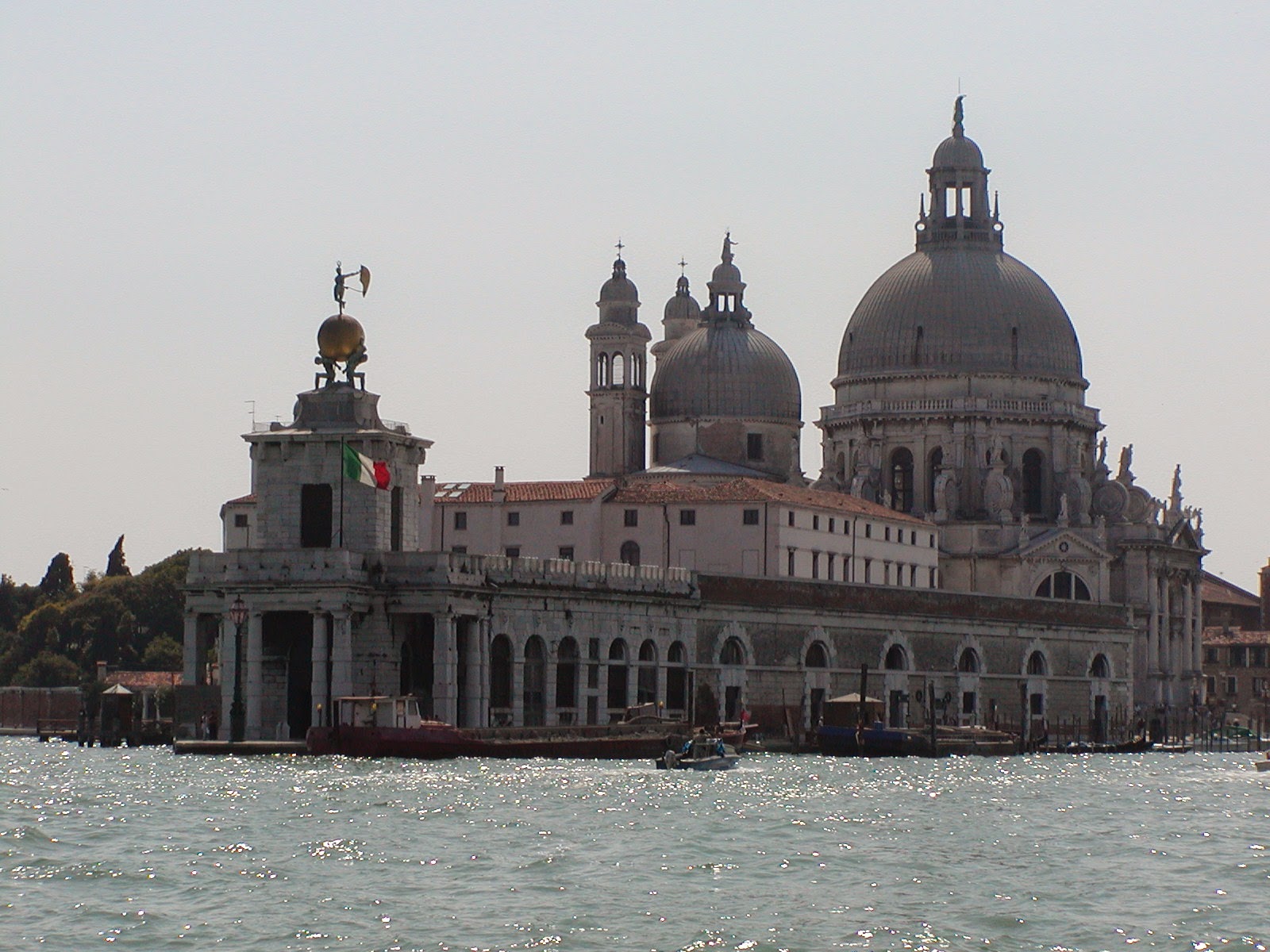
Punta della Dogana (foreground) and Santa Maria della Salute (behind).  The Dogana was built between 1678 and 1682 on the point where the Giudecca Canal joins the Grand Canal.  It was the customs house for the Republic of Venice.  Photo by C. Koiveneumi
From there they made their way to the far end of the Piazza San Marco 
Piazza San Marco, the 'Times Square' of Venice.  Photo by C. Koiveneumi
and thence to the Cavalletto, arriving nearly an hour after me and the luggage. 

The Cavalletto is through an arch near the northwest corner of Piazza San Marco and over a small bridge.  It is on a 'corner' where the canal broadens and then turns – running directly behind the buildings on the north side of Piazza San Marco.  
Water Entrance to Hotel Cavalletto (Albergo Cavalletto e Doge Orseolo).  Photo by C. Koiveneumi
Our room was on the corner of the building overlooking the canals on two sides.  When the windows were open,  it was filled with the cacophony of the gondoliers and their customers, since the corner of the canal opposite our room was where the gondolas were loaded, unloaded and tied up for the night.  
Gondolas on the canal from the windows of our room at the Hotel Cavalletto.  Photo by C. Koiveneumi
However, when the windows were closed the room was extremely quiet.  Carl had the single room next door which also overlooked the gondola basin.

That evening we walked through Venice to the Rialto Bridge on the Grand Canal.  
Rialto Bridge over the Grand Canal in Venice.  There are shops in the pavilion in the center of the bridge.
Photo by Blomme-McClure
Like the Ponte Vecchio in Florence, it is always packed with tourists.  It is one of only three bridges over the Grand Canal, although there are several tragettos – the wide gondolas that cross the canal on a regular time table.  Since the Rialto is a very high bridge, it affords lovely views of the palazzos lining the canal in both directions.
View from the top of the Rialto Bridge looking up the Grand Canal.  Photo by Blomme-McClure
On the far side of the bridge we found Trattoria alla Madonna (San Polo 594, Venezia, 041.5223824) which had been recommended by a New York friend.  It is in a narrow alleyway off the Fondamenta del Vin which runs along the canal from the end of the bridge and was readily apparent from the line of customers waiting in the alley to be seated.  Apparently it is always packed and anyone who wants to minimize the wait should be there when it opens.  There are no reservations, although some customers appear to get preferential treatment.  The specialty is fish and seafood and all of the varieties that we tried were fresh and delicious.  The prices are reasonable (for Venice) and the service is friendly, but fast paced (not a problem for New Yorkers, but possibly annoying for those accustomed to a more leisurely meal).

After dinner, we took another route back to the Piazza San Marco.  The square is never uncrowded (actually Carl got up early and went jogging several mornings and reported that it was quite peaceful in the early morning).  In the evenings the orchestras of at least four outdoor cafes create an aural competition offering jazz, show tunes, light classical and Venetian (Vivaldi, Scarlatti) music.  The one playing Vivaldi’s “Four Seasons” received the loudest cheers that evening.  Even with all of the people milling about and the clash of musical styles it is a magical urban space.  

While we were there (the Biennale was in progress) there was site-specific installation called 'Water and Fire' which lit up the second floor windows on the west side of the square.  LED screens alternately showed licking flames of red, orange and yellow and falling water of blue and white.  The square itself was alternately bathed in a warm red glow from the 'fire' and an icy blue glow from the 'water'. 
Basilica of San Marco bathed in light of 'Water and Fire' installation.  Photo by Blomme-McClure
It was a lovely work of site-specific art that brought added uniqueness to an already indelible place.