Showing posts with label 'Ash'. Show all posts

Friday, March 25, 2016

New York City Ballet Matinee on Sunday, February 21st

SUNDAY MATINEE, FEBRUARY 21, 3:00 PM

'21st Century Choreographers'

ASH: *Laracey, *Catazaro [Conductor: Capps]

     pause
THIS BITTER EARTH: **Mearns, T. Angle
     pause
THE INFERNAL MACHINE: *Phelan, *Chamblee [Conductor: Capps]
     intermission
JEUX: Mearns, *Lovette, Danchig-Waring, *Hall [Conductor: Capps]
     intermission
PAZ DE LA JOLLA: Hyltin, Ramasar, T. Peck [Conductor: Sill]

  *  First time in role at Saturday Matinee, February 21st

**  New York City debut at Saturday Matinee, February 21st

New York City Ballet's '21st Century Choreographers' program was on our subscription series.  Since we had watched Justin Peck's creation of 'Paz de la Jolla' in the movie 'Ballet 422', we were anxious to see the result on stage.  The rest of the program was not new to us -- we had seen several of these works close to the dates when they were first introduced to the Company's repertory.

'Ash' is a busy, energetic work by Peter Martins to a score by Michael Torke.  It was created in 1991 when the original cast was Wendy Whelan and Nilas Martins backed by four couples: Yvonne Borree, Rebecca Metzger, Monique Meunier, Kathleen Tracey, Albert Evans, Arch Higgins, Russell Kaiser and Ethan Stiefel.  At Sunday's program it was danced by Ashley Laracey and Zachary Catazaro with Sara Adams, Laine Habony, Ashley Hod, Unity Phelan, Devin Alberda, Cameron Dieck, Spartak Hoxha and Sebastian Villarini-Velez.
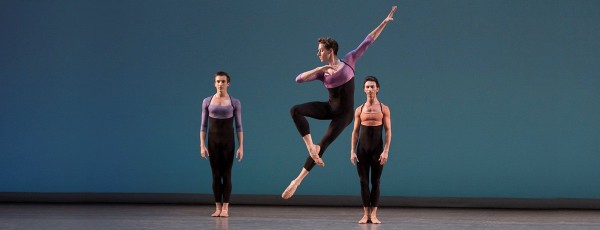
Devon Alberda, Cameron Dieck and Spartak Hoxha in Peter Martins' 'Ash'.
Photo by Paul Kolnik for NYC Ballet
The general design of 'Ash' reminds me of Balanchine's 'Square Dance' -- the hierarchy of principals and corps, the use of call and response, the dancers' general glee with their performances.  Ms. Laracey was sunny, but a little generic; Mr. Catazaro seemed subdued and underpowered.  Among the corps, I was particularly impressed with Mr. Alberda's crisp delivery of his solo passages and also enjoyed the sparkle added by Ms. Phelan, Ms. Adams and Mr. Dieck.

Christopher Wheeldon created 'This Bitter Earth' for Wendy Whelan and Tyler Angle as part of a larger work, 'Five Movements, Three Repeats', first performed at the Vail International Dance Festival in August, 2012.  As a stand-alone pas de deux it entered the Company's repertory at the 2012 Fall Gala.

Wendy Whelan and Tyler Angle in Christopher Wheeldon's 'This Bitter Earth' in 2012.  Photo by Paul Kolnik for NYC Ballet 
The music by Max Richter and Dinah Washington comes from the soundtrack for the movie 'Shutter Island'.

Partnered by Tyler Angle, Sara Mearns made her debut in the work the previous day.  Sara's dramatic temperament and extraordinary amplitude fit nicely into Wheeldon's duet of convoluted shapes and tricky partnering.  Tyler provides strong, somewhat stoic support.  'This Bitter Earth' is not a favorite ballet of mine -- more a piece d'occasion than a repertory staple -- but cast with first rate dancers like Sara and Tyler it makes a positive impact.

Peter Martins created 'The Infernal Machine' for Diamond Project V in May, 2002, to music of the same name by Christopher Rouse.  The original cast was Janie Taylor and Jock Soto.

The score is filled with odd ticks and jolts and sputters.  Unity Phelan and Preston Chamblee -- two of the Company's emerging young talents -- made their debuts in this work at the previous day's matinee.  Chamblee is a steady, confident partner while Phelan provides a feline intensity.  Martins gives them complicated, manipulative partnering moves that can often look awkward, but here they seem appropriate for the astringent score.
    
Preston Chamblee and Unity Phelan in 'The Infernal Machine' by Peter Martins.
Photo by Paul Kolnik for NYC Ballet

Here is a brief YouTube clip showing these two dancers in this work which has just shown up on the Company's website:

'Jeux', the ballet by Kim Brandstrup to the Debussy score, was new last fall.  You can read about my initial reaction here:

I concluded those comments by questioning whether 'Jeux' (and several other new Fall Season works) would hold up on repeated viewings -- it does not.  Sara Mearns was again extraordinary as the blindfolded woman who is cast aside.  Adrian Danchig-Waring again offered strong if nonchalant partnering for her as the jock with the ball.
  
Sara Mearns and the ensemble in Kim Brandstrup's 'Jeux' to the music of Debussy.
Photo by Paul Kolnik for NYC Ballet

Craig Hall and Lauren Lovette were new in this performance -- Craig as the cad who casts Sara aside for Lauren's flirty seductress.  Mr. Hall certainly has the matinee idol looks and strong partnering technique for the part, but he lacks the intense focus Amar Ramasar brought to the role.  With her gorgeous looks and sparkling presence Ms. Lovette makes seduction look simple.

Nevertheless, 'Jeux' is a disappointing ballet that doesn't offer new rewards on repeat viewings.  The vaguely sinister atmosphere and the harsh lighting on the women's bare legs also distract from it's appeal for me.

Justin Peck's 'Paz de la Jolla' which was the subject of the movie 'Ballet 422' was both old and new to us -- old in that we had watched its creation in 'Ballet 422', but new in that we had never seen the complete ballet on stage.  The ballet is set to Bohuslav Martinu's 'Sinfonietta la Jolla for Piano and Chamber Orchestra'.  Here is a description of the work written by Dr. Richard E. Rodda from a Harrisburg Symphony program:   

The opening movement is based on traditional sonata form and utilizes two basic thematic types. The first is bustling and active, filled with rapid figurations passed among the instruments; the second derives from the songfulness of folk music in its lyricism and chordal texture. A pleasing balance is achieved between these two contrasting elements without ever losing the exuberance and spontaneity that enlivens Martinů’s music. The second movement, slow in tempo and soulful in expression, uses folk song models to such an extent that Brian Large, in his study of the composer, labeled it “a virtual fantasia on Czech folk songs.” The finale is a vivacious rondo indebted to the irresistible closing movements of Haydn, whose music Martinů was studying closely at the time he composed the Sinfonietta.  

Justin created a ballet set on the beaches of Southern California where he grew up -- sun drenched by day and moonlit by night.  The cast was led here by Sterling Hyltin, Amar Ramasar and Georgina Pazcoguin (replacing Tiler Peck).  The 15 other dancers were a mix of soloists and corps -- most from the original 2012 cast.  They are all individually costumed in what I would characterize as Eisenhower-era beach wear designed by Reid Bartelme and Harriet Jung.

Costume sketch for 'Paz de la Jolla'  by Reid Bartelme and Harriet Jung.

Following the structure of Martinu's music, Justin's choreography begins with lively beach games interspersed with the stirrings of summer romance between Amar and an outsider, Sterling.  The moonlit central section is a romantic duet for Sterling and Amar often engulfed by shimmering images of surf or coastal fog for the ensemble, their bright beach wear now shrouded in silvery translucent smocks. 
 
Ensemble in translucent smocks during the central movement of Justin Peck's 'Paz de la Jolla'.
Careful inspections shows Amar Ramasar and Sterling Hyltin partially visible behind the ensemble.
Photo by Paul Kolnik for NYC Ballet 

In the final rondo the full cast engages in more beach frolics with Sterling now integrated into the larger group.

By now, we are familiar with some of the signature movement motifs that run through Justin's choreography.  What is amazing is how well he adjusts them and integrates them with the music he has chosen so that they produce a unique result.  Here's a video from the Company which highlights Justin's creation of 'Paz de la Jolla':

Better yet, seek out the movie 'Ballet 422' which provides even deeper insight into Justin's creative process.

Here's a short promotional video from the Company with snippets from 'Paz de la Jolla':

Final image of Justin Peck's 'Paz de la Jolla' with Tiler Peck, Sterling Hyltin and Amar Ramasar.
Photo by Paul Kolnik for NYC Ballet
Gina Pazcoguin, replacing Tiler Peck apparently on short notice, has been with 'Paz de la Jolla' from its earliest rehearsals.  She dances with sparkle and wit, but lacks Ms. Peck's indelible stage presence.  The costume (designed for Ms. Peck) did Ms. Pazcoguin no favors.  Sterling Hyltin and Amar Ramasar seemed to be an unlikely romantic couple on paper, but with Justin Peck's choreography the improbable becomes indelible.

*  *  *  *  *  *  *  *  *

For me, the best impressions in this program were made by Unity Phelan and Preston Chamblee -- together in Martins' 'Infernal Machine' and separately in the ensembles of Martins' 'Ash' (Ms. Phelan) and 'Jeux' (Mr. Chamblee).  They are young dancers to watch as they progress further up through the Company's rich and diverse repertory and (hopefully) find themselves inspiring choreographers in roles made for their unique abilities.

Tuesday, October 6, 2015

NYC Ballet Performance, Friday Evening, October 2nd

FRIDAY EVENING, OCTOBER 2, 8:00 PM (Conductor: Sill)

ASH: *Isaacs, *Stanley
     pause
SONATAS AND INTERLUDES: T. Peck, *Huxley [Solo Piano: Grant]
     pause
TARANTELLA: M. Fairchild, De Luz [Solo Piano: McDill]
     intermission
‘RŌDĒ,Ō: FOUR DANCE EPISODES: T. Peck, Ramasar, Ulbricht, Garcia, Veyette
     intermission
SLAUGHTER ON TENTH AVENUE: Mearns, T. Angle, *Chamblee, Dieck, Scordato, *Coll, Prottas, *Sanz
     *role debuts      

This program, subtitled 'Americana x Five', was immensely satisfying.  Everything was not first rate choreography -- but each work was danced with style and conviction by its talented cast.

'Ash' was choreographed by Peter Martins in 1991 to Michael Torque's commissioned score of the same name.  The original cast featured Wendy Whelan and Nilas Martins as the lead couple -- with four supporting couples that included such starry names as Yvonne Borree, Monique Meunier, Kathleen Tracey, Albert Evans and Ethan Stiefel.

With its neo-Baroque score, high energy and sections of 'call-and-response' choreography, 'Ash' is reminiscent of Balanchine's infinitely superior 'Square Dance'.  Martins' largely symmetrical step-for-note choreography seems frantic and airless, providing his dancers with a test of stamina, but little opportunity for genuine artistry.


Taylor Stanley and Ashly Isaacs in Peter Martins' 'Ash'.  Photo by Hiroyuki Ito for The NY Times

Still, the cast was superb.  Ashly Isaacs and Taylor Stanley in role debuts made strong impressions as the lead couple -- Ashly all speed and sharp angles and Taylor expansive with tensile strength in the convoluted partnering.  Devin Alberda stood out in one brief, dynamic solo.

Richard Tanner's 'Sonatas and Interludes' is danced to a series of pieces for prepared piano by John Cage which were played on stage by Cameron Grant.  Sometimes the music sounds like the humming of insects and at others like a child let loose in a hardware store, but Tanner hears it well and responds with interesting choreography.  It was created in 1982 for the Eglevsky Ballet with Heather Watts and David Moore and then was brought into NYC Ballet's repertory in 1988 for the company's American Music Festival when it was danced by Watts and Jock Soto.  

Tiler Peck and Anthony Huxley (in a debut) were beautifully connected in duets requiring split-second timing.  They seem less austere and more human than what I recall of their estimable predecessors.  I need to retract my previous reservations about Anthony's partnering skills which were strong and confident here.  Still, it's remarkable how his dancing expands when he holds the stage alone.  Tiler tackles the challenges of this role with her own combination of grit and sensuality.

Balanchine's 'Tarantella' to the music of Louis Moreau Gottschalk orchestrated by Hershey Kay is a crowd pleasing gem from 1964 choreographed for Patricia McBride and Edward Villella.  We've probably seen it 25-30 times over the years.
Megan Fairchild airborne in Balanchine's 'Tarantella'.  Photo by Paul Kolnik for NYC Ballet

It was danced on this program by Megan Fairchild and Joaquin de Luz.  Megan, newly returned to the company after her stint on Broadway in 'On the Town', seems to have brought back a welcome verve and confidence which matches nicely with Joaquin's natural showmanship.

We were seeing Justin Peck's 'Rodeo: Four Dance Episodes' which opened during the Company's last Winter Season for the second time.  My post about the 2/8/2015 performance is here:

http://zylopho.blogspot.com/2015/02/nycb-2815-matinee-performance.html

and there are brief comments about a NYCB seminar with Justin on 2/9/2015 in a 'quibbles and bits' post here: 

http://zylopho.blogspot.com/2015/03/still-more-ballet-quibbles-and-bits.html

Justin uses Aaron Copeland's "Four Dance Episodes from 'Rodeo'" which Copeland created from his original ballet score for Agnes de Mille's 1942 ballet 'Rodeo'.

The lead cast on Friday evening featured Tiler Peck in the role created by Sara Mearns, Anthony Huxley in the role created for Gonzalo Garcia, and Andrew Veyette in the role Justin created for him that Andy was able to dance last February.

This work for 15 men and a single woman holds up very well under repeat scrutiny.  Of course, the second episode for five men -- Daniel Applebaum, Craig Hall, Allen Peiffer, Andrew Scordato and Taylor Stanley -- continues to be the extraordinary core of the work.  While Taylor Stanley seems to have the 'featured' role in this quintet, my eye continues to stray to Craig Hall as the calm anchor of the group.  Craig does less showy stuff than the other four -- but has far greater impact for me.  In their slate blue and beige 'rugby' outfits these men create shifting formations that remind me of rock outcroppings in the badlands.

Craig Hall, Daniel Applebaum, Allen Peiffer and Andrew Scordato support Russell Janzen in Justin Peck's 'Rodeo: Four Dance Episodes'.
Photo by Paul Kolnik for NYC Ballet

Here's a clip from NYC Ballet of Justin Peck and Taylor Stanley discussing the work:

http://www.nycballet.com/Videos/Repertory-Trailers-No-Dates/Rodeo-rep-trailer-NO-DATES.aspx#.Vg6kZAiyeeI.email

Tiler Peck is boldly all-American in the third episode's pas de deux with Amar Ramasar.  In addition to partnering Tiler, Amar adds some goofball moments elsewhere in the ballet which play well now -- but will they continue to get laughs as the ballet ages?

Tiler Peck and Amar Ramasar in the Third Episode of Justin Peck's 'Rodeo: Four Dance Episodes'.Photo by Hiroyuki Ito for The NY Times 

George Balanchine's 'Slaughter on Tenth Avenue' was created in 1936 for the Richard Rodgers and Lorenz Hart musical 'On Your Toes' starring Ray Bolger and Tamara Geva.  Balanchine originally created 'Slaughter' for a movie starring Fred Astaire, but Astaire turned down the role.  Balanchine mounted it for New York City Ballet in 1968 with Suzanne Farrell as the Striptease Girl and Arthur Mitchell as the Hoofer.  We were there for its opening night that year.


George Balanchine with Suzanne Farrell and Arthur Mitchell working on 'Slaughter on Tenth Avenue' in 1968.
Photo by Martha Swope from the collection of the New York Public Library for the Performing Arts

It has returned to the repertory frequently since 1968 and with its familiar music and slapstick sensibility it's always a crowd-pleaser.  On Friday evening Sara Mearns was a classy, sexy stripper and Tyler Angle was a suave, dapper hoofer.  Tyler had a 'wardrobe malfunction' -- a rip in the seat of his pants that started near the beginning of the big tap finale and seemed to get bigger with each pirouette -- but he tapped right through to the end with no obvious embarrassment and the cool of a real trooper.


Sara Mearns as the Striptease Girl in Balanchine's 'Slaughter on Tenth Avenue'.
Photo by Paul Kolnik for NYC Ballet
This brief clip of Sara dancing 'Slaughter' with Robert Fairchild shows how she transforms herself into a real Broadway babe:

http://www.nycballet.com/Videos/Ballet-Detail-clips/Slaughter-on-10th-Avenue-excerpt.aspx#.Vg60M9Mr4NU.email

'Slaughter on Tenth Avenue' was the perfect climax to a satisfying evening of American ballet inspired by American music.