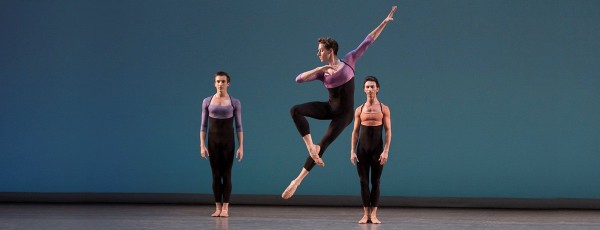
Showing posts with label Christopher Wheeldon. Show all posts

Monday, April 11, 2016

New York City Ballet, Tuesday Evening, February 9th

TUESDAY EVENING, FEBRUARY 9, 7:30 PM: NEW COMBINATIONS

POLARIS: Gerrity, Mann, Isaacs, *Finlay, Stanley, Applebaum, Kayali, Scordato
     pause
THE BLUE OF DISTANCE: Woodward, Phelan, Adams, Catazaro, Carmena, Chamblee, Villarini-Velez [Solo Piano: Chelton]
     pause
COMMON GROUND: Laracey, Maxwell, Reichlen, Ramasar, Huxley, Janzen, Gordon [Conductor: Sill]

ESTANCIA: T. Peck, T. Angle, Veyette [Conductor: Litton]

THE MOST INCREDIBLE THING: Stanley, Hyltin, Ramasar, la Cour, Janzen, *M. Fairchild [Conductor: Litton]

'Polaris', 'The Blue of Distance' and 'Common Ground':

'Polaris', 'The Blue of Distance' and 'Common Ground' were all new last fall.  You can read my comments about the ballets here:

In this performance of Myles Thatcher's 'Polaris' Emily Gerrity and Chase Finlay replaced Tiler Peck and Craig Hall in the leading roles.  Ms. Gerrity offered a bold and vibrant view of the outsider. Mr. Finlay, newly returned from serious injury, seemed cautious and bland.

In Robert Binet's 'The Blue of Distance' only Antonio Carmena and Preston Chamblee remain from the starry original cast.  Of the new additions I felt that the three women -- Sara Adams, Unity Phelan and Indiana Woodward -- proved alluring as the three 'mermaids'.  They and Messrs. Catazaro and Villarini-Velez fulfilled my October prophecy that this is a work that could be danced by a less starry cast without losing its impact as a hypnotic ensemble piece.

'Common Ground' by Troy Schumacher remains troubling chiefly because the costumes are so distracting.  The commissioned score remains interesting and Troy's choreographic response to it is skillful and lively.  The original cast seemed even better at this performance -- Troy has brought out the best in each of the seven dancers.  Teresa Reichlen, Ashley Laracey, Anthony Huxley and Russell Janzen all caught my eye for the way they took advantage of the choreographic opportunities Troy provides them.

'Estancia': 

Christopher Wheeldon created 'Estancia' for the Company's 2010 Spring Season to a score by Alberto Ginastera, the great Argentine composer.  The Ginastera score and libretto had been commissioned by Lincoln Kirstein in 1941 for George Balanchine to choreograph on their American Ballet Caravan -- one of the earlier iterations of what became New York City Ballet.  That company disbanded, however, before Balanchine could undertake the project.

The scenic designs for Wheeldon's 'Estancia' are by the Spanish architect, Santiago Calatrava, who provided designs for several new ballets presented that season.  I believe that collaboration with Calatrava was a precursor of the Company's annual Art Series.  Calatrava is the architect of the recently opened Transportation Center at the World Trade Center which is featured in this video from Cole Haan featuring five NYCB dancers Sara Mearns, Megan Fairchild, Craig Hall, Adrian Danchig-Waring, and Gretchen Smith:


For 'Estancia' Calatrava created a front curtain that is an abstraction of a stampeding herd of longhorn cattle: 

Santiago Calatrava's design for the front curtain of 'Estancia' by Christopher Wheeldon.
and a backdrop that is an abstracted and layered landscape of the Argentine pampas.

The cast for this performance included most of the original 2010 cast -- Tiler Peck as the Country Girl, Tyler Angle as the City Boy, and Andrew Veyette as the Wild Horse.  I missed Gina Pazcoguin as another wild horse -- a role that seems diminished in this staging.  Perhaps Wheeldon has done some tinkering since 2010 or perhaps Ms. Pazcoguin wasn't available.

'Estancia' opens with a singer, Steven LaBrie, singing 'El Gaucho Martin Fierro', Ginastera's setting of a poem by Jose Hernandez that inspired him to develop the libretto and write the score.  It sets a contemplative mood which is echoed in the opening scene of ranch workers going about early morning chores on the estancia.
  
Tyler Angle, the City Boy, arrives at the estancia. Tile Peck, the Country Girl (center) and the Country Folk disdain his fancy dress and fine manners.  Photo by Paul Kolnik for NYC Ballet
The City Boy arrives and is awed by the simple ranch life and smitten by the Country Girl who scorns his refined dress and fine manners.  He watches while she catches and tames the Wild Horse.  Determined to impress her, the City Boy tries to capture a wild horse.  She grudgingly admires his determination and ultimate success.  By the time the sun sets they have fallen in love and with the next dawn the lovers are integrated with the country folk as they begin the next days chores.


I wasn't persuaded by Wheeldon's telling of this tale in 2010 and I'm not sold on 'Estancia' by this performance either.  He offers some interesting steps and motifs for the wild horses and uses four long poles effectively to suggest a corral.
  
Tiler Peck as the Country Girl tames the Wild Horse, Andrew Veyette, in Christopher Wheeldon's 'Estancia'.
Photo by Paul Kolnik for NYC Ballet
The dances for the country folk and the pas de deux for the Country Girl and City Boy seem generic rather than specific to the story.  Balanchine was probably right to pass this material by even though Kirstein had paid for it.  


'The Most Incredible Thing':

Justin Peck's new work 'The Most Incredible Thing' was obviously the big draw on this program.  With costumes and sets by Marcel Dzama and a commissioned score by Bryce Dessner, 'Incredible' is based on a fairy tale of the same name by Hans Christian Andersen.  
Marcel Dzama (sets & costumes), Justin Peck (choreography) and Bryce Dessner (music).
It tells the story of a King (both Ask la Cour and Russell Janzen) who offers his daughter (Sterling Hyltin) in marriage along with half of his kingdom to whoever can do the most incredible thing.


The Creator (Taylor Stanley) creates a fabulous clock that produces wonderful displays for each hour in the day.  He presents the clock to the King and his daughter.  Everyone agrees that the clock is the most incredible thing and they begin preparations for the wedding.

But, the Destroyer (Amar Ramasar) arrives just before the wedding of the Princess to the Creator.  He smashes the clock.  Everyone agrees that the destruction of the clock is the most incredible thing.  The King is forced to give the Destroyer the hand of the Princess in marriage.

But, the fantastical figures from the smashed clock rise up and vanquish the Destroyer -- and everyone agrees that the resurrection of the clock's figures to attack the Destroyer is the most incredible thing and they all celebrate the marriage of the Princess and the Creator.

We know the story because there is a synopsis printed in the program . . . and from a seemingly endless string of Facebook and YouTube postings from the Company.  Unfortunately, the ballet itself muddies the plot rather than clarifying it.  The first pas de deux for the Creator and the Princess, while lovely, precedes the creation and presentation of the clock.  In fact, there is almost no connection established between the Creator and the clock.

After the clock is presented there is a series of divertissements for each hour led off by a solo for the Cuckoo (Megan Fairchild) representing one o'clock.  
Tiler Peck as the Cuckoo.
Photo by Paul Kolnik for NYC Ballet
The original costume for the Cuckoo was covered in feathers including a feathered 'ski mask' that was modified and later discarded in favor of a single feather -- a la 'The Firebird'.  Unfortunately, Ms. Fairchild took a bad nose dive center stage at her second entrance which marred the overall impact of her Cuckoo.  

Rebecca Krohn & Adrian Danchig-Waring as Adam & Eve
Photo by Paul Kolnik for NYC Ballet

For two o'clock there is a duet for Adam and Eve (Rebecca Krohn and Adrian Danchig-Waring) -- a sort of nightclub adagio for dancers in nude body-stockings with strategically placed vines and leaves.

Three o'clock is a trio for The Three Kings (Jared Angle, Daniel Applebaum and Gonzalo Garcia).  It is unclear from their generic choreography and medieval armor if these are the biblical magi or some other kings.  There is no gold, frankincense and myrrh -- just the shiny gold and silver armor and helmets and long metal staffs.

Four o'clock is the Four Seasons represented by an Empty Nest for Autumn (Brittany Pollack), a Crow for Winter (Marika Andersen), a Spring Bird (Gwyneth Muller), and a Grasshopper for Summer (Andrew Scordato).  
Brittany Pollack as the Empty Nest and
Gwyneth Mullet as the Spring Bird.
Photo by Paul Kolnik for NYC Ballet
These are among Mr. Dzama's most successful costumes and Mr. Peck responds with inspired movement that take full advantage of their impact.

Andrew Scordato's colorful makeup for the Summer Grasshopper.
Photo by Barbara Anastacio for NYTimes
For five o'clock there are the Five Senses -- five women in identical silver satin whirling dervish costumes with embedded hula hoops that obscure any meaningful choreography.
The Five Senses (which is which?).
Photo by Andrea Mohin for NYTimes


At six o'clock there is The Gambler (Daniel Ulbricht).  I don't have a clue what he's doing here -- other than a few spectacular leaps and spins while wearing a black costume with six white dots on his chest -- oh, maybe he's trying to throw himself a good crap shoot.
Daniel Ulbricht as The Gambler.
Photo by Barbara Anastacio for NYTimes


The Seven Deadly Sins or The Seven Day of the Week.
Photo by Paul Kolnik for NYC Ballet
Seven o'clock brings either The Seven Deadly Sins or The Seven Days of the Week played by seven corps women identically dressed in streaky orange, red and purple leotards with red-orange wigs sprouting rams horns.  Despite the confusion over what they represent they do have interesting choreography.

The Eight Monks arrive at eight o'clock looking more like Harry Potter wizards in long robes and tall, peaked hats that bobble as they move.  They can't dance in these costumes, so they march around the stage looking frustrated and portentious.


The Nine Muses in 'The Most Incredible Thing'.  Photo by Andrea Mohin for NYTimes
At nine o'clock the Nine Muses arrive in stiff black and white tutus that kind of look like the rings of Saturn and black Louise Brooks wigs.  Their choreography is the best ensemble dance in the piece:


Ten o'clock brings back the Cuckoo in nicely avian choreography.  But why does the Cuckoo get two of the twelve hours?  budgetary concerns?  appeasing a diva's demand for greater exposure?

Eleven children -- students of The School of American Ballet -- enter down a slide on the right of the clock.  They are adorable and Mr. Peck has given them wonderful choreography that neither condescends to their youth nor over taxes their ability.  More than doting family members in the audience will appreciate this section.

Finally, at twelve o'clock the entire cast of the divertissements assembles for a finale.  Mr. Peck usually has great finesse in dealing with odd numbers of dancers, but here he assembles the Seven Deadly Sins, the Eight Monks and the Nine Muses in a three by eight column with the extra Muse plunked in front of the line of Seven Sins.  He either ran out of time or inspiration or both for this recapitulation of themes from the divertissements.


Sterling Hyltin & Taylor Stanley as the Princess & the Creator lead the ensemble in the Twelve O'Clock finale.
Photo by Paul Kolnik for NYC Ballet

As the cast assembles for the wedding of the Princess and the Creator, the Destroyer suddenly appears.  He is wearing silver armor with a two-faced helmet and a silver club in place of one hand -- we've been told Mr. Dzama was inspired by Marcel Duchamp chess pieces for this club.  After using the club to smash the clock, the Destroyer forces himself on the Princess in an erotically-charged pas de deux:


Amar Ramasar & Sterling Hyltin as The Destroyer & the Princess.
This duet is Mr. Peck at his finest -- raising the difficulty by using the club/hand as both a complication and a threat -- and Ms. Hyltin and Mr. Ramasar seem inspired by the challenges.


As the pas de deux ends, the clock pieces arise from the rubble of the clock and attack the Destroyer -- in a whimsical touch some of the eleven children cling to his legs as he thrashes about and the Three Kings in their armor finally have a purpose.  The Destroyer is subdued and vanquished.  The Princess and the Creator are united in triumph.

'The Most Incredible Thing' is neither an unmitigated disaster nor an unparalleled success.  For me, Mr. Peck has placed too much faith in a strong-willed artistic partner (Mr. Dzama).  Some of the costumes work very well, while others are too unwieldy for ballet.  The overall effect of the costume and set designs is of clutter and distraction.  Mr. Dessner's music works well without being distinctive.

The introduction of the Princess as the King splits in half is a real coup de theatre, but it's effectiveness was diluted by the videos that came out before the first performance:


Here is a link to a piece where Mr. Dzama and Mr. Dessner discuss their creative process -- among other things, it attempts to justify the mess that Mr. Dzama installed on the Koch Theater promenade and throughout the Theater's public spaces:


Justin Peck with Marcel Dzama's backdrop for 'The Most Incredible Thing'.
Photo from The Last Magazine 

Friday, March 25, 2016

New York City Ballet Matinee on Sunday, February 21st

SUNDAY MATINEE, FEBRUARY 21, 3:00 PM

'21st Century Choreographers'

ASH: *Laracey, *Catazaro [Conductor: Capps]

     pause
THIS BITTER EARTH: **Mearns, T. Angle
     pause
THE INFERNAL MACHINE: *Phelan, *Chamblee [Conductor: Capps]
     intermission
JEUX: Mearns, *Lovette, Danchig-Waring, *Hall [Conductor: Capps]
     intermission
PAZ DE LA JOLLA: Hyltin, Ramasar, T. Peck [Conductor: Sill]

  *  First time in role at Saturday Matinee, February 21st

**  New York City debut at Saturday Matinee, February 21st

New York City Ballet's '21st Century Choreographers' program was on our subscription series.  Since we had watched Justin Peck's creation of 'Paz de la Jolla' in the movie 'Ballet 422', we were anxious to see the result on stage.  The rest of the program was not new to us -- we had seen several of these works close to the dates when they were first introduced to the Company's repertory.

'Ash' is a busy, energetic work by Peter Martins to a score by Michael Torke.  It was created in 1991 when the original cast was Wendy Whelan and Nilas Martins backed by four couples: Yvonne Borree, Rebecca Metzger, Monique Meunier, Kathleen Tracey, Albert Evans, Arch Higgins, Russell Kaiser and Ethan Stiefel.  At Sunday's program it was danced by Ashley Laracey and Zachary Catazaro with Sara Adams, Laine Habony, Ashley Hod, Unity Phelan, Devin Alberda, Cameron Dieck, Spartak Hoxha and Sebastian Villarini-Velez.

Devon Alberda, Cameron Dieck and Spartak Hoxha in Peter Martins' 'Ash'.
Photo by Paul Kolnik for NYC Ballet
The general design of 'Ash' reminds me of Balanchine's 'Square Dance' -- the hierarchy of principals and corps, the use of call and response, the dancers' general glee with their performances.  Ms. Laracey was sunny, but a little generic; Mr. Catazaro seemed subdued and underpowered.  Among the corps, I was particularly impressed with Mr. Alberda's crisp delivery of his solo passages and also enjoyed the sparkle added by Ms. Phelan, Ms. Adams and Mr. Dieck.

Christopher Wheeldon created 'This Bitter Earth' for Wendy Whelan and Tyler Angle as part of a larger work, 'Five Movements, Three Repeats', first performed at the Vail International Dance Festival in August, 2012.  As a stand-alone pas de deux it entered the Company's repertory at the 2012 Fall Gala.

Wendy Whelan and Tyler Angle in Christopher Wheeldon's 'This Bitter Earth' in 2012.  Photo by Paul Kolnik for NYC Ballet 
The music by Max Richter and Dinah Washington comes from the soundtrack for the movie 'Shutter Island'.

Partnered by Tyler Angle, Sara Mearns made her debut in the work the previous day.  Sara's dramatic temperament and extraordinary amplitude fit nicely into Wheeldon's duet of convoluted shapes and tricky partnering.  Tyler provides strong, somewhat stoic support.  'This Bitter Earth' is not a favorite ballet of mine -- more a piece d'occasion than a repertory staple -- but cast with first rate dancers like Sara and Tyler it makes a positive impact.

Peter Martins created 'The Infernal Machine' for Diamond Project V in May, 2002, to music of the same name by Christopher Rouse.  The original cast was Janie Taylor and Jock Soto.

The score is filled with odd ticks and jolts and sputters.  Unity Phelan and Preston Chamblee -- two of the Company's emerging young talents -- made their debuts in this work at the previous day's matinee.  Chamblee is a steady, confident partner while Phelan provides a feline intensity.  Martins gives them complicated, manipulative partnering moves that can often look awkward, but here they seem appropriate for the astringent score.
    
Preston Chamblee and Unity Phelan in 'The Infernal Machine' by Peter Martins.
Photo by Paul Kolnik for NYC Ballet

Here is a brief YouTube clip showing these two dancers in this work which has just shown up on the Company's website:

'Jeux', the ballet by Kim Brandstrup to the Debussy score, was new last fall.  You can read about my initial reaction here:

I concluded those comments by questioning whether 'Jeux' (and several other new Fall Season works) would hold up on repeated viewings -- it does not.  Sara Mearns was again extraordinary as the blindfolded woman who is cast aside.  Adrian Danchig-Waring again offered strong if nonchalant partnering for her as the jock with the ball.
  
Sara Mearns and the ensemble in Kim Brandstrup's 'Jeux' to the music of Debussy.
Photo by Paul Kolnik for NYC Ballet

Craig Hall and Lauren Lovette were new in this performance -- Craig as the cad who casts Sara aside for Lauren's flirty seductress.  Mr. Hall certainly has the matinee idol looks and strong partnering technique for the part, but he lacks the intense focus Amar Ramasar brought to the role.  With her gorgeous looks and sparkling presence Ms. Lovette makes seduction look simple.

Nevertheless, 'Jeux' is a disappointing ballet that doesn't offer new rewards on repeat viewings.  The vaguely sinister atmosphere and the harsh lighting on the women's bare legs also distract from it's appeal for me.

Justin Peck's 'Paz de la Jolla' which was the subject of the movie 'Ballet 422' was both old and new to us -- old in that we had watched its creation in 'Ballet 422', but new in that we had never seen the complete ballet on stage.  The ballet is set to Bohuslav Martinu's 'Sinfonietta la Jolla for Piano and Chamber Orchestra'.  Here is a description of the work written by Dr. Richard E. Rodda from a Harrisburg Symphony program:   

The opening movement is based on traditional sonata form and utilizes two basic thematic types. The first is bustling and active, filled with rapid figurations passed among the instruments; the second derives from the songfulness of folk music in its lyricism and chordal texture. A pleasing balance is achieved between these two contrasting elements without ever losing the exuberance and spontaneity that enlivens Martinů’s music. The second movement, slow in tempo and soulful in expression, uses folk song models to such an extent that Brian Large, in his study of the composer, labeled it “a virtual fantasia on Czech folk songs.” The finale is a vivacious rondo indebted to the irresistible closing movements of Haydn, whose music Martinů was studying closely at the time he composed the Sinfonietta.  

Justin created a ballet set on the beaches of Southern California where he grew up -- sun drenched by day and moonlit by night.  The cast was led here by Sterling Hyltin, Amar Ramasar and Georgina Pazcoguin (replacing Tiler Peck).  The 15 other dancers were a mix of soloists and corps -- most from the original 2012 cast.  They are all individually costumed in what I would characterize as Eisenhower-era beach wear designed by Reid Bartelme and Harriet Jung.

Costume sketch for 'Paz de la Jolla'  by Reid Bartelme and Harriet Jung.

Following the structure of Martinu's music, Justin's choreography begins with lively beach games interspersed with the stirrings of summer romance between Amar and an outsider, Sterling.  The moonlit central section is a romantic duet for Sterling and Amar often engulfed by shimmering images of surf or coastal fog for the ensemble, their bright beach wear now shrouded in silvery translucent smocks. 
 
Ensemble in translucent smocks during the central movement of Justin Peck's 'Paz de la Jolla'.
Careful inspections shows Amar Ramasar and Sterling Hyltin partially visible behind the ensemble.
Photo by Paul Kolnik for NYC Ballet 

In the final rondo the full cast engages in more beach frolics with Sterling now integrated into the larger group.

By now, we are familiar with some of the signature movement motifs that run through Justin's choreography.  What is amazing is how well he adjusts them and integrates them with the music he has chosen so that they produce a unique result.  Here's a video from the Company which highlights Justin's creation of 'Paz de la Jolla':

Better yet, seek out the movie 'Ballet 422' which provides even deeper insight into Justin's creative process.

Here's a short promotional video from the Company with snippets from 'Paz de la Jolla':

Final image of Justin Peck's 'Paz de la Jolla' with Tiler Peck, Sterling Hyltin and Amar Ramasar.
Photo by Paul Kolnik for NYC Ballet
Gina Pazcoguin, replacing Tiler Peck apparently on short notice, has been with 'Paz de la Jolla' from its earliest rehearsals.  She dances with sparkle and wit, but lacks Ms. Peck's indelible stage presence.  The costume (designed for Ms. Peck) did Ms. Pazcoguin no favors.  Sterling Hyltin and Amar Ramasar seemed to be an unlikely romantic couple on paper, but with Justin Peck's choreography the improbable becomes indelible.

*  *  *  *  *  *  *  *  *

For me, the best impressions in this program were made by Unity Phelan and Preston Chamblee -- together in Martins' 'Infernal Machine' and separately in the ensembles of Martins' 'Ash' (Ms. Phelan) and 'Jeux' (Mr. Chamblee).  They are young dancers to watch as they progress further up through the Company's rich and diverse repertory and (hopefully) find themselves inspiring choreographers in roles made for their unique abilities.

Wednesday, August 19, 2015

That's Show Business . . .

We recently had visitors from Belgium -- George's cousin, Freddy, and his partner, Jan -- in town.  Although they hadn't been in New York City since 2010, they have been frequent visitors to the city since 1970 and know their way around.  While they were here they saw four Broadway musicals -- 'Kinky Boots', 'An American in Paris', 'Aladdin', and 'The King and I'.  We joined them for 'American in Paris' and 'King and I'.

'An American in Paris':

This show is loosely based on the classic 1951 Vincente Minnelli movie starring Gene Kelly and Leslie Caron.  'An American in Paris' has music and lyrics by George and Ira Gershwin, a book by Craig Lucas, direction and choreography by Christopher Wheeldon, and stars Robert Fairchild and Leanne Cope.


Poster for 'An American in Paris: A New Musical'
Wheeldon has, of course, been attracted to Gershwin's 'An American in Paris' ballet score before.  In 2005, he created a 21-minute ballet based the movie's story for New York City Ballet -- with Damian Woetzel, Jenifer Ringer, and Karla Corbes in the leading roles.  The 2005 ballet has since been mounted for several other ballet companies around the world.  Wheeldon is also well aware of George Balanchine's 'Who Cares?' which utilizes many of the same Gershwin tunes as his new musical.  Wheeldon danced one of the demi-soloist roles in the 1990's when he was a soloist with New York City Ballet and Robert Fairchild has had notable success in its leading male role. As a result, Wheeldon's staging and choreography for this show has a deja-vu-all-over-again quality.

Robert Fairchild -- a New York City Ballet principal dancer -- is sensational as Jerry -- even when much of his dancing consists of dodging constantly moving pieces of the set which often crowd the stage space.  Robbie is a surprisingly good singer and a gifted actor.

Leanne Cope -- a Royal Ballet first artist -- seems to have been chosen primarily for her resemblance to the movie's Leslie Caron.  As Lise, the love interest of Jerry and two other characters, she lacks Caron's gamin charm and the charisma needed as the focal point of the love quadrangle at the center of the story.  Her dancing is merely adequate and her acting and singing are pallid. 

Wheeldon's expressionistic staging of the opening scene showing the devastation of Paris at the end of World War II is wonderfully evocative of the disorientation and deprivation the Germans left behind.  Between that terrific beginning and the climactic 'American in Paris' ballet there are long stretches of barely watchable exposition; great Gershwin songs wedged into the flimsy, poorly defined plot; and inane dance sequences -- like 'Fidgety Feet'.  Unfortunately, the supposedly 'cinematic' use of roving pieces of the set distracts from the convoluted plot and shrinks the space needed for dancing.

Fortunately, the stage is cleared for the 'American in Paris' ballet which gives Wheeldon the opportunity to showcase Fairchild's expansive, bravura dancing and gives Ms. Cope a shot at redeeming her otherwise small-scaled performance.  It's Robbie's show from start to finish, but his stellar performance is repeatedly undermined by Wheeldon's busy staging, by Lucas' incoherent plot, and by the vacuum where the leading lady should be.

'The King and I':

Lincoln Center Theater's revival of Rodgers and Hammerstein's 'The King and I' at the Vivian Beaumont Theater is sumptuous and heart-rending.

Poster for the Lincoln Center Theater revival of 'The King and I' at the Vivian Beaumont Theater.
 

The show is anchored by a luminous performance from Kelli O'Hara as Anna Leonowens -- the Welsh army widow hired to teach the many children of the King of Siam.  With her elegant diction and immaculate phrasing Ms. O'Hara breathes fresh life and meaning into classic Rodgers & Hammerstein songs -- including 'Whistle a Happy Tune', 'Getting to Know You', 'Hello, Young Lovers', and 'Shall We Dance' --adding great emotional depth to the show.
   
Kelli O'Hara and Jose Llana as Anna and the King in Lincoln Center Theater's 'The King and I'
Jose Llana, who replaced Ken Watanabe in mid-July, plays the conflicted King -- coping with threats from Asian enemies and European empire builders while maintaining his authority over Siam -- with both nuance and swagger.  As with any major role replacement, the entire cast was especially attentive to Mr. Llana's performance as the King -- giving the whole show an extra jolt of electricity.
   
Ruthie Ann Miles as Lady Thiang with Kelli O'Hara as Anna in 'The King and I'
Ruthie Ann Miles plays Lady Thiang -- the King's head wife (his Queen has died four years before the show begins) -- with dignity and compelling empathy.  Her singing of 'Something Wonderful' and its many reprises are among the emotional highlights of the show.

The sets by Michael Yeargan make use of the entire Beaumont stage with its enormous depth, width and height.  Golden pillars glide about modifying the playing space from grand to intimate to fit the scale of each scene.  The costumes by Catherine Zuber are sumptuous and exotic. 

The Rodgers & Hammerstein score -- richly rewarding for its insightful lyrics as well as its soaring, haunting melodies -- was played with great style by a large pit orchestra.  The famous ballet by Jerome Robbins, 'The Little House of Uncle Thomas', was respectfully refreshed for this production by Christopher Gattelli, whose understated choreography elsewhere blended nicely into the production.

I felt that there were casting missteps with Tuptim and Lun Tha -- the 'young lovers' forced to 'kiss in the shadows' -- and the Crown Prince -- who has the last important speech of the show.  But Bartlett Sher has pulled together a remarkable, coherent and insightful production centered on the three extraordinary lead performances.

*  *  *  *  *  *  *  *  *  *  *  *

We agreed with our Belgian visitors that 'The King and I' was the best show we saw during their visit -- and like us, they felt that 'An American in Paris' was the most disappointing.  They liked 'Kinky Boots' -- and loved Disney's 'Aladdin'.  


Friday, February 20, 2015

NYCB 2/8/15 Matinee Performance

SUNDAY MATINEE, FEBRUARY 8, 3:00 PM [Conductor: Sill]  
PICTURES AT AN EXHIBITION: Mearns, *Lovette (replaces T. Peck), *Woodward, *Hyltin, Smith, T. Angle, Danchig-Waring, Garcia, Ramasar, Gordon [Solo Piano: Grant] 
RODEO: FOUR DANCE EPISODES/PECK (WORLD PREMIERE): *Mearns, *Ramasar, *Ulbricht, *Garcia, *Veyette Suozzi
MERCURIAL MANOEUVRES: T. Peck, J. Angle, *Segin, *Huxley, *Adams [Solo Piano: Moverman, Solo Trumpet: Mase]

*Debut in role on Tuesday, February 4th, NEW COMBINATIONS evening

The New Combinations program each Winter season at New York City Ballet is always built around new choreography -- in honor of George Balanchine's birthday on January 22nd.  This year the program opened with Alexei Ratmansky's 'Pictures at an Exhibition' -- which premiered during the Company's Fall 2014 season -- see my comments here:

http://zylopho.blogspot.com/2014/10/new-york-city-ballet-thursday-october-9.html

With Wendy Whelan's retirement at the end of the Fall season her role is now danced by Sterling Hyltin.  Since Tiler Peck was dancing the female lead in 'Mercurial Manoeuvres', her role in 'Pictures' was danced by Lauren Lovette on Sunday afternoon and Indiana Woodward danced the role originated by Abi Stafford.  The rest of the cast remained unchanged from last October.

Sterling Hyltin has the regrettable task of taking on roles created or otherwise imprinted by Wendy Whelan.  At the Sunday, February 1st, matinee she was completely successful in taking on The Novice in Robbins' 'The Cage' -- a role which Whelan owned for nearly two decades after learning it from Robbins himself.  Here, undertaking Whelan's role as the woman in gold Hyltin had the right angular airiness in the pas de deux with Tyler Angle, but lacked gravitas for the 'Dances at a Gathering' moment near the end when the character bends down to touch the stage.  In fact, I think that Ratmansky would be wise to rethink that moment -- without Wendy it seems even more cliched.
Amar Ramasar, Sterling Hyltin and Sara Mearns in Ratmansky's 'Pictures at an Exhibition'.
Photo by Paul Kolnik for NYC Ballet.
Sara Mearns and Amar Ramasar continue to provide eloquent performances in their pas de deux, their solos and their participation in larger group passages.  Lauren Lovette and Gonzalo Garcia looked great together in their duets and Lauren added her dark-eyed vivacity elsewhere.  Though Indian Woodward is mostly seen as part of the ensemble in this work, it is nice to see her stepping out of the corps.  She uses the opportunity here to demonstrate her unique musical qualities and hoydenish stage presence.

Although the use of Kandinsky-like design elements distinguishes 'Pictures', it continues to feel like Ratmansky's tribute to (or rip-off of) Robbins' 'Dances at a Gathering' -- a collection of short piano pieces (played eloquently by Cameron Grant) and a cast of ten deployed in a communal round of dances -- even more than his 'Russian Seasons' had (at least that ballet had a singer and hats).  To me, much of Ratmansky's oeuvre for NYCB seems derivative of earlier and better repertory.

Justin Peck's 'Rodeo: Four Dance Episodes' uses the orchestral suite that Aaron Copeland created from his ballet music for Agnes DeMille's 'Rodeo' (1942).  The suite is in four movements which Justin labels 'episodes'.  Justin uses a cast of 16 -- a principal couple (Sara Mearns and Amar Ramasar); three men (Daniel Ulbricht, Gonzalo Garcia, and Sean Suozzi -- replacing the injured Andrew Veyette); five men (Taylor Stanley, Craig Hall, Daniel Applebaum, Andrew Scordato, and Allen Peiffer); and six men (Messrs. Coll, Nelson, Prottas, Janzen, Walker, and Villarini-Velez) -- that's 1 woman and 15 men.
Amar Ramasar lifts Sara Mearns above 12 of the men in Justin Peck's 'Rodeo: Four Dance Episodes'.
Photo by Paul Kolnik for NYC Ballet
The costumes are by Reid Bartelme, Harriet Jung and Justin Peck.  They give the entire cast a high school jock vibe.
Costume sketches by Reid Bartelme and Harriet Jung for Justin Peck's 'Rodeo: Four Dance Episodes.
The 'five men' are in costumes that resemble rugby uniforms -- dark brownish shorts, long sleeved matching shirts with a wide pale blue band across the chest and blue, brown and white striped knee-length leg warmers that look like rugby socks.  In the two outer movements the rugby players mix with the other 10 men who wear long pants and T-shirts or tank tops in various shades of brown with the same wide chest band. 

Five men in the Second Episode of Justin Peck's 'Rodeo: Four Dance Movements'.
Photo by Paul Kolnik for NYC Ballet
The second episode features just the 'rugby team' in a gorgeous adagio for five men that is the heart (and possibly the soul) of the ballet.  Taylor Stanley with his taut line stands out in this group, while Craig Hall is the strong steady anchor and the entire team works together to create sculptural stage images that capture the viewer's eye and beautifully complement the laconic Copland music.
Sara Mearns and Amar Ramasar in Episode Three of Justin Peck's 'Rodeo: Four Dance Episodes'.
Photo by Paul Kolnik for NYC Ballet
Sara Mearns and Amar Ramasar have a generally contemplative duet in the third episode.  Mearns is mostly in prom queen or head cheerleader mode, but she gives the lone woman a wonderful calm joy that plays well against Ramasar's out-going, hopeful jock.

In the two outer episodes, all of the men are in jock mode -- racing across the stage from the left wing in a long diagonal as the curtain opens, then cavorting in groupings of three, four or five.  The three lead men could be gymnasts -- competing in leaps and pirouettes.  Peck makes striking use of the athleticism of all 15 men.  They seem to belong in the great American West -- where there is plenty of room for their expansive, space-filling exhuberance.

Here's a link to three brief clips from the ballet on the Company's website:

http://www.nycballet.com/Ballets/N/New-Copland-Peck.aspx

The sharp-eyed can pick out Justin Peck in the first clip -- dancing in place of Andrew Veyette as he did in some sections on opening night.  

Peck has given the Company a wonderful new piece, filled with hope and vigor and the wistful innocence of youth.  I would only change the coyly arch spelling of 'rodeo' in his title -- it's too clever for this very appealing work.

Christopher Wheeldon's 'Mercurial Manoeuvers' was created in April, 2000, for the Diamond Project using Dmitri Shostakovitch's 'Piano Concerto #1'.  The original cast included Miranda Weese and Jock Soto with Edwaard Liang.  On Sunday it was lead by Tiler Peck and Jared Angle.  Anthony Huxley, Kristen Segin and Sara Adams made debuts in their featured roles the previous Tuesday.

The opening is a coup d'theatre that never fails to impress -- the male soloist (Huxley) stands alone at the back of the stage in a red unitard against a red background flanked by dark translucent panels as the mysterious opening section of the concerto begins.  
Joaquin De Luz as the 'man in red' in the opening of Wheeldon's 'Mercurial Manoeuvers'.
Photo by Paul Kolnik for NYC Ballet
The shadowy figures of the twelve-member female corps  appear behind these dark panels arrayed in two rows of three on each side.  As the man moves forward the panels slowly begin to lift, revealing the women on either side of him.  The means are so simple, but the effect is dazzling.

Anthony Huxley is an impressive dancer with his own arrow sharp technique, but he is quite different from Edward Liang -- who originated the role -- and from Daniel Ulbricht and Joaquin De Luz who have danced it more recently.  Huxley makes it less overtly flamboyant and more elegantly articulate.  Wheeldon's choreography has enough elasticity to embrace each of these dancers as individuals.
Tiler Peck and Jared Angle in the pas de deux from Wheeldon's 'Mercurial Manouevres'.
Photo by Paul Kolnik for NYC Ballet
Tiler Peck and Jared Angle were wonderfully fluid as the central couple -- no mean feat given Wheeldon's penchant for difficult, off-center partnering.  Kristen Segin and Sara Adams were perky as the two female soloists.  Wheeldon marshalls the corps of 12 women and four men effectively in complex and interesting patterns.  As with many Wheeldon ballets there are too many entrances and exits -- and an overall sense of busy-ness.  But that haunting and brilliant opening sequence sticks in the mind.  And the central pas de deux -- when it is executed with the confidence and finesse that Tiler and Jared brought to it -- can be a stunning display of partnering pyrotechnics.

The Shostacovitch Piano Concerto was beautifully played by the piano soloist, Alan Moverman, with brilliant trumpet solos by Raymond Mase.  In fact, the music on Sunday afternoon was top notch under the direction of Andrews Sill and with the excellent Cameron Grant as piano soloist in 'Pictures at an Exhibition'.

This program proved a delightful celebration of Balanchine's 111th birthday and a reminder of the mission of NYC Ballet to continue to bring new chorography to the stage.