Showing posts with label Michelangelo. Show all posts

Monday, December 22, 2014

Italian Trip Diary -- Day #2 (part 2) -- Rome -- St. Peter's Basilica

Monday, July 2, 2001 Rome (continued):

After the gelato break, we walked along the Vatican walls and on around to St. Peter’s Square (Piazza San Pietro).  The arms of Bernini’s colonnades are always impressively, grandly welcoming.  They really are a wonderful invitation to come inside the basilica.  
St. Peter's Square (Piazza San Pietro) as seen from the steps of the Basilica.  The piazza was designed by Gian Lorenzo Bernini between 1656 and 1667.  It consists of two semi-circular arcades of Tuscan columns four-deep bracketing an oval plaza centered by an Egyptian obelisk installed in 1586 and flanked by two granite fountains.
The Pope would be celebrating his last open air mass of the summer in the piazza before heading to
his summer residence at Castel Gandolfo.  Photo by Blomme-McClure
However, a note of caution to visitors – be properly dressed.  This is the one place in Italy where the “propriety police” are strictly enforcing the signs about proper dress.  People in shorts, tank tops, and tight clothes were being turned away.
Young man being turned away from the Basilica -- his pants are too tight and too short to meet the strict
dress code of the St. Peter's 'propriety police' (see the pictogram behind him).  Photo by Blomme-McClure
We saw women tying on wrap skirts over their shorts and people zipping on the bottoms of their convertible shorts.  Several people pulled out light weight trousers and tops similar to those worn in operating rooms to slip on (it was hot).

St. Peter’s Basilica is one of the grandest churches in Christendom.  Nearly every part of it is done on an enormous scale that is overwhelming and ultimately oppressive.  There is so little human scale to the place that the throngs of tourists seem like a busy ant colony. 
Nave of St. Peter's Basilica looking west from the altar.  Successive architects included Bramante,
Michelangelo, Carlo Maderno and Bernini.  The barrel vault is supported by four giant arched bays
with transverse barrel vaults over the side aisles.  Photo by Blomme-McClure

This is probably the impression that the Roman Catholic builders wanted to convey to “the faithful”, but for those of us simply interested in the art and architecture it is a building that you respect, not one that you love.  Michelangelo’s dome
The interior of the dome of St. Peter's Basilica designed by Michelangelo rises over the main crossing.
Photo by Blomme-McClure
sits grandly above Bernini’s baldaquin
The baldaquin designed by Bernini is reputed to be the biggest piece of bronze in the world.
The twisting columns are decorated with bees (the symbol of Pope Urban VIII) and laurel leaves.
Bernini's 'Cathedra Petri' which houses the 'throne of Peter' is visible on the back wall of the apse.
In front of the baldaquin, two marble staircases behind the balustrade lead down to the tomb of St. Peter.
Photo by Blomme-McClure
covering the altar over the tomb of St. Peter.  Tombs and monuments for popes and famous Catholics are scattered everywhere.
Monument for Pope Alexander VII designed by Bernini.  Photo by Blomme-McClure
Tomb of Queen Christina of Sweden, a devout Roman Catholic who abdicated the throne and moved to Rome.
Greta Garbo played her in a movie.  Photo by Blomme-McClure

Michaelangelo’s “Pieta”, kept behind bullet-proof glass, is a mob scene and virtually impossible to see. 
'Pieta' by Michelangelo, marble, 1498-99.  After a madman attacked the sculpture with a hammer in 1972
it was placed behind bullet-proof glass.  Photo by Blomme-McClure
We stood in a line   
Line (heavy on nuns) to view the sarcophagus of Pope John XXIII.
Photo by Blomme-McClure
to see the body of John XXIII which lies near a famous statue of St. Peter.
Body of Pope John XXIII in a glass coffin.  Photo by Blomme-McClure
Although everyone is dressed properly, the behavior of the mob seems more appropriate for a carnival than for the center of the Roman Catholic church.  Flash bulbs are going off everywhere – a young man takes a picture of his girl friend making a mock confession – nuns have their picture taken with the body of the Pope.

We left the church somewhat dispirited by the experience.  Fortunately, the sun on the square with the enclosing colonnades is somehow more inspiring. 
Piazza San Pietro (St. Peter's Square) with canopy and chairs for outdoor papal mass.  Photo by Blomme-McClure
This is in spite of the fact that much of the square and the steps leading up to the church are obliterated by chairs, barricades and a temporary stage which we learn will be used for the Pope’s final mass of the summer before his retreat to Castel Gondolfo. 
Tourist seeking directions from a member of the Swiss (papal) Guards.
Photo by Blomme-McClure
We found the taxi line on the far side of the square and headed back to the hotel.
Piazza San Pietro with trees on the Janiculum Hill rising behind. 
 The colossal statue of St. Paul from 1847 is in the foreground.  Photo by Blomme-McClure

After a nap break, we took a taxi to Trastevere.  It’s advisable to carry a good map of the area because most taxi drivers will not take you into the maze of narrow streets which are often for pedestrians only.  By trial and error and with the help of an Italian couple with a map who spoke some English we found Ristoranti Sabatini in Trastevere (Piazza Santa Maria in Trastevere 13, Rome, 065812026, http://www.ristorantisabatini.com/
) where we dined outside with the lively street life of the square as entertainment and the church of Santa Maria in Trastevere as a backdrop across the square.  The food was delicious, but our waiter was the most obnoxious we encountered on our trip.  He seemed to be the only surly waiter in Italy, including all of the others at Sabatini and we decided that it was just bad luck.  We did manage to beg him to call us a taxi at the end of the meal.  The taxi could only come to the edge of the square and then had to back up several blocks before he even had enough room to turn around.

Sunday, December 21, 2014

Italian Trip Diary -- Day #20 (part 1 of 2) -- Rome -- Vatican Museums, Sistine Chapel

Monday, July 2, 2001 Rome:

Monday was Vatican day.  We got up early in order to be in line for the Vatican Museums by 7:30 a.m.   Fortunately, our taxi driver was smart enough to take us to the end of the line, which saved us about a 10-minute walk back from the entrance.  The museums open at 8:45 a.m. and we got to the front of the line about 9:25 a.m.

The Vatican Museums are vast – divided into separate areas for painting, antiquities, books, maps and archeology (at least).  Nearly everyone, though, is headed for the Sistine Chapel.  We discovered that there are at least two ways to get to the chapel, one (a longer and more crowded route) through the Raphael Rooms and one (a faster and less congested route) through the modern art galleries.  Doug and Carl took the Raphael, while George decided to try the modern art route.  The apartments in the Stanze di Raffaello (Raphael Rooms) painted by Raphael and his students are wonderful.  The frescoes in the first of the four rooms, the Hall of Constantine, were actually created by three followers of Raphael after his death in 1520 AD. 
'The Battle of the Milvian Bridge' by Giulio Romano, fresco, circa 1525 AD.
The fresco depicts the battle between the Emperor Constantine and his rival Maxentius in 312 AD.
Photo by Blomme-McClure

The ceiling of the Room of Constantine by Tommaso Lauretti  is an allegorical depiction of the triumph of Christianity over paganism with the classical statue lying broken at the foot of the Crucifix.
Photo by Blomme-McClure

The Room of the Fire in the Borgo (Stanza dell'incendio del Borgo) depicts scenes from the lives of Popes Leo III and Leo IV.  It was painted by Raphael's assistants using designs of Raphael.
'Fire in the Borgo' by Giulio Romano, fresco, 1514 AD.  This fresco depicts an event in 847 AD when Pope Leo IV (in the window right of upper center) stopped the fire in the Borgo with his benediction.  
The fresco was executed by Romano from designs by Raphael.  Photo by Blomme-McClure 

The Room of the Signatura (Stanza della Segnatura) contains the most famous of Raphael's frescoes, 'The School of Athens'.

'The School of Athens' by Raphael, fresco, 1509 AD.  This fresco shows the search for truth through knowledge.
Photo by Blomme-McClure

Still, everything in the Vatican is overwhelmed by the splendor of Michelangelo’s work in the Sistine Chapel.  This was the first time that we had seen the Chapel's frescoes since the completion of the controversial restoration and cleaning in 1994.  The difference from the mellow, smokey look we first saw in the early 1970's and the vivid look we saw in 2001 is incredible.  The brighter colors clarify the shapes of the hundreds of figures and make all of the frescoes much more three dimensional.  The panels in the Creation sequence on the ceiling seem more sculptural and the sibyls and prophets in the surrounding lunettes are magnificent -- vigorous and muscular.   

The Sistine Chapel with frescoes by Michelangelo on the ceiling, 1508 to 1512 AD,
and the west (altar) wall, 1535 to 1541 AD.  The frescoes on the walls below and between the windows are by a who's who of famous Italian Renaissance artists -- Perugino, Botticelli, Ghirlandaio, and others.
Photo by Blomme-McClure
Unfortunately, viewing the chapel is like trying to meditate in the middle of a three-ring circus.  You know that you are in the presence of great art, but you are constantly distracted by the hubbub of tourists around you jostling for position.
'Creation of Adam' by Michelangelo, fresco, 1508 to 1512 AD.  This is probably the most famous panel from the 'Genesis' series of frescoes on the Sistine Chapel ceiling. Photo by Blomme-McClure
'Expulsion from the Garden of Eden' by Michelangelo, fresco, 1508 to 1512 AD.  This panel from the 'Genesis'
series seems newly vivid and three-dimensional following the 1984-1994 restoration.
Photo by Blomme-McClure
'Delphic Sibyl' by Michelangelo, fresco, 1508 to 1512 AD.  On the arches supporting the ceiling of
the Sistine Chapel, Michelangelo painted in heroic scale the prophets who foresaw the coming of Christ.
Photo by Blomme-McClure
We actually circled back to the Chapel again after lunch at the Museum’s café.  While there were less crowds in the early afternoon the light on the frescoes made them seem somewhat more prosaic.  Let’s just say that they are awesome under any lighting conditions and that the controversial cleaning and restoration has left them more vivid and more exciting.  We were particularly taken by the enormous 'Last Judgement' fresco covering the entire altar wall.  
'The Last Judgement' by Michelangelo, fresco, 1535 to 1541 AD, detail.
Photo by Blomme-McClure
In addition to the Chapel, the Vatican painting collection (Pinacoteca) was also worth visiting – a lovely Raphael “Transfiguration” 
'Transfiguration of Christ' by Raphael, oil on canvas, 1518-1520.  Photo by Blomme-McClure

and Caravaggio’s “Descent from the Cross” in particular.  And among the ancient statues in in the Octagonal Courtyard of the Pius-Clementine Museum, the Apollo Belvedere
'Apollo Belvedere', Roman copy of a Greek bronze original, marble, circa 130 to 140 AD.
Photo by Blomme-McClure
the Venus Felix, 
'Venus and Her Son, Cupid' aka 'Venus Felix', Roman, marble, circa 170 AD.  Some scholars have
suggested that the placement of the arms might approximate the missing arms of the Venus de Milo.
Photo by Blomme-McClure 

and the Antinous as Hermes in the Octagonal Courtyard of the Pius-Clementine Museum are also extraordinary and beautifully displayed.  
'Hermes' formerly known as 'The Belvedere Antinous', Roman copy of Greek original, marble,
circa 2nd century AD.  Antinous was the Emperor Hadrian lover.  Photo by Blomme-McClure

Nearby, the early Greco-Roman Belvedere Torso was sketched by Michelangelo and is supposed to have inspired much of his later works.  
'Belvedere Torso', Roman copy of an earlier original, marble, circa 1st century BC or 1st century AD.
Michelangelo made sketches of this sculpture and it is believed to have inspired figures in his'Last Judgement' in the Sistine Chapel.  Photo by Blomme-McClure
You certainly sense the connection between this piece and the muscular bodies of the Sistine Chapel's 'Last Judgement' and also the unfinished Michelangelo 'captives in stone' at the Accademia in Florence and the Louvre in Paris.  

Everywhere you look there are opulent ceilings and paneling and beautiful and significant objects.
The Sistine Hall of  the Vatican Library.  Photo by Blomme-McClure
There is a lovely outdoor terrace with views of the Papal gardens and the dome of St. Peter’s which offers a respite from the sensory overload of the museums.  
View of the dome of St. Peter's Basilica by Bramante and Michelangelo as seen from a terrace of the Vatican Museums.  Photo by Blomme-McClure
We staggered out of the museum into the mid-afternoon sun and stopped along the walls of the Vatican for ice cream.

(I'll continue with our visit to St. Peter's Basilica in my next post on Italy:  Italian Trip Diary - Day #20 (part 2) -- Rome -- St. Peter's Basilica.)


Wednesday, November 26, 2014

Italian Trip Diary -- Day #19 -- Rome

Sunday, July 1, 2001, Rome:

On Sunday morning we took a taxi to the Victor Emmanuel Monument on the Piazza Venezia.  The monument was erected in honor of Victor Emmanuel II, the first King of Italy.
The Victor Emmanuel Monument home of Italy's Tomb of the Unknown Soldier.  Photo by Blomme-McClure
 It was designed by Giuseppe Sacconi in 1885 and the sculptures adorning it were created by Italian sculptors of that era.  It houses the Tomb of Italy's Unknown Soldier who was buried there in 1921.  While it is an important site, the structure -- which can be seen from all over Rome -- is widely derided as 'the wedding cake', 'the typewriter' and even 'the urinal'.
Two of the domed churches near the Piazza Venezia -- Santa Maria di Loreto begun in 1507 by Anotnio da Sangallo and completed in 1582 by Jacobo del Duca and  Santissimo Nome di Maria al Foro Traiano designed by Antoine Derizet around 1740.  Trajan's Column rises out of the Trajan Forum on the right.
Photo by Blomme-McClure

We went to the right of the monument, passed the ramp leading to the Basilica of Santa Maria in Aracoeli, and climbed the ramp to the Piazza del Campidoglio on the Capitoline Hill.
Piazza del Campidoglio with statue of Marcus Aurelius.  Photo by Blomme-McClure
This beautiful square is based on a design by Michelangelo.  An equestrian statue of Marcus Aurelius
Equestrian statue of Marcus Aurelius at the center of the Piazza del Campidoglio.  This is a replica -- the original
is inside the Capitoline Museum.  Experts speculate that the emperor is granting clemency to an enemy
captive about to be trampled under the horse's right front hoof.  Photo by Blomme-McClure
is the central focus of the radiating pavement.  The Palazzo Senatorio
Palazzo Senatorio which was redesigned by Michelangelo by moving the campanile to the center and adding the imposing double staircase with fountains and statuary below.  Photo by Blomme-McClure
is at the back flanked by two buildings that form the Capitoline Museum (they’re connected by an underground passageway which has a spur that goes under the Senatorio to a gallery with splendid views of the Roman Forum).

Capitoline Museum in the Palazzo dei Conservatori is a medieval palace the was redesigned by Michelangelo in the 1530's as part of the Piazza del Campidoglio project.  On the opposite side of the Piazza, Michelangelo added the matching Palazzo Nuevo to his design -- although it was not finished until 1654. 
The galleries of the Capitoline Museum contain an abundance of wonderful paintings and sculptures including 'The Dying Gaul'.  You can see photos and comments about 'The Dying Gaul' in my post from last winter here: 

http://zylopho.blogspot.com/2014/03/the-dying-gaul-at-national-gallery-of.html

There is so much wonderful art in the Capitoline Museum that I'm creating a separate post on the museum following this one.

We had lunch on a roof terrace with views out over the city to the Vatican.
View from the roof terrace of the Capitoline Museum including the domes of the Vatican (between the trees)
 and the Basilica of Sant Andrea della Valle.  Photo by Blomme-McClure
There was a wedding reception in progress, so access was restricted.

After completing our tour of the museum, we walked down the Capitoline Hill behind the Victor Emmanuel into the Forum, under the Arch of Septimius Severus
The Arch of Septimius Severus forms the entrance to the Roman Forum.  The arch was dedicated in 203 AD in honor of the victories of Septimius Severus over the Parthians in 194 thru 199 AD.
Photo by Blomme-McClure
Bas reliefs of Parthian captives on the Arch of Septimius Severus.  Photo by Blomme-McClure
and through the ruins of many magnificent temples
Temple of Vesta set against the ruins of the House of Tiberius in the Roman Forum.
Photo by Blomme-McClure
The Temple of Antonino & Faustina which the Christians repurposed as the Basilica of  Saints Cosmo & Damiano.
Photo by Blomme-McClure

and buildings to the Arch of Titus.
The Arch of Titus was built by the Emperor Domitian in 82 AD to commemorate his older brother, Titus,
and his many  military victories including the Siege of Jerusalem in 70 AD.  Photo by Blomme-McClure
It was a hot, sunny day and the Forum was crowded with tourists.

From the Arch of Titus we walked to the Colosseum
Colonnade along the Via Sacra leading from the Roman Forum to the Colosseum.  Roman triumphal processions came along this route on their way to victory celebrations in the Colosseum.  Photo by Blomme-McClure
which is no longer in the center of a swirling sea of traffic and has been extensively repaired and buttressed. 
The Colosseum (aka the Flavian Amphitheatre) was built between 70 AD and 80 AD by the emperors Vespasian,
Titus and Domitian (the Flavian emperors).  It held between 50,000 and 80,000 spectators.
Photo by Blomme-McClure
There was quite a wait for tickets to get inside, which is somewhat disappointing.  The area beneath the floor of the arena (what George refers to as “the backstage” area) has been partially covered by new floor (so the Pope can say one mass a year or something)
The interior of the Colosseum with the temporary floor used by the Pope to say mass.  Photo by Blomme-McClure
which allows visitors to walk out above the maze of cells and cages where the martyrs and lions and gladiators were kept before Nero’s spectacles. 
The maze of cells and passageways where the martyrs, beasts and gladiators were held below the floor of the
arena at the Colosseum (what George calls the 'backstage').  Photo by Blomme-McClure
Somehow this new structure interferes with the ancient sense of brutality which the place used to convey before the renovation.
The Arch of Constantine at the southwest corner of the Colosseum is the most recent of the Roman triumphal arches, built in 315 AD to commemorate Constantine's victory in the Battle of Milvian Bridge in 312 AD.
Photo by Blomme-McClure

We stopped for a drink at a café overlooking the arena and then taxied back to the hotel for a much deserved nap after an exhilarating day.  We opted for a restaurant near the hotel, Ristorante Il Giardino (now Giardino di Alvino,Via Zucchelli 29, Rome  www.ilgiardinodialbino.com/home.html).  We ate in a lovely vine-covered courtyard which had once been a handball court – a peaceful end to a long, hot day.


Thursday, August 14, 2014

Italian Trip Diary -- Day #11 -- Bologna to Padua

Saturday, June 23, 2001 -- Bologna to Padua:

On Saturday morning, we met Luca at the café in the Piazza Maggiore for coffee and then a quick tour of central Bologna.
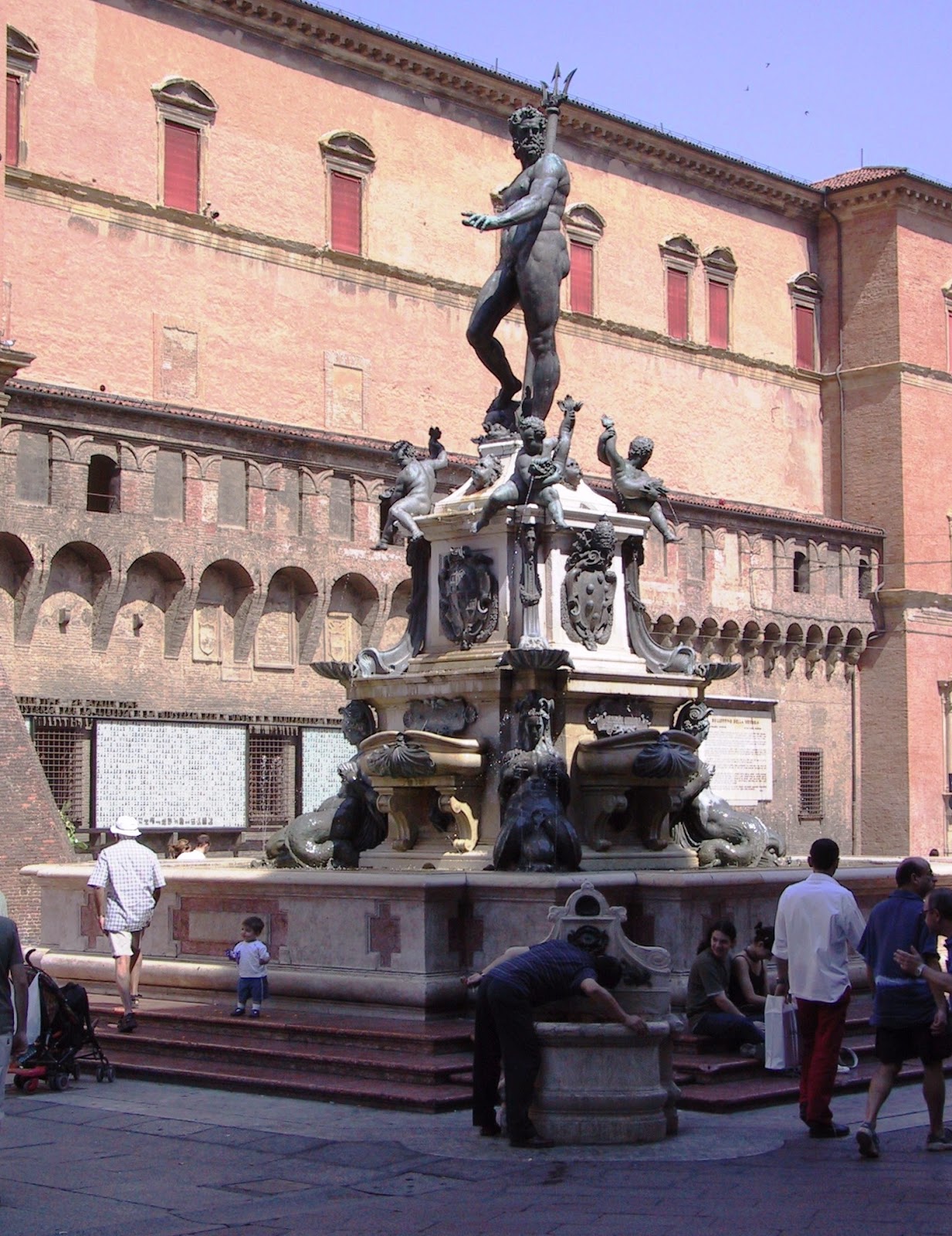
'Fountain of Neptune' in Piazza Maggiore, Bologna, by Giambologna, 1565.  Photo by Blomme-McClure
We visited the Basilica of San Petronio which has wonderful sculptural elements on the incomplete facade by Jacopo della Quercia (1425 to 1434).
The unfinished facade of the Basilica of San Petronio in Bologna.  The basilica was a project of the city of
Bologna, not the Roman Catholic Church.  It was constructed between 1390 and 1514 when it was halted
by Pope Pius IV who was worried that it would be more grand than the St. Peter's basilica  in Rome.
Photo by Blomme-McClure

Porta Magna (main doorway) with sculpture by Jacopo della Quercia.
Photo by Blomme-McClure

Bas relief on Porta Magna shows three scenes from Genesis: (from the top) 'The Creation of Eve from Adam's Rib'; 'The Temptation of Adam'; and 'The Expulsion from the Garden of Eden' all by Jacopo della Quercia.  Photo by Blomme-McClure

'The Virgin and Child with Saints Petronius and Ambrose' above the central doorway by Jacopo della Quercia.  The relief panels show New Testament scenes including 'Adoration of the Shepherds';
'Adoration of the Magi'; 'Nativity'; and 'Massacre of the Innocents'.  Photo by Blomme-McClure

Porte Minore di Sinistra, to the left of the main door.  The lunette shows Christ rising from
the tomb while two of the three Roman soldiers sleep.  Photo by Blomme-McClure
Nave of Basilica of San Petronio.  Photo by Blomme-McClure

 Luca pointed out that the south side of the basilica had been noted by Frank Lloyd Wright as early example of “organic” architecture.
South facade of Basilica of San Petronio, commended by Frank Lloyd Wright.
Photo by Blomme-McClure

We also visited Church of San Domenico, the founder of the Dominican order of priests -- 'the order of the preachers'.  
Basilica of San Domenico, Bologna.  Photo by Blomme-McClure
Nave of San Domenico as seen from the choir.  Photo by Blomme-McClure
Detail of marquetry on choir stalls by Fra Damiano da Bergamo from 1540-1549.
Photo by Blomme-McClure
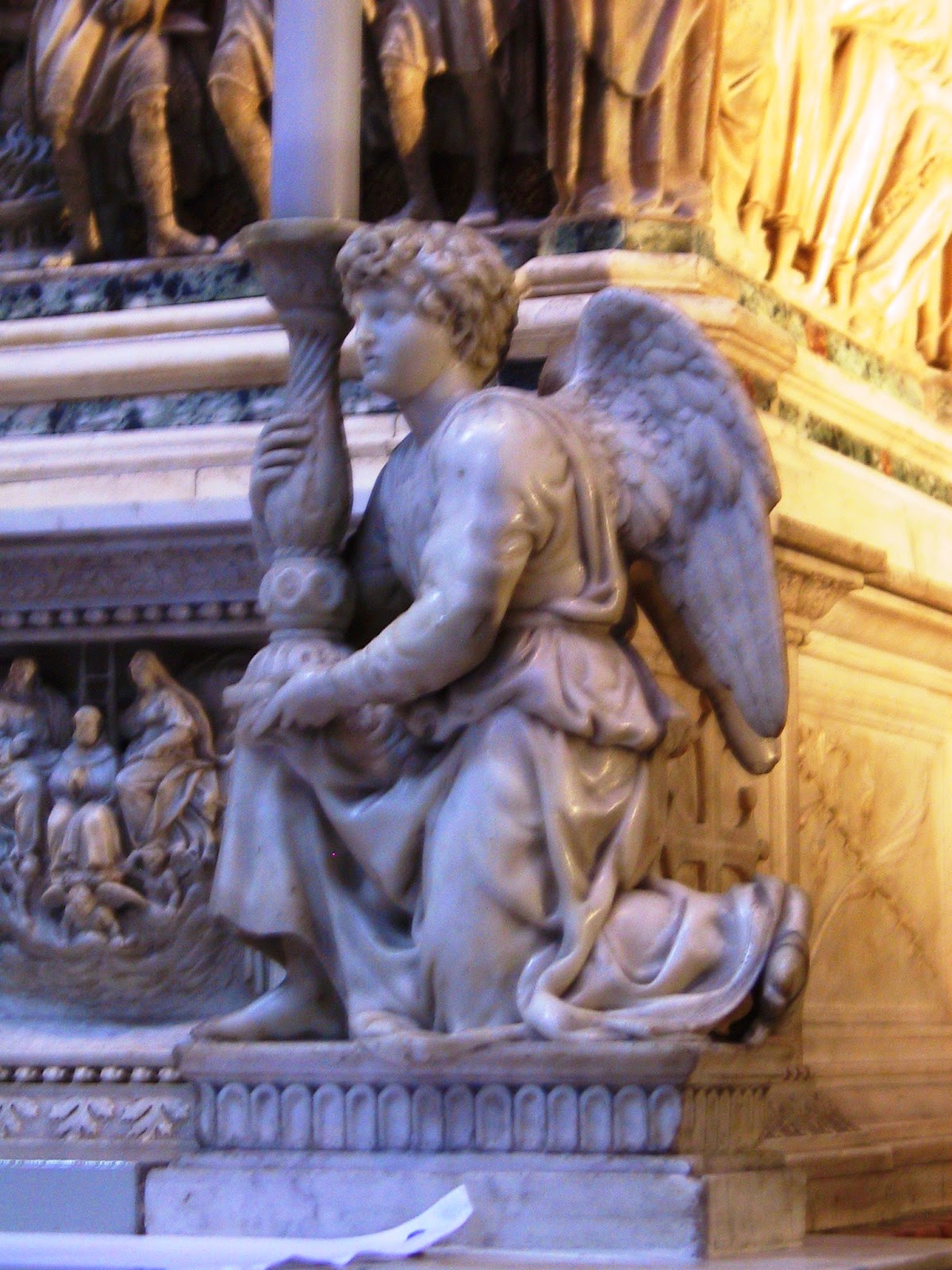
It contains a chapel with the elaborate tomb of San Domenico (Saint Domenick) with three sculptures by Michelangelo, including an angel holding a candle.
Arca di San Domenico (Tomb of Saint Domenic) by Nicollo Pisano and others.
Photo by Blomme-McClure
According to Luca, it is a test for gay men to correctly identify the Michaelangelo angel.
Kneeling Angel on Arca de San Domenico by Michelangelo.  Photo by Blomme-McClure
 
Statue of 'San Procolo' by Michelangelo, 1494.  Photo by Blomme-McClure
 

'San Petronio' begun by Nicollo Pisano and completed by Michelangelo.
Photo by Blomme-McClure
The designs and execution of the tomb which is in a chapel on the north side of the basilica won Niccolo the new name of Niccolo dell'Arca .  

We were very impressed that a custodian knew Luca and opened the locked gate to a cloister so that we could see it.
Cloister of Basilica of  San Domenico, Bologna.  Photo by Blomme-McClure

Choir and Apse of Basilica of San Dominico seen from Cloisters.  Photo by Blomme-McClure
Luca also took us into the courtyard of the old University of Bologna where the walls and ceilings are encrusted with the coats of arms of former students and intellectual societies.  
A courtyard of the University of Bologna which was founded in 1088.
Photo by Blomme-McClure
Arcade ceiling with the coats of arms of famous students of the University of Bologna.
Photo by Blomme-McClure

Statue of Louis Galvani, the noted Italian anatomist in Piazza Galvani.
Photo by Blomme-McClure
After our tour, we said 'good-bye' to Luca, returned to the Baglioni to retrieve our luggage and the car for our drive to Padua – about an hour away.

Padua is unprepossessing at best – a medium-size city of no special charm for us.  Perhaps it was our hotel, the Grand’ Italia Hotel (Corso del Popolo 81, Padova, 049 8761111, http://www.hotelgranditalia.it/) which sits above a McDonalds on a plaza where the railroad station meets the regional bus network.  It is about a 15-minute walk through a rather drab area to the old part of the city and about a 30-minute walk to the city’s main attraction, the Basilica of St. Anthony.  That evening we had dinner at Ristorante Belle Parti (Via Belle Parti 11, Padova, 049/8751822) near the old vegetable market (Piazza delle Erbe) on the south side of an old dump called the Palazzo Raggione.  There is a fruit market (Piazza della Frutta) on the north side of the same building.  Belle Parti is a very nice, traditional restaurant with a huge Parma ham sitting in the middle of an antipasta table.  The food and service were good, if unmemorable.