Showing posts with label Piazza Maggiore. Show all posts

Thursday, August 14, 2014

Italian Trip Diary -- Day #11 -- Bologna to Padua

Saturday, June 23, 2001 -- Bologna to Padua:

On Saturday morning, we met Luca at the café in the Piazza Maggiore for coffee and then a quick tour of central Bologna.
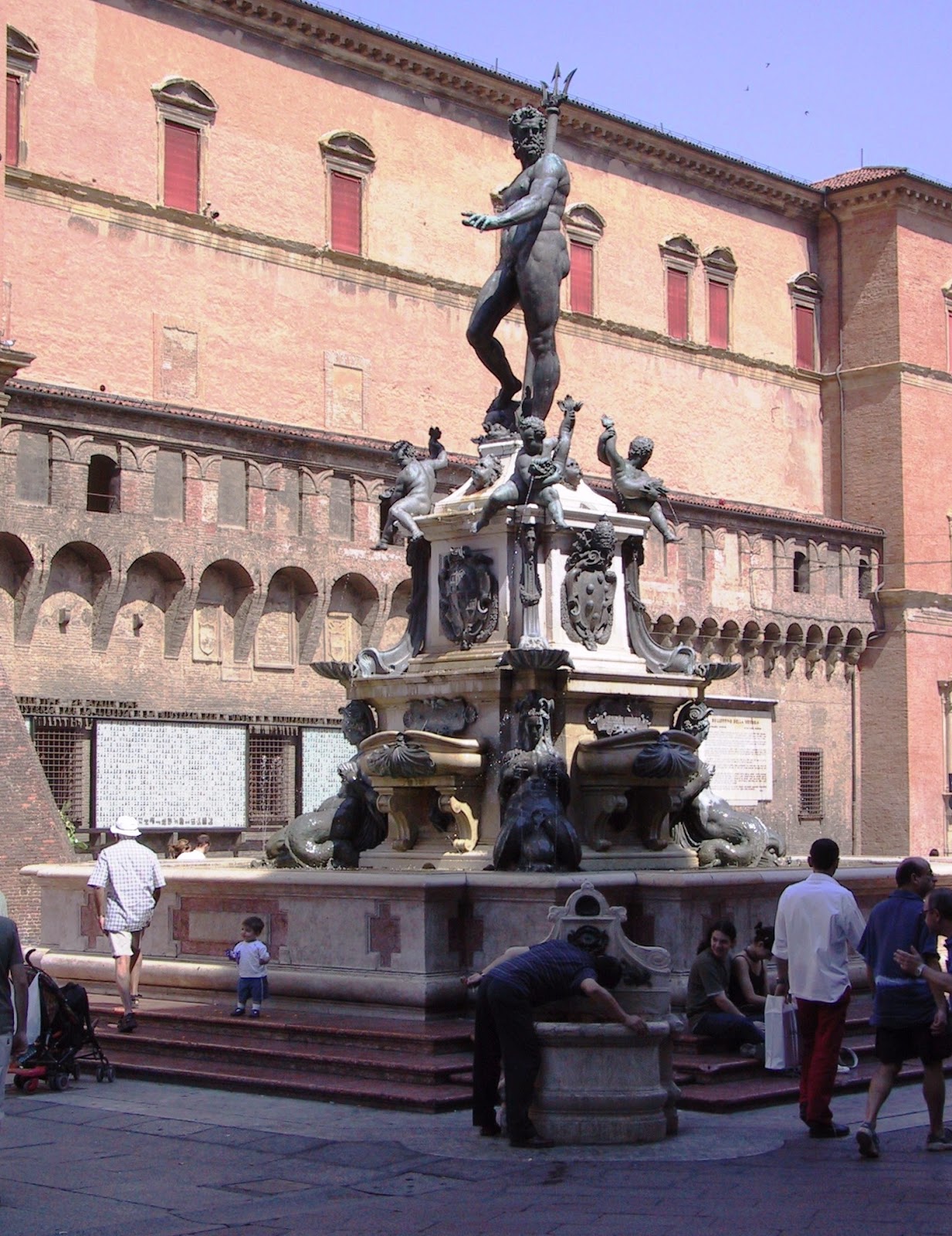
'Fountain of Neptune' in Piazza Maggiore, Bologna, by Giambologna, 1565.  Photo by Blomme-McClure
We visited the Basilica of San Petronio which has wonderful sculptural elements on the incomplete facade by Jacopo della Quercia (1425 to 1434).
The unfinished facade of the Basilica of San Petronio in Bologna.  The basilica was a project of the city of
Bologna, not the Roman Catholic Church.  It was constructed between 1390 and 1514 when it was halted
by Pope Pius IV who was worried that it would be more grand than the St. Peter's basilica  in Rome.
Photo by Blomme-McClure

Porta Magna (main doorway) with sculpture by Jacopo della Quercia.
Photo by Blomme-McClure

Bas relief on Porta Magna shows three scenes from Genesis: (from the top) 'The Creation of Eve from Adam's Rib'; 'The Temptation of Adam'; and 'The Expulsion from the Garden of Eden' all by Jacopo della Quercia.  Photo by Blomme-McClure

'The Virgin and Child with Saints Petronius and Ambrose' above the central doorway by Jacopo della Quercia.  The relief panels show New Testament scenes including 'Adoration of the Shepherds';
'Adoration of the Magi'; 'Nativity'; and 'Massacre of the Innocents'.  Photo by Blomme-McClure

Porte Minore di Sinistra, to the left of the main door.  The lunette shows Christ rising from
the tomb while two of the three Roman soldiers sleep.  Photo by Blomme-McClure
Nave of Basilica of San Petronio.  Photo by Blomme-McClure

 Luca pointed out that the south side of the basilica had been noted by Frank Lloyd Wright as early example of “organic” architecture.
South facade of Basilica of San Petronio, commended by Frank Lloyd Wright.
Photo by Blomme-McClure

We also visited Church of San Domenico, the founder of the Dominican order of priests -- 'the order of the preachers'.  
Basilica of San Domenico, Bologna.  Photo by Blomme-McClure
Nave of San Domenico as seen from the choir.  Photo by Blomme-McClure
Detail of marquetry on choir stalls by Fra Damiano da Bergamo from 1540-1549.
Photo by Blomme-McClure
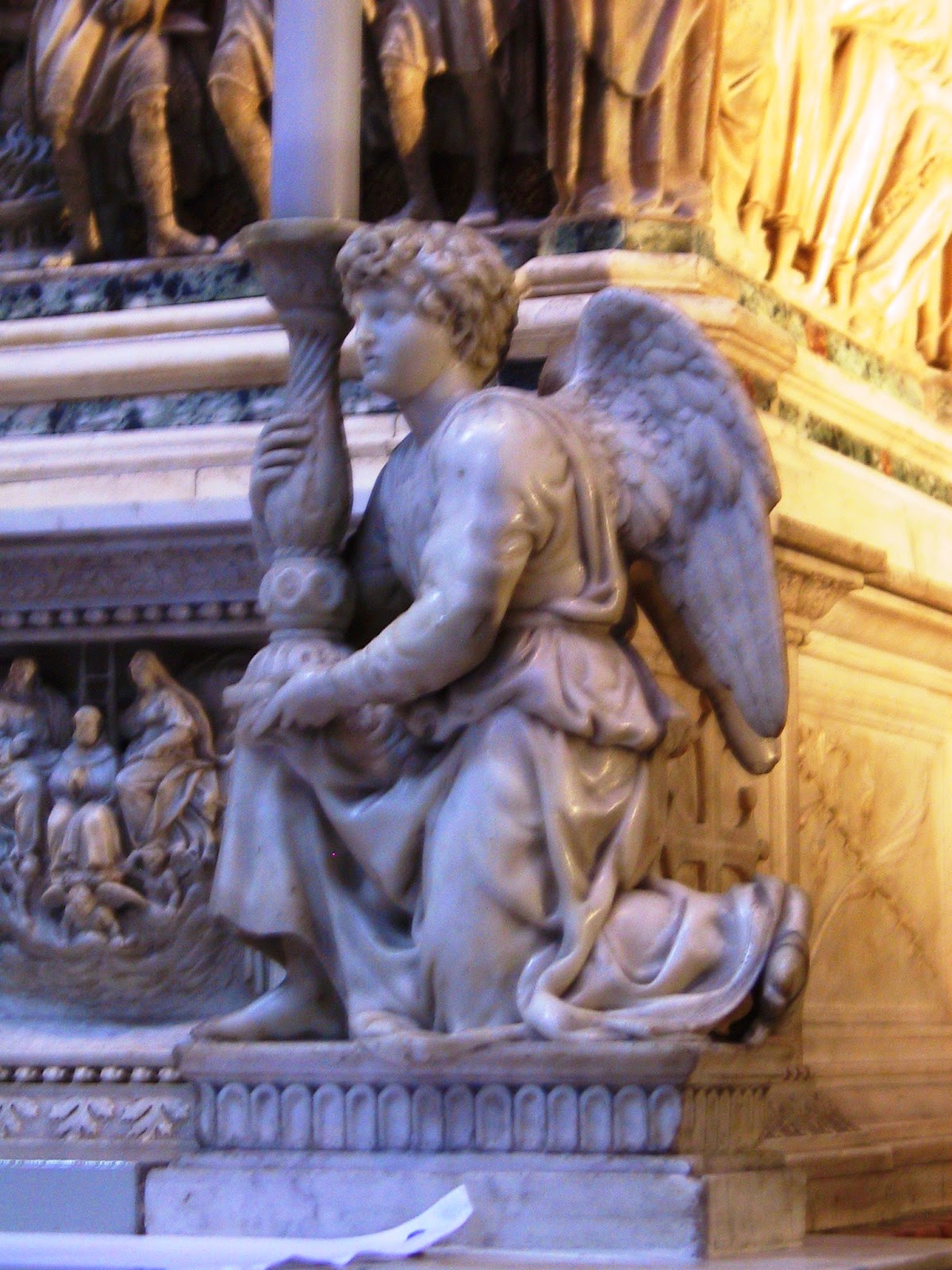
It contains a chapel with the elaborate tomb of San Domenico (Saint Domenick) with three sculptures by Michelangelo, including an angel holding a candle.
Arca di San Domenico (Tomb of Saint Domenic) by Nicollo Pisano and others.
Photo by Blomme-McClure
According to Luca, it is a test for gay men to correctly identify the Michaelangelo angel.
Kneeling Angel on Arca de San Domenico by Michelangelo.  Photo by Blomme-McClure
 
Statue of 'San Procolo' by Michelangelo, 1494.  Photo by Blomme-McClure
 

'San Petronio' begun by Nicollo Pisano and completed by Michelangelo.
Photo by Blomme-McClure
The designs and execution of the tomb which is in a chapel on the north side of the basilica won Niccolo the new name of Niccolo dell'Arca .  

We were very impressed that a custodian knew Luca and opened the locked gate to a cloister so that we could see it.
Cloister of Basilica of  San Domenico, Bologna.  Photo by Blomme-McClure

Choir and Apse of Basilica of San Dominico seen from Cloisters.  Photo by Blomme-McClure
Luca also took us into the courtyard of the old University of Bologna where the walls and ceilings are encrusted with the coats of arms of former students and intellectual societies.  
A courtyard of the University of Bologna which was founded in 1088.
Photo by Blomme-McClure
Arcade ceiling with the coats of arms of famous students of the University of Bologna.
Photo by Blomme-McClure

Statue of Louis Galvani, the noted Italian anatomist in Piazza Galvani.
Photo by Blomme-McClure
After our tour, we said 'good-bye' to Luca, returned to the Baglioni to retrieve our luggage and the car for our drive to Padua – about an hour away.

Padua is unprepossessing at best – a medium-size city of no special charm for us.  Perhaps it was our hotel, the Grand’ Italia Hotel (Corso del Popolo 81, Padova, 049 8761111, http://www.hotelgranditalia.it/) which sits above a McDonalds on a plaza where the railroad station meets the regional bus network.  It is about a 15-minute walk through a rather drab area to the old part of the city and about a 30-minute walk to the city’s main attraction, the Basilica of St. Anthony.  That evening we had dinner at Ristorante Belle Parti (Via Belle Parti 11, Padova, 049/8751822) near the old vegetable market (Piazza delle Erbe) on the south side of an old dump called the Palazzo Raggione.  There is a fruit market (Piazza della Frutta) on the north side of the same building.  Belle Parti is a very nice, traditional restaurant with a huge Parma ham sitting in the middle of an antipasta table.  The food and service were good, if unmemorable.

Sunday, August 10, 2014

Italian Trip Diary -- Day #10 -- Siena to Bologna

Friday, June 22, 2001 Siena to Bologna:

The next morning we got the car and after loading up our luggage we proceeded to get lost in Siena trying to find the autostrada north toward Florence and then on to Bologna.  The countryside north of Florence becomes even more mountainous, with deep gorges and steep mountains.  The autostrada climbs over the pass punctuated by several tunnels and high bridges soaring over breathtaking chasms and then descends as you near Bologna into a broad plain. 

We arrived in Bologna in mid-afternoon and made our way down another primarily pedestrian street to the (truly) Grand Hotel Baglioni (Via Indipendenza 8, Bologna, 051-225445) – Bologna’s answer to New York’s Plaza and St. Regis and Carlisle all rolled into one.  We were led by an assistant manager (or major domo of some sort) through the grand lobby and along a wide hallway to our rooms on the third floor.  Actually, our room wasn’t ready, so we were led to Carl’s room which would have been big enough for all three of us – a king-size bed, a sitting area, a dressing area and a huge bathroom.  Because our room wasn’t ready, the management sent us complimentary coffee while we waited.  Another major domo appeared to escort us two doors down the hall to our room when it was ready.  Both rooms looked directly across the street to the cathedral which had imposing Baroque statues just above our level.
Baroque statue of saint on facade of Cathedral in Bologna.  Photo by Blomme-McClure
Bologna is famous for its arcades which cover the sidewalks all over the center of the city.  
Covered pedestrian arcades run for blocks in Bologna.  Photo by Blomme-McClure

Each of Bologna's arcades has its own distinct architectural style.  Photo by Blomme-McClure
They provide shelter from the weather – rain, snow, sun, whatever – but can also seem rather sinister when they are too crowded or completely empty (when they seem rather like particularly suspenseful scenes from some Hitchcock movie) or when they become shelters for the homeless.  There are two very tall medieval towers in the center of the city (a la San Gimignano) which lean perilously toward each other.

That evening, our friend Luca met us at the hotel.  We went first for drinks on the Piazza Maggiore between the Palazzo Comunale (city hall) and the Basilica of San Petronio.
Palazzo Comunale (Palazzo d'Accursio) on Piazza Maggiore, Bologna.  Photo by Blomme-McClure

Entrance to Palazzo d'Accursio with bronze statue of Pope Gregory XIII.
Photo by Blomme-McClure
Palazzo del Podesta with two outdoor cafes on Piazza Maggiore, Bologna.   Photo by Blomme-McClure


'Fountain of Neptune' in Piazza Maggiore, Bologna, by Giambologna, 1565.  
Unfinished faced of Basilica of San Petronio is in background.  Photo by Blomme-McClure 
The basilica was left unfinished when Bologna fell to the Pope and he decided that, if completed, it would rival Rome and the Vatican as a center of religion, learning and political power.  In the early evening the square was a lively spot and the café was a great place to observe the street life of the city.

During drinks Luca told us about the city – its history and architecture and famous university – one of the oldest in the world.  Luca obviously loves Bologna and is both an enthusiastic and knowledgeable guide.
Many of the arcades in Bologna have painted ceilings with the crests of noble families.
Photo by Blomme-McClure
After sitting in the square for about an hour, we strolled down some of the arcades, past the Torri Pendenti -- the two tall medieval towers (a la San Gimignano) that lean perilously toward one another and on to Ristorante Cesarina (Via San Stefano 19b, Bologna, 051-23-20-37 or 051-23-55-43http://www.ristorantecesarina.it/) where we sat outdoors under the arcade and enjoyed a lovely Bolognese dinner.  Luca had tortellini en brodo, lovely little meat-filled pasta dumplings served in a delicious broth, which is a local specialty.  The restaurant is on the square where the Church of San Stefano sits.  There are seven different sanctuaries within the church, each of which commemorates a different event in the passion of Christ.

After dinner Luca took us to the Bologna gay & lesbian center, which is located in one of the old gates houses in the city wall.  There are three levels which include several bars, a small disco and a performance space on the roof where we could see and hear a performance artist “performing” in a spotlight as we approached.  The crowd consisted mostly of young men traveling in cliques.  We had one drink and moved on.  Luca walked us back to the Baglioni and then he took Carl on to a gay bar.