'SWAN LAKE', Sunday Matinee, September 24, 3:00 PM:
(Conductor: Sill)
ODETTE/ODILE: Bouder
SIEGFRIED: Veyette
VON ROTBART: Chamblee
QUEEN: Kikta
JESTER: Ulbrecht (replaced Villarini-Velez who replaced Ball)
BENNO: Sanz
PAS DE TROIS: Adams, Segin
PAS DE QUATRE: LeCrone, Pollack, Pereira, Gordon
HUNGARIAN: Kretzschmar, Applebaum
RUSSIAN: Gerrity (replaces Isaacs), Stanley
SPANISH: Dutton-O’Hara, Alberda, Anderson, Walker
NEAPOLITAN: Villwock, Villarini-Velez
PRINCESSES: Manzi, Boisson, Mann, Brown, O. MacKinnon, Miller
I saw the dress rehearsal and two performances of Peter Martins' 'Swan Lake'. Martins uses much of George Balanchine's choreography for the first lakeside scene. Balanchine in turn based the choreography of his one-act 'Swan Lake' on the Petipa and Ivanov versions that he knew from his school days in St. Petersburg in the early 20th century.
Martins own choreographic contributions to this production run the gamut from brilliant to workmanlike to eccentric to just awful. I find the windmill arms in the ballroom pas de quatre particularly egregious. Martins' first scene in the palace garden is at least partly redeemed by the adorable children -- students from the School of American Ballet. And his final lakeside scene concludes brilliantly -- leaving the viewer with a positive impression of the production.
I had seen much of the September 24th cast rehearsing the first act the previous Tuesday afternoon (9/19/2017). At the rehearsal Ashley Bouder and Andrew Veyette gave half-hearted run-throughs, often simply marking their steps. Surprisingly, at the Sunday matinee, Andrew's performance continued to be half-hearted -- both uninvolving and uninvolved. Ashley, on the other hand gave a full-on performance that was surprisingly nuanced in the lakeside scenes and brilliantly bravura in the ballroom pas des deux. As she acknowledges in one of the Company's videos, she struggles with Odette's lakeside scenes whereas Odile's ballroom persona and choreography are right in her wheelhouse.
Here's the web address of that video:
https://www.youtube.com/watch?v=v19PaQ6XF48
 |
| Ashley Bouder with corps of Swan Maidens in the first lakeside scene of Peter Martins' 'Swan Lake'. Photo by Paul Kolnik courtesy of NYC Ballet |
Daniel Ulbrecht was suitably brilliant as the Jester -- although this silly and disruptive role makes it hard to appreciate his astonishing technical feats while being annoyed whenever he appears.
Aaron Sanz was a revelation as Benno all three times that I saw him dance. His dancing in the first act pas de trois was elegant and arrow sharp -- fully inhabiting gorgeous images that linger in the imagination. His dancing was very fine, especially when contrasted at the September 24th performance with Veyette's lackluster Siegried.
'SWAN LAKE', Sunday Matinee, October 1, 3:00 PM:
(Conductor: Litton)
ODETTE/ODILE: *T. Peck
SIEGFRIED: *Finlay
VON ROTBART: Chamblee
QUEEN: Kikta
JESTER: Hoxha
BENNO: Sanz
PAS DE TROIS: Adams, Segin
PAS DE QUATRE: LeCrone, Pollack, Pereira, Gordon
HUNGARIAN: *Wellington, *Knight
RUSSIAN: *A. Stafford, *Catazaro
SPANISH: Dutton-O’Hara, Alberda, Anderson, Walker
NEAPOLITAN: Villwock, Villarini-Velez; PRINCESSES: Manzi, Boisson, Hod, Kretzschmar, Johnson, Miller
* First Time in Role, Wednesday Evening, September 27th
Tiler Peck and Chase Finlay made their debuts as Odette/Odile and Prince Siegfried at the Wednesday evening performance just prior to our Sunday matinee. Their engagement and chemistry were exemplary. Chase presented a relatively cool stage persona as Siegfried, but seemed consistently involved in the opening scene and smitten during his first lakeside scene with Tiler's Odette. Tiler portrayed Odette as wary and frightened before succumbing to Siegfried's tender ardor. In the ballroom scene Tiler's Odile was suitable alluring and duplicious and Chase as Siegfried was completely swept up in the subterfuge concocted by Von Rotbart and Odile which tricks him into betraying Odile.
 |
| Tiler Peck and Chase Finlay in the ballroom pas de deux from 'Swan Lake' Photo by Paul Kolnik from NYC Ballet |
https://www.facebook.com/nycballet/videos/10159597432895529/
Take a moment to read the comments below the video on the Company's Facebook page.
I have never seen a conductor put down his baton and join the ovation, but Maestro Litton did just that. Mr. Finlay offered his own brilliant moments and provided stellar support for Ms. Peck throughout the performance except for a minor bobble at the end of the final scene when their finale embrace went briefly askew.
That final scene is one of the triumphs of Mr. Martins staging. After that final embrace, Odette bourees diagonally backward from Siegfried disappearing into the back-lit flock of swan maidens clustered in the rear corner of the stage. Siegfried crumples in despair at losing her forever.
21st CENTURY CHOREOGRAPHY: Sunday, October 8 at 3 PM
LITURGY: Maria Kowroski, Jared Angle
POLYPHONIA: Unity Phelan, Emilie Gerrity, Ashley Hod, Lauren Lovette, Zachary Catazaro, Aaron Sanz (replaces Harrison Ball), Joseph Gordon, Russell Janzen
ODESSA: Sara Mearns, Ashley Bouder, Sterling Hyltin, Tyler Angle, Taylor Stanley, Joaquin De Luz
THE TIMES ARE RACING: Tiler Peck, Brittany Pollack, Savannah Lowery, Indiana Woodward, Ashly Isaacs, Justin Peck, Amar Ramasar, Sean Suozzi
'Liturgy' and 'Polyphonia' are both choreographed by Christopher Wheeldon to the music of Arvo Part -- 'Fratres for Violin, Strings and Percussion' for 'Liturgy' -- and Gyorgy Ligeti --ten short piano solos and duets for 'Polyphonia'. Except for their music the two works seem quite similar and I would put them on different programs rather than having one follow the other.
In 'Liturgy' Maria Kowroski and Jared Angle executed the choreography that Wheedon created for Wendy Whelan and Jock Soto in 2003. Somehow Maria and Jared seemed too cautious and solemn here.
When Mr. Wheeldon created 'Polyphonia' in 2001, Whelan and Soto were the central couple. The piece opens with all eight dancers on stage. As they move their movements are magnified and distorted by their overlapping shadows on the pale backdrop -- an early example of Wheeldon's theatrical acumen.
 |
| A cast in the opening moments of Christopher Wheeldon's 'Polyphonia' Photo by Paul Kolnik for NYC Ballet |
Alexei Ratmansky's 'Odessa' uses a collection of incidental music that Leonid Desyatnikov composed for 'Sunset', a Russian film about Jewish gangsters in Odessa following the Russian Revolution. It premiered during the Company's 2017 Spring season and this is the second time we saw it with substantially the same cast -- three leading couples and a corps of twelve.
 |
| Sterling Hyltin & Joaquin De Luz in Ratmansky's 'Odessa' Photo by Paul Kolnik for NYC Ballet |
https://www.youtube.com/watch?v=c6nJNnqGzLI
The closing image -- Sara Mearns and Tyler Angle isolated in a spot light among murky vertical rows of the remaining cast as Sara is slowly rotated while bending away from her partner -- is sensational .
 |
| Amar Ramasar & Sara Mearns in the final moments of Ratmansky's 'Odessa' Photo by Paul Kolnik for NYC Ballet |
'The Times Are Racing', the Justin Peck sneaker ballet, was first performed as part of the New Combinations program last January. The recorded music by Dan Deacon is often very loud and propulsive. Justin responds with modern choreography that reminds me of an of-the-moment up-date of Jerome Robbins' 'Interplay' and 'Opus Jazz'. The costumes by Humberto Leon of Opening Ceremony are variations on jeans, hoodies and other casual street wear.
 |
| Original cast in Opening Ceremony costumes for Justin Peck's 'The Times Are Racing' Photo by Paul Kolnik for NYC Ballet |
 |
| Justin Peck & Robert Fairchild in video for Peck's 'The Times Are Racing' Still from NYC Ballet promotional video |
https://www.youtube.com/watch?v=nj0nltZOf50
The playful, frisky central romantic duet was beautifully danced by Tiler Peck and Amar Ramasar -- the original cast. Later in the fall season it was danced by Taylor Stanley and Daniel Applebaum(a female to male swap). These cast changes indicate just how open Justin is to contemporary life in the city and how he's absorbed that into this piece as it moves into repertory.
'The Times are Racing' was certainly the highlight of this program. It is an exhilarating piece that captures the energy of being young and filled with life in our city right now.
PREMIERS FROM FALL FASHION GALA: Friday, October 13 at 8 PM
THE CHAIRMAN DANCES: Megan LeCrone
THE WIND STILL BRINGS (New Walton/Schumacher)
COMPOSER’S HOLIDAY (New Foss/Reisen): Emma Von Enck, Christina Clark, Gabriel Bolden+, Roman Mejia+
NOT OUR FATE (New Nyman/Lovette): Meaghan Dutton-O’Hara, Ask la Cour, Taylor Stanley, Preston Chamblee, Sara Adams, Laine Habony, Mary Elizabeth Sell, Sarah Villwock, Christopher Grant, Lars Nelson
PULCINELLA VARIATIONS (New Stravinsky/Peck): Georgina Pazcoguin*, Miriam Miller*, Ashly Isaacs*, Emilie Gerrity*, Lydia Wellington*, Russell Janzen*, Andrew Scordato, Harrison Coll*, Sean Suozzi*
{PULCINELLA VARIATIONS (New Stravinsky/Peck) original Fashion Gala cast: Sterling Hyltin, Sara Mearns, Tiler Peck, Brittany Pollack, Indiana Woodward, Jared Angle, Andrew Scordato, Gonzalo Garcia, Anthony Huxley}
* First Time in Role
The Company offered the premiers of four new ballets at its Fall Fashion Gala on September 29th. At these annual galas the Company pairs choreographers with fashion designers to create new works. Sometimes the pairings lead to inspired results and sometimes either the designers or the choreographers unbalance the overall effort. We caught up with these new works plus Martins' 'The Chairman Dances' on October 13th.
To say that 'The Chairman Dances' to music of John Adams from his opera 'Nixon in China' is a trifle gives it too much credit. Here the 16-member female corps was fronted by an austere, uninflected performance by Megan LeCrone. Thankfully, the program was all up-hill from there.
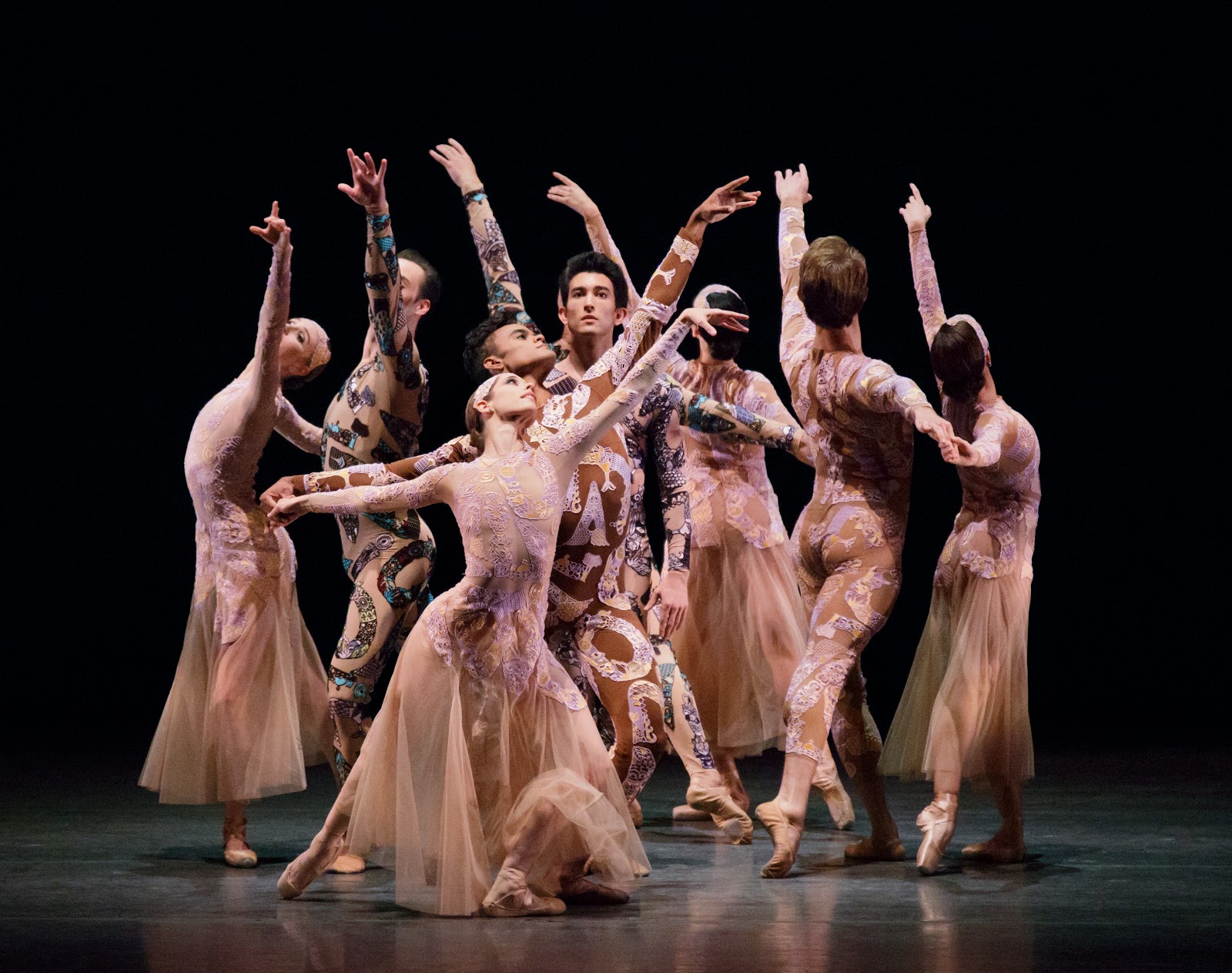
Troy Schumacher's 'The Wind Still Brings' has costumes by Jonathan Saunders and music by William Walton -- excerpts from his 'Piano Quartet in D minor'. Here the eccentric Saunders' costumes -- a combination of wrap skirts (for men & women), palazzo pants and various tunics all in a dark robbins-egg-blue and flesh tones with trailing ribbons of fabric -- overwhelmed and muddled Troy's inventive choreography.
 |
| The cast in Troy Schumacher's 'The Wind Still Brings' in Jonathan Saunders costumes Photo by Paul Kolnik for NYC Ballet |
Gianna Reisen -- a recent alumna of the School of American Ballet and now an apprentice of the Ballet Semperoper of Dresden -- created 'Composer's Holiday' to music by Lukas Foss -- 'Three American Pieces for Violin and Piano'. It was her first ballet for a professional company following three ballets she created for SAB's student choreography workshop and the New York Choreographic Institute. The costumes by Virgil Abloh of Off-White were fairly traditional -- the women in solid white, flesh colored, or black above-the-knee dance dresses and the men in black pants with tight partly sheer shirts.
 |
| Emma Von Enck and cast in Gianna Reisen's 'Composer's Holiday' wearing Virgil Abloh's costumes Photo by Paul Kolnik for NYC Ballet |
Lauren Lovette choreographed 'Not Our Fate' with costumes by Fernando Garcia and Laura Kim of MONSE and Oscar de la Renta to the music of Michael Nyman -- three excerpts from his 'Concert Suite from Prospero's Books'. The work was inspired by a poem written by Mary Elizabeth Sell -- a Company dancer. The final lines of her poem are:
"Spreading love, spreading hate
Is our choice, not our fate."
 |
| The cast with Meaghan Dutton-O'Hara aloft in Lauren Lovette's 'Not Our Fate' Photo by Paul Kolnik for NYC Ballet |
 |
| Preston Chamblee and Taylor Stanley in Lauren Lovette's 'Not Our Fate' Photo by Paul Kolnik for NYC Ballet |
Justin Peck's 'Pulcinella Variations' to Igor Stravinsky's 'Pulcinella Suite' had costumes by Tsumori Chisato.
 |
| Tsumori Chisato's costume sketches for Justin Peck's 'Pulcinella Variations' |
 |
| Original cast in Tsumori Chisato's costumes for Justin Peck's 'Pulcinella Variations' Photo by Paul Kolnik for NYC Ballet |
http://www.nycballet.com/Videos/Ballet-Detail-clips/Pulcinella-Variations-excerpt.aspx
Endeavoring to look beyond the kooky costumes at Mr. Peck's movements reveals an interesting string of solos and duets book-ended by two ensembles for the full company of nine. In this cast I particularly admired Miriam Miller and Russell Jansen in the Serenata; Lydia Wellington in the Allegretto; Emilie Gerrity in the Andantino; and Ashley Isaacs and Harrison Coll in the Gavotta. Perhaps after the novelty of the costumes fades, we'll be able to appreciate Mr. Peck's choreography. It was certainly fun to watch these dancers move in their costumes though.
ALL BALANCHINE: Sunday, October 15 at 3 PM
CORTEGE HONGROIS: Reichlen, Janzen, King, Kretzschmar, Lowery, Suozzi
LA VALSE: Sara Mearns, Tyler Angle, Amar Ramasar (replaces Aaron Sanz), Ghaleb Kayali, Kristen Segin, Devin Alberda (replaces Sebastian Villarini-Velez), Brittany Pollack, Daniel Applebaum, Emilie Gerrity, Andrew Scordato, Megan Johnson, Lydia Wellington, Marika Anderson
SQUARE DANCE: Ashley Bouder, Taylor Stanley
DUO CONCERTANT: Sterling Hyltin, Robert Fairchild
Initially this all-Balanchine matinee was sequenced 'Square Dance', 'La Valse', and 'Cortege Hongrois' -- an order that has all of the hallmarks of Mr. Balanchine's superb programming instincts. When it was announced that this would be Rob Fairchild's final performance with the Company, the sequence was shuffled to add 'Duo Concertant' to the end of a less coherent program of Balanchine works -- but an order that makes sense in the context of Peter Martins' own flair for staging grand farewells.
Speaking of grand farewells, Balanchine created 'Cortege Hongrois' for Melissa Hayden's farewell performance in May, 1973 -- which we attended. Balanchine had already used music from Glazunov's ballet 'Raymonda' -- composed in 1897-98 for the Imperial Theater in St. Petersburg -- for his 'Raymonda Variations' in 1961 and 'Pas de Dix' in 1955. For 'Cortege Hongrois' he used the Glazunov's music from the Hungarian divertissement that concludes 'Raymonda' -- a mixture of Hungarian character dances and grand classical ballet. The white, gold and bright green costumes by Rouben Ter-Artunian have been widely reviled and ridiculed, but the choreography derived from Petipa's original is exuberant and appropriately festive.
 |
| Company in finale of Balanchine's 'Cortege Hongrois' Photo by Paul Kolnik for NYC Ballet |
'La Valse' is a rather macabre ballet to Ravel's 'Valses Nobles et Sentimentales' and 'La Valse'. Part of its mystique comes from the extraordinary Karinska costumes -- especially the women's ankle length skirts layering various sunset colors of tulle which the dancers manipulate as part of the swirling choreography. The first section of eight waltzes introduces three women often referred to as the 'three fates', three couples, and finally the central couple -- here Sara Mearns and Tyler Angle -- in the eighth waltz. In the second section Death (Amar Ramasar) seduces the virginal Sara. She dies in a fiery vortex of swirling dancers. As Ravel once noted about his music "we are on the edge of a volcano".
When Balanchine created 'Square Dance' to music by Arcangelo Corelli and Antonio Vivaldi in 1957 there was a square dance caller and the orchestra on stage with the dancers, led by Patricia Wilde and Nicolas Magallanes in the principal roles. When Balanchine revived the ballet in 1976 the caller was gone, the orchestra was in the pit, and a difficult new adagio solo was added for Bart Cook.
Ashley Bouder and Taylor Stanley led 'Square Dance' with the requisite technical brilliance. Balanchine's filligreed call-and-response choreography between the principals and corps requires for technical brilliance from the entire cast and the seasoned corps responded to Ashley and Taylor with brio and finesse.
 |
| Ashley Bouder & Taylor Stanley with cast in Balanchine's 'Square Dance' Photo by Paul Kolnik for NYC Ballet |
https://www.youtube.com/watch?v=GpRZcx1KDQo
For his final New York City Ballet performance, Rob Fairchild danced the Balanchine/Stravinsky 'Duo Concertant' with his frequent partner Sterling Hyltin -- as very young dancers they originated the leading roles in Peter Martins' 'Romeo + Juliet' in 2007. 'Duo Concertant' was created for Kay Mazzo and Peter Martins as part of the Company's 1972 Stravinsky Festival. For me this ballet can seem rather slight and trite -- often used as filler on more substantial programs. Even on this occasion -- Rob's farewell to the Company -- it seemed like a collection of choreographic sketches without much weight.
 |
| Stirling Hyltin & Robert Fairchild in Balanchine's 'Duo Concertant' Photo by Paul Kolnik for NYC Ballet |
Of course the Koch Theater was packed with Robbie's many fans and there was a huge ovation at the conclusion of 'Duo Concertant'. Robbie and Sterling took several bows before the great gold curtain -- which then swept up to reveal Robbie alone on stage with a basket of roses. As the Company's principals came on stage to salute him, Robbie dispensed a single rose to each along with hugs and kisses. Eventually he was joined by Peter Martins, all of the Company dancers in the theater that afternoon and Nicolaj Hubbe. After a shower of silver confetti and several more solo bows the curtain slowly descended on Robbie's stellar ballet career.
 |
| Robert Fairchild acknowledging his final ovation at NYC Ballet surrounded by Peter Martins and the Company Photo by Kent G. Becker |
* * * * * * *
The Company's fall season exposed the dichotomy of it's repertory and programming -- the need to balance it's economic realities (represented by the two-week run of the full-evening 'Swan Lake' and the unbalanced designer/choreographer pairings for the traditional Fashion gala) with it's adventurous choreographic tradition (represented by the four new ballets from the Fashion gala and the program of 21st century works). The racial type-casting in 'Swan Lake' contrasted with casting in new works that pushed sexual boundaries. Engaging and encouraging female choreographers will help address the dearth of women creators in classical ballet -- but there are very few role models for them.
The same is true for the dancers -- there are a few role models for the men of color, but none above the corps for women of color . They can't all look to Misty Copeland at ABT for inspiration. There are now several dancers of color among the corps and recent apprentices. They've fought the odds to get this far, but what can they aspire to in the Company -- third Princess from the left in 'Swan Lake', maybe a variation in 'Raymonda Variations', maybe a role in a new ballet?
In this post I've tried to highlight the positive aspects of this season, but not ignore its shortcomings. As usual, the dancing was often extraordinary, the choreography was variable, the music was eclectic and generally well-played and the level of design was all over the map.