Showing posts with label Brunelleschi. Show all posts

Friday, April 24, 2015

'Sculpture in the Age of Donatello' at MoBiA

We took in the exhibition 'Sculpture in the Age of Donatello' at the Museum of Biblical Art in March.  All 23 of the objects in the exhibition are from the Museo dell'Opera del Duomo in Florence.  The objects are only available during the renovation and re-imagining of the Museo dell'Opera del Duomo -- the museum associated with the Cathedral (Santa Maria del Fiore) of Florence (known as 'Il Duomo').  

There is an introductory video which seems to be about the reconfiguration of Museo dell'Opera del Duomo and the art treasures of the three buildings that comprise the Cathedral complex -- the Cathedral, the Campanile, and the Baptistry.  Many of these works had to be removed from the exteriors of the Duomo complex because they were suffering from environmental damage primarily caused by air pollution. 
The main gallery of MoBiA for the exhibiton 'Sculpture in the Age of Donatello'.  Photo by Blomme-McClure 
The exhibition has been beautifully mounted in MoBiA's main gallery which is divided by gauzy white fabric into niches and rooms.  The free-standing sculptures are mounted on high pedestals which approximate the way that they would have been seen in their original locations around the Cathedral complex.  While we were in the gallery a few visitors were actually lying on the floor to further approximate the views the Florentine public would have had when the sculptures were newly finished and installed. 

The exhibition features several masterpieces by the sculptor Donatello (Donato di Niccolo di betto Bardi, 1386- 1466) who worked in several Italian towns during the first half of the 15th century.  He spent several years in Florence creating works to embellish the Cathedral complex.  In addition to works by Donatello the exhibition contains several works from the end of the 14th century through the middle of the 15th century by other artists who often worked side-by-side with Donatello on the Duomo.

The most stunning work in the exhibition is Donatello's 'Saint John the Evangelist' (circa 1409-1411) -- a seated figure of the bearded evangelist holding a book (the gospel of John).  It originally stood beside the Cathedral's main western door -- no doubt passing judgment on Florentines as they entered the church.
'Saint John the Evangelist' by Donatello, marble, circa 1409-1411.  Photo by Blomme-McClure
Stern and austere, the bearded figure flanked the central western door of the Cathedral with Nanni di Banco's 'Saint Luke' of 1408.  
'Saint Luke' by Nanni di Banco, marble, 1408 and 'Saint John the Evangelist' by Donatello, marble,
circa 1409-1411.  Photo by Blomme-McClure
While the two figures are of the same scale, the 'Saint Luke' seems much less imposing due to the smug, self-satisfied facial expression and the complex drapery of his robe -- it's beautiful, but distracting.
'Saint Luke' by Nanni di Banco, marble, 1408.  Photo by Blomme-McClure
In the first niche inside the entrance there is a lovely, late 14th-century 'Annunciation' by Giovanni d'Ambrogio from about 1397.
'Annunciation' by Giovanni d'Ambrogio, marble, circa 1397.  Photo by Blomme-McClure
The sensuous robes of both the Madonna and the Angel Gabriel have remarkable detail and naturalness -- the fabric appears gossamer thin and beautifully draped.
'Annunciation' -- detail of the Angel Gabriel -- by Giovanni d'Ambrogio, marble, circa 1397.
Photo by Blomme-McClure
Donatello created several old testament figures to fill niches in the campanile.  Two are on display in this exhibition -- 'The Prophet Habbakuk' (also known as 'Lo Zuccone') and 'The Sacrifice of Isaac'.
'The Prophet Habbakuk' (aka 'Lo Zuccone') by Donatello, marble, circa 1423-1435.
Photo by Blomme-McClure
'Habbakuk' is an austere standing figure, approximately lifesize, bald and barefoot.  The strong lines of the drapery of his robe make the sculpture appear even taller and more commanding and gives it the elongated feeling of an El Greco saint.
'The Sacrifice of Isaac' by Donatello, marble, circa 1421.  Photo by Blomme-McClure
There's an almost Art Deco quality about 'The Sacrifice of Isaac' that Donatello sculpted around 1421 for the Campanile.  The blocky figure of Isaac passively waits for his father, Abraham, to strike the sacrificial blow, while the animated figure of Abraham writhes and recoils from the deed that God has commanded him to commit.  It is a gorgeously expressive work -- much more animated than most of Donatello's work.

The show also includes three hexagonal relief medallions from a set that Luca della Robbia created for the Campanile.
' Grammar' by Luca della Robbia, marble, 14th century.  Photo by Blomme-McClure
'Disputation' (aka 'Plato & Aristotle') by Luca della Robbia, marble, 14th century.  Photo by Blomme-McClure
'Music' (aka 'Orpheus') by Luca della Robbia, marble, 14th century.  Photo by Blomme-McClure
The whimsical scene of the lutist playing 'Music' to soothe the beasts of the forest is especially delightful.  And the animated 'Disputation' is almost like a cartoon panel from a comic book.


The della Robbia studio also created the crosier in gold and enamel to be carried by the bishop in processions and ceremonies in the Cathedral.
'Cr0sier' (detail) by Studio of Luca della Robbia, gold & enamel, 14th century.  Photo by Blomme-McClure 
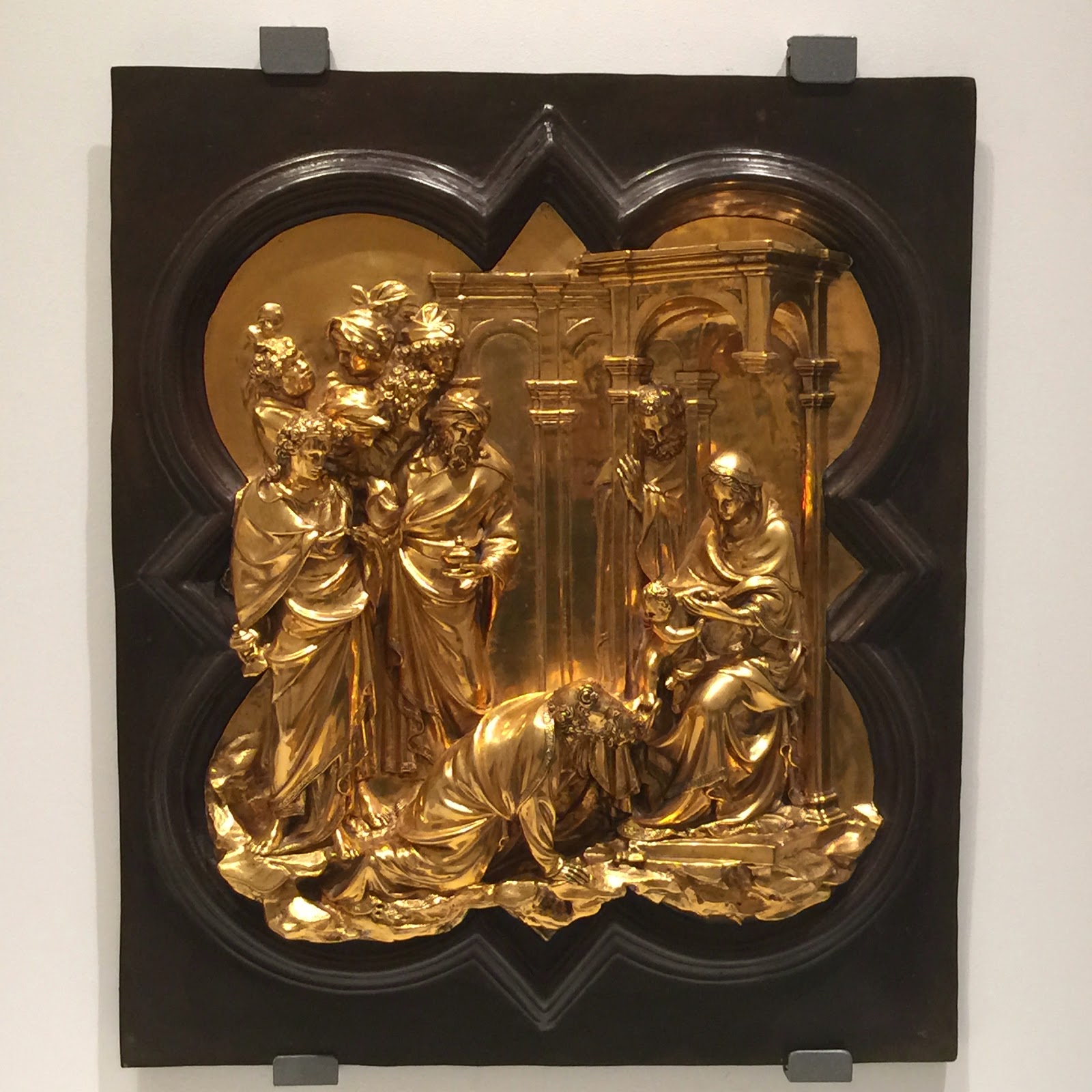
Three gilded bronze panels show scenes from the life of Christ that were part of Lorenzo Ghiberti's original east doors to the Baptistry (opposite the Cathedral's main doors).  They are displayed with stone reliefs derived from the same compositions from the early 15th century.  These doors, commissioned in 1401, were later moved to the north side of the Baptistry when Ghiberti was given a second commission for the current east doors (which Michelangelo named the 'Gates of Paradise') in 1425.  After withstanding centuries of air pollution and corrosion, all of the original bronze panels from Ghiberti's two commissions have been moved inside the museum and restored.  Today the panels in the Baptistry doors are copies of the originals.
Three panels by Lorenzo Ghiberti, bronze, circa 1401 to 1424 displayed with stone reliefs derived from the same compositions.  Photo by Blomme-McClure
Ghiberti's individual bronze panels of the life of Christ from the 1401 commission display the rudimentary animation and use of perspective that came to full flower in his panels of the twelve Old Testament scenes for the 1425 commission.


'Adoration of the Magi' by Lorenzo Ghiberti, gilded bronze, circa 1401 to 1420.  Photo by Blomme-McClure
'Flagellation of Christ' by Lorenzo Ghiberti, gilded bronze, circa 1401-1420.  Photo by Blomme-McClure
'Crucifixion' by Lorenzo Ghiberti, gilded bronze, circa 1401-1420.  Photo by Blomme-McClure
For the 'Adoration of the Magi' Ghiberti uses two-point perspective in the temple surrounding the Holy Family.  In the 'Flagellation of Christ' there is a sense of movement in the torquing bodies of the Roman Centurions wielding their whips on the cringing Christ.  It also uses single-point perspective in the temple behind the figures.  In the 'Crucifixion' an overall symmetry focuses the viewer's attention on the figure on the cross.  Both Donatello and Brunelleschi were apprentices in Ghiberti's studio during the time that the panels for the 1401 commission were being created.

Donatello created two bronze heads to adorn his cantoria (singing gallery) inside the Cathedral.  They appear to be identical.  Luca della Robbia also created a cantoria for the Cathedral -- both are now in the museum.
'Bronze Heads' by Donatello, bronze, circa early 14th century.  Photo by Blomme-McClure
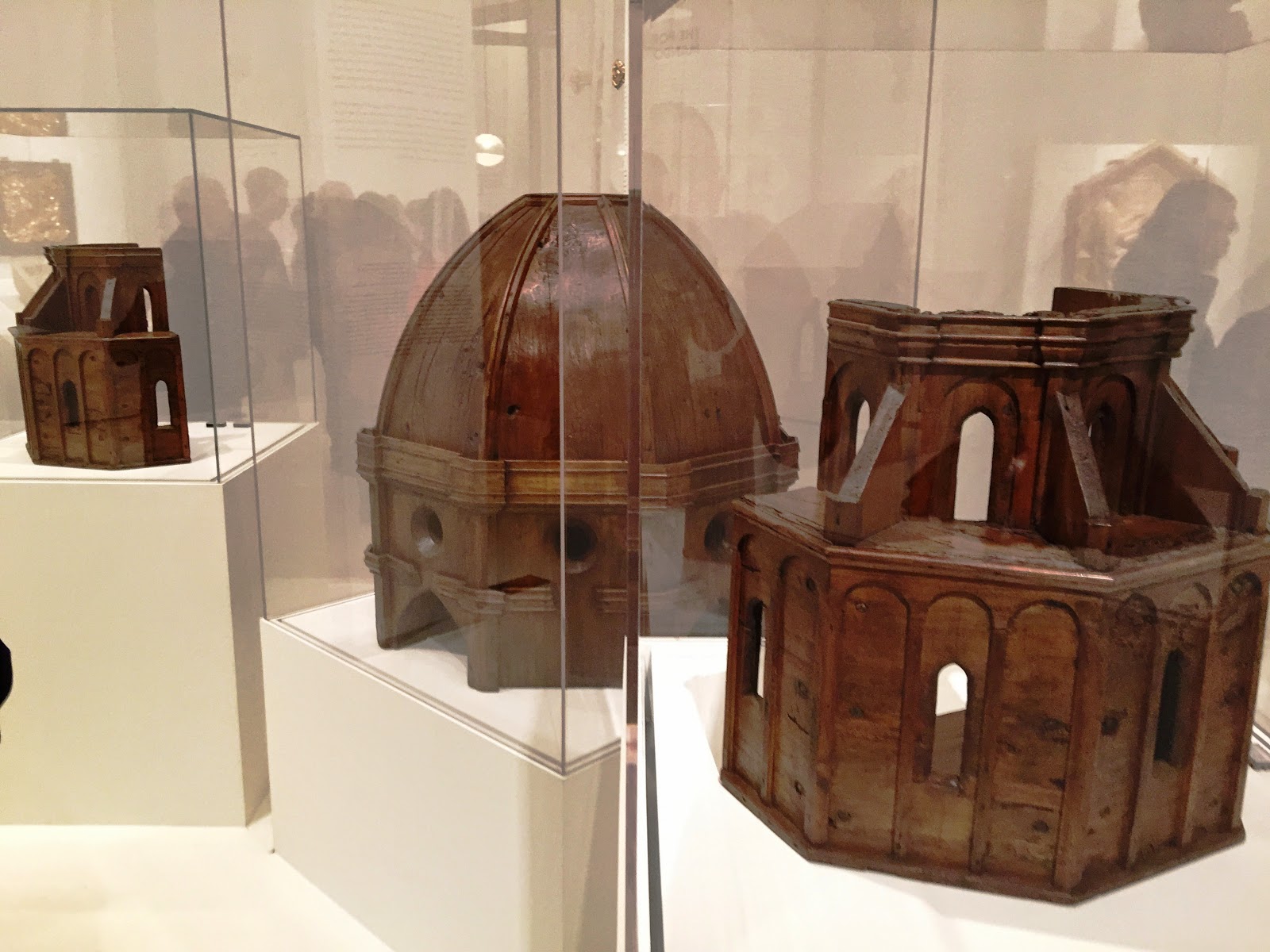
The wooden models for the Cathedral's dome (Il Duomo) created by Filippo Brunelleschi are miniatures of the gigantic dome he built over the Cathedral's crossing.  Brunelleschi won the commission for the dome in competition with Ghiberti.  After losing the 1425 competition for the Baptistry doors to Ghiberti, Brunelleschi had gone to Rome with his friend Donatello to study the architecture of the ancient city.  Inspired by the Pantheon in Rome, Brunelleschi devised an even larger dome for Florence.  It is an engineering marvel as well as an architectural triumph.
Models for the Cathedral dome by Filippo Brunelleschi, wood, circa 1418-1446.  Photo by Blomme-McClure
The exhibit, 'Sculpture in the Age of Donatello' will remain at the Museum of Biblical Art (on the northwest corner of Broadway & 61st Street) through June 14th.  I urge anyone interested in three-dimensional art to see it while it's here.  MoBiA is the only stop for this exhibition.  When the show closes all of the pieces in the exhibition will return to Florence to await installation in the renovated Museo dell'Opera del Duomo.  

See my blog post on our June, 2001 visit to the Museo dell'Opera del Duomo for more on the objects in this splendid museum:

http://zylopho.blogspot.com/2014/07/italian-trip-diary-day-7-florence-to.html

See my blog post on our 2001 visit to the Bargello Gallery in Florence to view additional works by Donatello:

http://zylopho.blogspot.com/2014/07/italian-trip-diary-day-6-florence.html

Sunday, June 15, 2014

Italian Trip Diary -- Day #4, Florence

Saturday, June 16, 2001, Florence:

We had an early (for us) breakfast at the hotel because we had 10:45 a.m. reservations at the Uffizi (Galleria degli Uffizi) that we had secured on the internet (http://www.uffizi.com/online-ticket-booking-uffizi-gallery.asp).  So after breakfast, we walked around the back of the Duomo
Campanile and South Facade of the Duomo, Florence, photo by Blomme-McClure
into the Piazza Signoria, past the Loggia di Lanzi with the famous Cellini bronze “Perseus with the Head of Medusa” 
'Perseus with the Head of Medusa' by Benvenuto Cellini in the Loggia di Lanzi, Florence,
photo by Blomme-McClure
and on to the Uffizi. There was a long line to get in, so we felt smug as we walked right up to the entrance with our internet receipt and started on a marvelous journey through the treasure house of mostly Tuscan art.  The early rooms feature powerful Italian Primitive paintings by Cimabue and Giotto.  These are followed by wonderful Bottecelli’s including the famous “Birth of Venus” and “Spring” – sensual overload!
'Birth of Venus' by Sandro Botticelli, Uffizi Gallery, Florence, photo from Uffizi.org

'Allegory of Spring' by Sandro Botticelli, Uffizi Gallery, Florence, photo from Uffizi.org

There is a natural break when you transfer from the east wing to the west wing through a corridor with windows looking out to the Ponte Vecchio crossing the Arno to the south
Ponte Vecchio viewed from windows of the Uffizi Gallery, Florence,
(the gallery directly under the red tiled roof allowed the Medici to go from the Uffizi to the Pitti Palace across the Arno without going outside), 

photo by Blomme-McClure
and on the opposite side down between the wings of the Uffizi to the copy of David in the Piazza della Signoria.
Palazzo Vecchio with dome of Duomo beyond from Uffizi Gallery, Florence,
photo by Blomme-McClure
We took advantage of this natural break to stop for lunch at the museum’s terrace cafĂ© on the roof of the Loggia di Lanzi with the tower of the Palazzo Vecchio rising to our right and the dome and campanile of the Duomo straight ahead.

After lunch we resumed with the galleries containing the Michelangelo “tondo” of the Holy Family and other great art.  
'Holy Family' by Michelangelo, Uffizi Gallery, Florence, photo from Uffizi.org

This wing seems disappointing after the extremely high standard set by the east wing galleries, but certainly not by world art standards.

Leaving the Uffizi dazed and confused by art overload, we walked out to the Piazza della Signoria for a gelato break.
Equestrian statue of Grand Duke Cosimo I di Medici by Giambologna in
Piazza della Signoria, Florence, photo by Blomme-McClure
Then it was on to the Duomo.  The nave of the Duomo is extremely plain and very big – just four huge gothic bays. The two transcepts are the same size and shape as the chancel creating a symmetrical cluster around the crossing.  It was begun in 1296 by Arnolfo di Cambio and completed by Filippo Brunelleschi's dome in 1436 -- one of the largest domes in the world.
Nave of the Duomo (looking east from West Doors), Florence, photo by Blomme-McClure
The Vasari frescoes of the 'Last Judgement' on the dome above the crossing are extraordinary.  It was in this 'Last Judgement' that we discovered that the figures descending to hell were much more interesting than those ascending to heaven – greater sense of movement, more nudity (especially male) and engaging in more imaginative (sinful) activities.  
'Last Judgement' frescoes begun by Giorgio Vasari in 1568 on dome of Duomo, Florence,
photo by Blomme-McClure
We could only imagine how these images would affect the people of the Middle Ages struggling with their own sins!

'Resurrection' by Luca della Robbia above north door of Sacristy, Duomo, Florence,
photo by Blomme-McClure
North Transcept of the Duomo, Florence, photo by Blomme-McClure
Our hotel was just a short walk from the Duomo, so we went back for a nap.  
Basilica of the Most Holy Annunciation on the northeast side of the Piazza della Santa Annuziata,
our hotel was on the nothwest side of the piazza, photo by Blomme-McClure
The entrance to our hotelLoggiato dei Serviti
Carl decided to go back and climb the campanile – from which he got some wonderful panoramic views of the city and the surrounding hills as well as fantastic close-ups of the dome, the Signoria and San Minianato al Monte.

In the evening we went to Enoteca Pinchiori (Via Ghibellina 87, 39 055 242777, www.enotecapinchiorri.it/), the best restaurant in Italy at that time, according to the Red Guide Michelin.  As we arrived we were fitted for jackets since we weren’t dressed “appropriately”.  Enoteca is a “wine bar” that serves wonderful food with grand serving flourishes – all of the entrees are placed in front of each guest at the table under large silver domes.  Suddenly enough staff members materialize at the table to uncover all of the dishes simultanesouly with a flourish.  The effect is both luxurious and intimidating.  Our meal unfurled at a leisurely pace and the food was delicious – as were the three types of wine that Carl ordered (and that we tasted).