Showing posts with label Ashly Isaacs. Show all posts

Friday, July 24, 2015

Ever More Ballet Quibbles and Bits . . .

Seeing Triple at SAB This Summer:

With much of the School of American Ballet's fifth floor studios a construction zone this summer, it's easy to think that you're seeing triple in the maze of plastic drop cloths and the cacophony of sledge hammers and nail guns.  You're not!
Marcos, Cesar and Angel Ramirez Castellano.  Photo by Ramon Espinosa for AP
I was doing double-takes as I encountered first one dark-haired, dark-eyed young man . . . then another . . . and another coming down the hall toward the back studios about 30 paces apart.  They're Angel, Cesar and Marcos Ramirez Castellano, 15-year-old identical triplets from Cuba who are attending SAB's Summer Session.  Here's a 2013 video profiling them that was produced by the BBC when they were just 13:

https://www.youtube.com/watch?v=ePjRF9oBhrw

You can think of their attendance at the five-week Summer Session as SAB's contribution to the recent thaw in U.S.-Cuban relations. 

SAB Founders Society Picnic:

Every summer, the School of American Ballet invites the members of its Founders Society -- a group of individuals who have made provisions for SAB in their estate plans -- to a 'picnic' followed by an opportunity to observe a Summer Session class.  

The 'picnic' has usually been held in the Student Lounge adjacent to the School's studios.  This summer the picnic -- a lovely buffet lunch of sandwiches, wraps, salads, cookies and fresh fruits (I missed the brownies this year) -- was held in rooms at the back of the Rose Building cafeteria because the areas around the student lounge on the 5th floor are under construction.  During the lunch, we heard from members of the School's Development Staff --  Cheryl Kohn, Chief Development Officer; Kristen Barrett, Director of Institutional Giving; and Giulia Gabrielli, Individual Giving Membership Coordinator -- about the renovation of the 5th floor and about various aspects of this year's Summer Session (including the Ramirez Castellano triplets).

Following the luncheon, Founders Society members were given a choice of watching Susan Pillare teach a girls toe class or Jock Soto teach the Intermediate Men.  We selected Jock's class.  There were 18 students in the class varying in age, height, ethnicity and ability.

While they were still at the barre, Jock taught them a complicated series of arm movements to accompany some fairly routine steps.  Then he divided them into two teams of nine and asked each team to select one representative to demonstrate the combination, and another to 'judge' the other team's choice in a competition.  Each judge was then asked for the number of 'errors' committed by the other team's man.  Jock took the two numbers and combined them into the number of push-ups that everyone had to do.

Over the course of the hour and a quarter class, the observers get a sense of which students have both the ability and drive to continue at SAB in the Winter Term or perhaps return for another Summer Term in 2016.  I had my eye on four out of the 18 that I'd like to see back at SAB again -- two that seem to be quite young and still quite short and two that seem more mature and more developed.  I felt that the other 14 lacked either the focus or the natural ability to succeed at SAB in the future.

Three Promotions at New York City Ballet:

Anyone who's been following this blog knows that I enthusiastically favor the three promotions that New York City Ballet announced at the end of their Spring season on June 7th:  Anthony Huxley and Lauren Lovette to principal dancers and Ashly Isaacs to soloist.


Anthony Huxley blossomed this spring from his naturally introspective elegance into a more expansive dancer in roles like James in Bournonville's 'La Sylphide' and Oberon in Balanchine's 'Midsummer Night's Dream'.  He still needs to work on his partnering skills, but his technical finesse and newly assured stage presence make him a valued addition to the top of the Company's roster.

Lauren Lovette and Anthony Huxley in Balanchine's 'Raymonda Variations'.
Photo by Andrea Mohin for NY Times

Lauren Lovette is one of the Company's most sunny and vivacious ballerinas -- plus she is drop dead gorgeous.  Since joining the Company as an apprentice in 2009 Lauren has essayed a wide variety of iconic roles in the NYCB repertory and brings a special sparkle to everything she dances.  This spring she was a spritely Sylph in Peter Martins' staging of Bournonville's 'La Sylphide'.

Ashly Isaacs struggled with injuries during her transition from SAB to NYCB -- she accepted SAB's Mae L. Wien Award in a cast and on crutches at the 2009 Workshop Gala -- but has since blossomed into an extraordinary dancer -- fleet, daring and musically adventurous.  Among her recent roles have been Dewdrop in 'The Nutcracker', Hippolyta in 'Midsummer Night's Dream' and the pas de deux from Bournonville's 'Flower Festival at Genzano'.
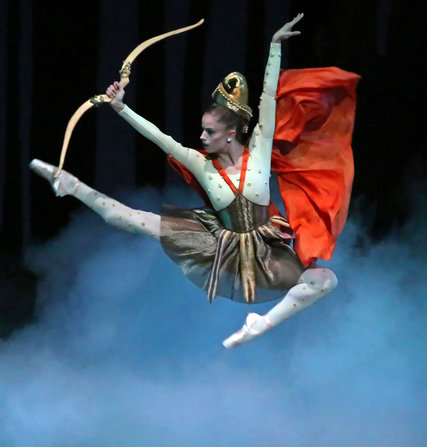

Ashly Isaacs as Hippolyta in Balanchine's 'A Midsummer Night's Dream'.
Photo by Andrea Mohin for the NY Times
Congratulations to all three dancers on these promotions which recognize both their achievements and their potential.

Sunday, May 10, 2015

NYC Ballet Matinee Performance, Sunday, May 3rd . . .

SUNDAY MATINEE, MAY 3, 3:00 PM [Conductor: Otranto]

APOLLO: *Danchig-Waring, T. Peck, *Isaacs, Lovette

AGON: Kowroski, Ramasar, Veyette, King, Hod (replaces Smith),Krohn, Alberda, Applebaum
DUO CONCERTANT: Bouder, *Huxley [Solo Piano: McDill; Solo Violin: Delmoni]
SYMPHONY IN 3 MOVEMENTS: Hyltin, Pereira, Lowery, Stanley, Ulbricht, Scorda

* First Time in Role on Wednesday, April 29th


This program from the Balanchine Black & White Festival was subtitled 'Stravinsky/Balanchine'.  It included four works Balanchine created to Stravinsky's music spanning the years from 1928 through 1972 -- all danced in (mostly black and white) leotards.

First, a word about the excellent playing of the New York City Ballet Orchestra under the conductor Clotilde Otranto on Sunday. These Stravinsky scores are this orchestra's birthright.  They have been playing them for many, many years.  Under Maestra Otranto's enthusiastic baton they sounded as fresh and clean as when they were first encountered.


Apollo

When Balanchine created 'Apollo' (aka 'Apollon Musagete') for Diaghilev's Ballets Russes in 1928 it featured elaborate costumes and sets by the French painter Andre Bauchant.  A year later there were new costumes by Coco Chanel.  By the time he staged it for NYC Ballet in 1951 he had begun a process of stripping away the sets, the costumes and the scenario.  By the 1957 staging the costumes by Karinska were extremely simple leotards -- with brief skirts for the three women.  When he restaged it for Mikhail Baryshnikov in 1979 Balanchine eliminated the prologue -- which portrayed the birth and infancy of Apollo -- and the spare, steep staircase at the back representing Mount Parnassus -- which Apollo and the three muses climbed in the finale.  (I seem to recall that this version was also used by Rudolf Nureyev on his tour programs starting as early as 1967.)

On Sunday, two of the dancers -- Adrian Danchig-Waring as Apollo and Ashly Isaacs as Polyhymnia -- had just debuted in their roles the previous Wednesday.  Danchig-Waring's Apollo is very much a work in process.  He hasn't created a coherent through-line that pulls the individual dance scenes together to portray the young god's development from adolescence into manhood.  On a technical level he doesn't always place the iconic images correctly on the stage and he doesn't accurately align them in relation to the proscenium and the audience -- usually due to an under or over rotation of a turn.

Adrian Danchig-Waring as Apollo in Balanchine's ballet.  Photo by Paul Kolnik for NYC Ballet
Ashly Isaacs' Polyhymnia, muse of mime, was danced with enormous confidence and brio.  Isaacs is still in the corps, but she is this year's Janice Levin Dancer honoree.  It is clear that she has a brilliant future.  Isaacs filled the stage with big, bold, joyous dancing that plays with and against Stravinsky's music.
Tiler Peck as Terpsichore, Ashly Isaacs as Polyhymnia, Lauren Lovette as Calliope and Adrian Danchig-Waring
as Apollo in Balanchine's 'Apollo'.  Photo by Paul Kolnik for NYC Ballet

Tiler Peck's Terpsichore, muse of dance, seemed bored, petulant and lacked rapport with Danchig-Waring's Apollo.  Lauren Lovette's Calliope is not one of her best role, failing to catch the muse of poetry's sparkle and contorting her beautiful face with ugly grimaces while 'reciting' her poetry.  Perhaps Ms. Peck and Ms. Lovette are letting their off-stage affection for different Apollos (Robert Fairchild and Chase Finlay respectively) distort their performances in this cast.
Final image of the current 'Apollo' with Tiler Peck & Adrian Danchig-Waring.   Note the awkward placement of Adrian's left foot and the lack of turnout in the left leg.  Photo by Paul Kolnik for NYC Ballet

The final image of the 1979 version of 'Apollo' that Balanchine left us is the sunburst of the sun god with the legs of the three muses arrayed in arabesque around him -- what the late critic Robert Garris referred to as 'the Apollo-logo'.  'Apollo' remains an essential work in the Balanchine cannon and we can only hope that this cast will coalesce in future performances.

Agon
Balanchine commissioned Stravinsky to compose the score for 'Agon', which premiered in 1957.  Stravinsky modelled the individual sections of the score on dances from a mid-17th century French dance manual.  Balanchine uses the first three sections: Pas de Quatre (Four Boys); Double Pas de Quatre (Eight Girls); and Triple Pas de Quatre (Eight Girls, Four Boys) to introduce his dancers.  I'm always amazed and amused by how Balanchine moves the 12 dancers in the triple pas like chess pieces between the three groups of four dancers to form mixed-sex foursomes before aligning them back into the three same-sex foursomes.

The company fielded a perfect cast for Sunday's matinee of 'Agon'.

In the first Pas de Trois, Andrew Veyette (with Lauren King and Ashley Hod) danced with polished athleticism.
Andrew Veyette dancing the 'Sarabande' from Balanchine's 'Agon'.  Photo by Paul Kolnik for NYC Ballet
 In the second Pas de Trois, Rebecca Krohn (with Devin Alberda and Daniel Applebaum) infused the 'Bransle Gay' with sensuous angularity and handled being thrown from one man to the other with cool aplomb.

Maria Kowroski used her extraordinary extension and flexibility to clearly etch the extremes of the Pas de Deux.  More importantly, she interacted with Amar Ramasar -- making him more than a stalwart and steady partner by acknowledging and reacting to his warmth and charisma.  They are great in this iconic pas de deux.

Amar Ramasar and Maria Kowroski in the 'Agon' pas de deux.  Photo by Paul Kolnik for NYC Ballet
In Part III the Danse des Quatre Duos (4 twos) morphs into the Danse des Quatre Trois (four threes) and then the four boys repeat the opening steps in reverse in the Coda -- followed by an ovation for a truly extraordinary performance.

Duo Concertant

I'm not really sure why 'Duo Concertant' is so often in the repertory.  It is a piece for a violinist (Arturo Delmoni), a pianist (Nancy McDill), and two dancers (Ashley Bouder and Anthony Huxley) that was created for the 1972 Stravinsky Festival (originally with Kay Mazzo and Peter Martins).  Over the years it has been danced by many great dancers -- Peter Boal, Mikhail Baryshnikov and Nikolaj Hubbe all danced it with Yvonne Borree.

The dancers spend about a third of the piece simply listening to the two musicians play Stravinsky's music -- 'Duo Concertant' from 1934.  Even the greatest dancers have difficulty feigning interest in the music while standing still.  When they do dance it is in snippets -- often with folk dance overtones.  It ends with a maudlin section on a darkened stage where the dancers' hands and heads are caught in a single follow spot as they play out an intensely romantic interlude.

Anthony Huxley and Ashley Bouder in 'Duo Concertant'.  Photo by Paul Kolnik for NYC Ballet
Neither Ashley Bouder nor Anthony Huxley (who debuted in the role the previous Wednesday) are ideally cast in this work -- Bouder is too extroverted, Huxley too introverted.  Neither is a very good listener when they just stand behind the piano.  I'm sure that we will see 'Duo Concertant' again, but I don't need to -- it serves as short (and boring) program filler and in the case of this program it suffers in comparison to the masterpieces around it.

Symphony in Three Movements

Balanchine also created 'Symphony in Three Movements' for the 1972 Stravinsky Festival to the symphony Stravinsky composed between 1942 and 1944.  It uses a large cast -- three principal couples, five demi-soloists couples, and a 16 woman corps.  In the outer two movements they are all deployed in complex patterns that challenge the eye with countervailing rhythms and movements.
The opening line of 16 corps women in 'Symphony in Three Movements'.  Photo by Paul Kolnik for NYC Ballet
The curtain opens on a diagonal line of the corps women -- all in white leotards with ponytails.  It seems like a neo-classical version of a classical 'vision' scene -- the 'Kingdom of the Shades' from 'La Bayadere' or the second act of 'Giselle' perhaps.  But as soon as they begin to move and as the principals and demi-soloists are introduced you realize that this is an edgy, jagged modern work -- 'Shades' on steroids. 
Taylor Stanley and Sterling Hyltin in the central pas de deux of 'Symphony in Three Movements'.
Photo by Paul Kolnik for NYC Ballet
The central movement is a quiet, slightly exotic pas de deux for one of the principal couples -- on Sunday, Sterling Hyltin and Taylor Stanley.  Hyltin and Stanley seem nicely matched.  Their 'oriental' arm ripples seemed a bit extreme (like some slightly crazed Odettes), but they created an oasis of calm between the frantic energy of the first and third movements.

In the closing moments of the third movement Balanchine clears the stage for the principal and demi-soloist couples by having the corps girls stand half covered behind the wings.  As the momentum builds they step out of the wings and back into them -- creating a dynamic frame for the dancing at center stage.  Suddenly all of the cast is on stage in patterns that reminds me of the crews that guide planes onto the deck of an aircraft carrier.

Full cast in the finale of 'Symphony in Three Movements'.  Photo by Paul Kolnik for NYC Ballet
Sunday's performance of this iconic Balanchine work seemed ragged and under-rehearsed.  Lines that should have been straight weren't; patterns that should have been clearly aligned weren't. This detracted from the complete joy that this work can provide.