Showing posts with label Stravinsky. Show all posts

Sunday, May 10, 2015

NYC Ballet Matinee Performance, Sunday, May 3rd . . .

SUNDAY MATINEE, MAY 3, 3:00 PM [Conductor: Otranto]

APOLLO: *Danchig-Waring, T. Peck, *Isaacs, Lovette

AGON: Kowroski, Ramasar, Veyette, King, Hod (replaces Smith),Krohn, Alberda, Applebaum
DUO CONCERTANT: Bouder, *Huxley [Solo Piano: McDill; Solo Violin: Delmoni]
SYMPHONY IN 3 MOVEMENTS: Hyltin, Pereira, Lowery, Stanley, Ulbricht, Scorda

* First Time in Role on Wednesday, April 29th


This program from the Balanchine Black & White Festival was subtitled 'Stravinsky/Balanchine'.  It included four works Balanchine created to Stravinsky's music spanning the years from 1928 through 1972 -- all danced in (mostly black and white) leotards.

First, a word about the excellent playing of the New York City Ballet Orchestra under the conductor Clotilde Otranto on Sunday. These Stravinsky scores are this orchestra's birthright.  They have been playing them for many, many years.  Under Maestra Otranto's enthusiastic baton they sounded as fresh and clean as when they were first encountered.


Apollo

When Balanchine created 'Apollo' (aka 'Apollon Musagete') for Diaghilev's Ballets Russes in 1928 it featured elaborate costumes and sets by the French painter Andre Bauchant.  A year later there were new costumes by Coco Chanel.  By the time he staged it for NYC Ballet in 1951 he had begun a process of stripping away the sets, the costumes and the scenario.  By the 1957 staging the costumes by Karinska were extremely simple leotards -- with brief skirts for the three women.  When he restaged it for Mikhail Baryshnikov in 1979 Balanchine eliminated the prologue -- which portrayed the birth and infancy of Apollo -- and the spare, steep staircase at the back representing Mount Parnassus -- which Apollo and the three muses climbed in the finale.  (I seem to recall that this version was also used by Rudolf Nureyev on his tour programs starting as early as 1967.)

On Sunday, two of the dancers -- Adrian Danchig-Waring as Apollo and Ashly Isaacs as Polyhymnia -- had just debuted in their roles the previous Wednesday.  Danchig-Waring's Apollo is very much a work in process.  He hasn't created a coherent through-line that pulls the individual dance scenes together to portray the young god's development from adolescence into manhood.  On a technical level he doesn't always place the iconic images correctly on the stage and he doesn't accurately align them in relation to the proscenium and the audience -- usually due to an under or over rotation of a turn.

Adrian Danchig-Waring as Apollo in Balanchine's ballet.  Photo by Paul Kolnik for NYC Ballet
Ashly Isaacs' Polyhymnia, muse of mime, was danced with enormous confidence and brio.  Isaacs is still in the corps, but she is this year's Janice Levin Dancer honoree.  It is clear that she has a brilliant future.  Isaacs filled the stage with big, bold, joyous dancing that plays with and against Stravinsky's music.
Tiler Peck as Terpsichore, Ashly Isaacs as Polyhymnia, Lauren Lovette as Calliope and Adrian Danchig-Waring
as Apollo in Balanchine's 'Apollo'.  Photo by Paul Kolnik for NYC Ballet

Tiler Peck's Terpsichore, muse of dance, seemed bored, petulant and lacked rapport with Danchig-Waring's Apollo.  Lauren Lovette's Calliope is not one of her best role, failing to catch the muse of poetry's sparkle and contorting her beautiful face with ugly grimaces while 'reciting' her poetry.  Perhaps Ms. Peck and Ms. Lovette are letting their off-stage affection for different Apollos (Robert Fairchild and Chase Finlay respectively) distort their performances in this cast.
Final image of the current 'Apollo' with Tiler Peck & Adrian Danchig-Waring.   Note the awkward placement of Adrian's left foot and the lack of turnout in the left leg.  Photo by Paul Kolnik for NYC Ballet

The final image of the 1979 version of 'Apollo' that Balanchine left us is the sunburst of the sun god with the legs of the three muses arrayed in arabesque around him -- what the late critic Robert Garris referred to as 'the Apollo-logo'.  'Apollo' remains an essential work in the Balanchine cannon and we can only hope that this cast will coalesce in future performances.

Agon
Balanchine commissioned Stravinsky to compose the score for 'Agon', which premiered in 1957.  Stravinsky modelled the individual sections of the score on dances from a mid-17th century French dance manual.  Balanchine uses the first three sections: Pas de Quatre (Four Boys); Double Pas de Quatre (Eight Girls); and Triple Pas de Quatre (Eight Girls, Four Boys) to introduce his dancers.  I'm always amazed and amused by how Balanchine moves the 12 dancers in the triple pas like chess pieces between the three groups of four dancers to form mixed-sex foursomes before aligning them back into the three same-sex foursomes.

The company fielded a perfect cast for Sunday's matinee of 'Agon'.

In the first Pas de Trois, Andrew Veyette (with Lauren King and Ashley Hod) danced with polished athleticism.
Andrew Veyette dancing the 'Sarabande' from Balanchine's 'Agon'.  Photo by Paul Kolnik for NYC Ballet
 In the second Pas de Trois, Rebecca Krohn (with Devin Alberda and Daniel Applebaum) infused the 'Bransle Gay' with sensuous angularity and handled being thrown from one man to the other with cool aplomb.

Maria Kowroski used her extraordinary extension and flexibility to clearly etch the extremes of the Pas de Deux.  More importantly, she interacted with Amar Ramasar -- making him more than a stalwart and steady partner by acknowledging and reacting to his warmth and charisma.  They are great in this iconic pas de deux.

Amar Ramasar and Maria Kowroski in the 'Agon' pas de deux.  Photo by Paul Kolnik for NYC Ballet
In Part III the Danse des Quatre Duos (4 twos) morphs into the Danse des Quatre Trois (four threes) and then the four boys repeat the opening steps in reverse in the Coda -- followed by an ovation for a truly extraordinary performance.

Duo Concertant

I'm not really sure why 'Duo Concertant' is so often in the repertory.  It is a piece for a violinist (Arturo Delmoni), a pianist (Nancy McDill), and two dancers (Ashley Bouder and Anthony Huxley) that was created for the 1972 Stravinsky Festival (originally with Kay Mazzo and Peter Martins).  Over the years it has been danced by many great dancers -- Peter Boal, Mikhail Baryshnikov and Nikolaj Hubbe all danced it with Yvonne Borree.

The dancers spend about a third of the piece simply listening to the two musicians play Stravinsky's music -- 'Duo Concertant' from 1934.  Even the greatest dancers have difficulty feigning interest in the music while standing still.  When they do dance it is in snippets -- often with folk dance overtones.  It ends with a maudlin section on a darkened stage where the dancers' hands and heads are caught in a single follow spot as they play out an intensely romantic interlude.

Anthony Huxley and Ashley Bouder in 'Duo Concertant'.  Photo by Paul Kolnik for NYC Ballet
Neither Ashley Bouder nor Anthony Huxley (who debuted in the role the previous Wednesday) are ideally cast in this work -- Bouder is too extroverted, Huxley too introverted.  Neither is a very good listener when they just stand behind the piano.  I'm sure that we will see 'Duo Concertant' again, but I don't need to -- it serves as short (and boring) program filler and in the case of this program it suffers in comparison to the masterpieces around it.

Symphony in Three Movements

Balanchine also created 'Symphony in Three Movements' for the 1972 Stravinsky Festival to the symphony Stravinsky composed between 1942 and 1944.  It uses a large cast -- three principal couples, five demi-soloists couples, and a 16 woman corps.  In the outer two movements they are all deployed in complex patterns that challenge the eye with countervailing rhythms and movements.
The opening line of 16 corps women in 'Symphony in Three Movements'.  Photo by Paul Kolnik for NYC Ballet
The curtain opens on a diagonal line of the corps women -- all in white leotards with ponytails.  It seems like a neo-classical version of a classical 'vision' scene -- the 'Kingdom of the Shades' from 'La Bayadere' or the second act of 'Giselle' perhaps.  But as soon as they begin to move and as the principals and demi-soloists are introduced you realize that this is an edgy, jagged modern work -- 'Shades' on steroids. 
Taylor Stanley and Sterling Hyltin in the central pas de deux of 'Symphony in Three Movements'.
Photo by Paul Kolnik for NYC Ballet
The central movement is a quiet, slightly exotic pas de deux for one of the principal couples -- on Sunday, Sterling Hyltin and Taylor Stanley.  Hyltin and Stanley seem nicely matched.  Their 'oriental' arm ripples seemed a bit extreme (like some slightly crazed Odettes), but they created an oasis of calm between the frantic energy of the first and third movements.

In the closing moments of the third movement Balanchine clears the stage for the principal and demi-soloist couples by having the corps girls stand half covered behind the wings.  As the momentum builds they step out of the wings and back into them -- creating a dynamic frame for the dancing at center stage.  Suddenly all of the cast is on stage in patterns that reminds me of the crews that guide planes onto the deck of an aircraft carrier.

Full cast in the finale of 'Symphony in Three Movements'.  Photo by Paul Kolnik for NYC Ballet
Sunday's performance of this iconic Balanchine work seemed ragged and under-rehearsed.  Lines that should have been straight weren't; patterns that should have been clearly aligned weren't. This detracted from the complete joy that this work can provide.

Monday, October 13, 2014

New York City Ballet -- Sunday, October 5, 2014

On Sunday afternoon, October 5th, we saw New York City Ballet in an all Balanchine program.  It was anything but austere neo-classical Balanchine though.

SUNDAY MATINEE, OCTOBER 5, 3:00 PM
[Conductor: Capps]
DONIZETTI VARIATIONS: T. Peck, De Luz
LA SONNAMBULA: Whelan, R. Fairchild, Arthurs, Sanz, Adams, Villwock, Laurent, Ippolito, King, Carmena, Schumacher
FIREBIRD: Bouder, J. Peck, Muller. Catazaro

Tiler Peck airborne in Balanchine's  'Donizetti Variations'.  Photo by Andrea Mohin for NY Times
The opening work was 'Donizetti Variations' from 1960, set to the effervescent ballet music from Gaetano Donizetti's 'Don Sebastian'.  Unfortunately the dancing didn't consistently project the buoyancy of Mr. B's choreography.  Tiler Peck and Joaquin De Luz are not ideally paired as the principal couple -- Joaquin is too short and too forceful, while Tiler is a bit too reticent and refined, neither projecting quite enough of the work's bubbly exuberance.  The corps dancing lacked the crispness that makes their sections so witty when they are danced with confidence and brio.

'La Sonnambula' (called 'Night Shadow' when it was first seen in 1946 at the Ballet Russe de Monte Carlo) uses music of Vittorio Rieti based on themes from the operas of Vincenzo Bellini.  It is set at a masked ball given by the Baron in the courtyard of his castle.  An arch at the back of the stage is bridged by a second floor gallery leading to a circular tower stage left with a starry sky beyond.

After an initial dance lead by the Baron (Aaron Sanz, who made his debut in the role the prior day) and the Coquette (Faye Arthurs), the Poet (Robert Fairchild) appears. The Poet and the Coquette seem to know each other, but the Baron stiffly introduces them anyway and then stalks off.  There are divertissements for the guests:  a Pastorale for two couples (Sara Adams, Sarah Villwock, Ralph Ippolito and Austin Laurent); a pas de deux for an Oriental couple (Lauren King and Antonio Carmena, both in splendid form); and a Harlequin (Troy Schumacher).  During the divertissements, the Coquette and the Poet sit on a bench under the arch where they flirt, while the guests gossip about them.

After the entertainment, the Coquette and the Poet lead the guests in a dance which involves a great 'ice capades' circle and some intertwining chains.  As the guests promenade off stage, the Baron suddenly appears and grabs the Coquette away, leaving the Poet alone on stage.

A light appears in the gallery window stage right and slowly crosses the gallery and descends the tower stairs.  The Sleepwalker (Wendy Whelan) enters from the tower door carrying a candle while wafting about the stage in ethereal bourrees.  
Wendy Whelan as the Sleepwalker in Balanchine's 'La Sonnambula'.  Photo by Paul Kolnik for NYC Ballet
The Poet is enchanted but the Sleepwalker continues on in her trance, eluding him and his efforts to distract and awaken her.  They engage in a 'pas de deux' -- the Poet only touches the candle, but never the Sleepwalker.  The Coquette emerges and observes the Poet following the Sleepwalker into the tower.  Enraged, she rushes off to tell the Baron.  


The guests reappear for another dance lead by the Baron and the Coquette. During the dance she tells the Baron that the Poet has followed the Sleepwalker into the tower.  The Baron draws a dagger and rushes into the tower.  The Poet staggers out clutching his chest and collapses center stage.  The Sleepwalker reappears, still in a trance but somehow aware that the Poet lies dead at her feet.  The four divertissement men lift his lifeless body and place it in the Sleepwalker's arms.  She exits into the tower carrying the dead Poet.

Rob is the lucky Poet torn between Faye's gorgeous, worldly Coquette and Wendy's ethereal, other-worldly Sleepwalker.  As an artist, of course he chooses the elusive muse over the glamorous but shallow courtesan.  This role is one of Wendy's late-career triumphs and in Rob Fairchild she has found yet another ardent partner.
Wendy Whelan and Rob Fairchild during curtain calls for 'La Sonnambula'.
Photo by Edward G. Becker for Ballet Focus
The final ballet of the afternoon was 'Firebird' to the familiar Stravinsky orchestral suite with costumes and scenery based on the work of Marc Chagall.  Balanchine created the ballet in 1949 for Maria Tallchief, his wife and muse at the time.  It created a sensation and catapulted Tallchief into the role of prima ballerina of the year-old New York City Ballet.

Ashley Bounder in the title role of George Balanchine's 'Firebird'.  Photo by Paul Kolnik for NYC Ballet
    
Ashley Bouder's interpretation of the Firebird is justly renowned.  Legend has it that she learned the role from Sean Lavery in something like 20 minutes in 2000, when she was called upon as a last minute replacement.  Ashley has since polished it to a breath-taking gleam.  Her glamorous entrance, her avian pas de deux with Justin Peck (as the oafish Prince Ivan), her calmly skimming berceuse all use Ashley's technical arsenal to magical effect.  The surrounding ballet goes on too long and relies on Stravinsky's music and Chagall's decor to carry the tale and provide both platform and frame for Ashley's superb dancing in the title role.

Thursday, May 29, 2014

Jonathan Stafford Farewell Performance in 'Jewels'

SUNDAY MATINEE, MAY 25, 3:00 PM

JEWELS

JONATHAN STAFFORD FAREWELL PERFORMANCE

(Guest Conductor: Kessels)

EMERALDS: Bouder, Ramasar, A. Stafford, J. Stafford, Pereira, Carmena, Laracey 


RUBIES: Hyltin, Veyette, Reichlen [Solo Pianist: Grant] 

DIAMONDS: Mearns, J. Stafford 

We attended the first performance of 'Jewels' in April, 1967.  The performances of its original cast are the after-images against which I judge all of the performances that we've seen in the intervening 47 years -- not only by NYC Ballet, but also by Paris Opera Ballet, San Francisco Ballet, the Maryinsky Ballet, Miami City Ballet, Pennsylvania Ballet.
Balanchine with his 'Jewels' ballerinas: (clockwise from lower left) Suzanne Farrell (Diamonds);
Mimi Paul & Violette Verdy (Emeralds); and Patricia McBride (Rubies).

McBride's puffy ruffled skirt was jettisoned after the initial performances.
In fact, we also saw Sara Mearns and Jonathan Stafford make their debuts in 'Diamonds' in 2008.  This past January at a NYC Ballet seminar, we heard the four retiring principals (Ringer, Taylor, Marcovici, and Stafford) talk about their careers and their future plans.  The moderator, Tyler Angle, asked them each to pick a word about their career and explain it.  Jon chose the word 'proud' and explained how proud he was when he and Sara finished their joint debut in 'Diamonds' after working so hard to realize it.  I remember noting at the time that they looked thrilled, even triumphant, at having scaled this particular peak of the Balanchine repertory together.
Jonathan Stafford and Sara Mearns in Balanchine's 'Diamonds', 
(NYC Ballet has used this dramatic photo by Paul Kolnik in their advertising this Spring)
Due to debilitating injuries, Jon Stafford has had a rather stop-and-go performing career at NYCB.  He received his early training at Marcia Dale Weary's Central Pennsylvania Youth Ballet, then came to the School of American Ballet in 1997.  He was named an apprentice at NYCB in October, 1998 and joined the company's corps de ballet in February, 1999; advanced to soloist in March, 2006, and to principal in May, 2007.   Jon began teaching at SAB in 2006.  He now teaches intermediate and advanced men's classes and beginning adagio classes when his performing schedule permits.  Upon his retirement from performing, Jon will become a ballet master at the company and continue to be on the SAB faculty.
  
Jon is a tall, elegant dancer and an attentive partner.  His stage presence is somewhat stiff and formal, often lacking fluency and personal charisma, but Jon can be close to ideal in certain Balanchine cavalier roles.  His first important principal role was as the 'walking' cavalier in 'Emeralds' and one of his outstanding personal successes was in 'Diamonds' with Sara Mearns.

On Sunday afternoon, Jon danced the 'walking' cavalier (created for Francisco Moncion) in 'Emeralds' with his younger sister, Abi (in the role created for Mimi Paul).  Although they looked very comfortable dancing together they have only rarely been paired at NYC Ballet.  For me, some of their steps looked too robotic, lacking the subtle interior pulse that the best performances of these roles convey and that is clearly heard in Faure's hushed, almost mystical music.
Jonathan and Abi Stafford in 'Emeralds', photo by  Julieta Cervantes for NY Times
Ashley Bouder and Amar Ramasar danced the 'Emeralds' roles created for Violette Verdy and Conrad Ludlow.  Both Ashley and Amar successfully tamed their more flamboyant instincts and danced their parts with sensitivity and nuance.  Ashley used her arms and hands to project the depth, mystery and musicality with which Verdy had imbued the role.  Amar was an attentive partner, but also a musically sensitive soloist.  He grins a bit too much when the music is livelier, which dissipates the overall solemnity that should permeates the piece. 

Ashley Laracey, Erica Pereira and Antonio Carmena danced the pas de trois (created for Suki Schorer, Sara Leland and John Prinz) with a nice airiness.  Antonio is a bit too solid to fit my ideal (Prinz was a tall, slender dancer), but he does have the lightness and precisely etched technique required.
Erica Pereira, Antonio Carmena, and Ashley Laracey in the 'Emeralds' pas de trois,
 photo by Andrea Mohin for the NY Times
The music for 'Emeralds' is from Gabriel Faure's incidental music for 'Pelleas et Melisande' and 'Shylock'. In 1976 Balanchine added an additional pas de deux (to the 'Nocturne' from 'Shylock') and the final pas de sept (to 'La Mort de Melisande' from 'Pelleas et Melisande') to the original choreography. In some performances the intricate and stately finale can seem anticlimactic, but on Sunday it was spell-binding -- beautifully danced by all seven dancers while the audience seemed to collectively hold its breath.
A recent pas de sept cast including (front) Ashley Bouder, Jared Angle, Jon Stafford, Sara Mearns,
(back) Ashley Laracey, Antonio Carmena, Erica Pereira, photo by Andrea Mohin for the NY Times
It's interesting to note that six of the ten women in the 'Emeralds' corps are apprentices from the School of American Ballet.  They looked lovely and danced the simple corps passages with novice solemnity and unity. 


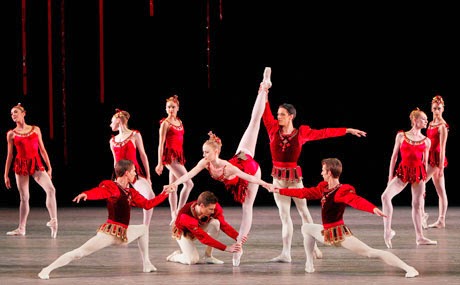
On Sunday, Sterling Hyltin, Andrew Veyette, and Teresa Reichlen danced the roles created by Patricia McBride, Edward Villella, and Patricia Neary in 'Rubies'.  The music for 'Rubies' is Stravinsky's 'Capriccio for Piano and Orchestra' with Cameron Grant as the piano soloist.  It is one of Stravinsky's jazziest and most approachable scores and inspired Balanchine to choreograph a lively 'American' piece filled with his version of bathing beauties, pin-up girls and jocks.

At this point, Tess Reichlen virtually owns the role created by Patricia Neary as the tall, enigmatic siren.  Her technical control of the difficult balances, soaring jetes and assorted exotic moves is astonishing and she dares to be witty, flirty, sensuous and aloof.
Teresa Reichlen with corps women in 'Rubies', photo by Paul Kolnik for NYC Ballet
(I'd swear that this was Photo-Shopped, if we hadn't just seen Tess do it live)
Hyltin and Veyette are less persuasive in the McBride and Villella roles.  Sterling's technique has improved tremendously since she first burst on to our radar as Juliet in Peter Martins' 'Romeo+Juliet', but McBride made this role more angular and spiky than Sterling manages.  No one any longer bends her knee slightly the way McBride did when she swung her leg forward with knee nearly touching forehead and then back so toe nearly touched the back of her head -- which always struck me as one of the role's signatures -- or crumples rag-doll limp into her partners arms the way McBride did.  Sterling performs the role like a slightly inebriated southern sorority girl, never achieving McBride's mix of control and abandon.
Andrew Veyette and Sterling Hyltin in 'Rubies', photo by Paul Kolnik for NYC Ballet
Like Villella, Veyette is a jock.  Balanchine made this role a slightly tongue-in-cheek tribute to Villella's prowess as a college baseball player and championship boxer.  Veyette came to ballet via gymnastics and his dancing is always athletic and usually vital.  On Sunday though, he seemed a little off his game and slightly preoccupied -- not fully invested in this role that can seem such a delightful romp with jogging, mimed rope skipping and chases by the four corps men.


Teresa Reichlen with corps (including Messrs. Schumacher, Villalobos and Laurent) in 'Rubies',
photo by Paul Kolnik for NYC Ballet

The work of the four corps men (Ippolito, Laurent, Schumacher, and Villalobos) was vibrant and joyous throughout.  Their interaction with the disdainful Reichlen was especially fun to watch.

Balanchine set 'Diamonds' to the last four movements of Tschaikovsky's 'Symphony #3 in D Major (he deemed the first movement 'undanceable').  On Sunday afternoon, the fourth movement (Scherzo: allegro vivo) -- with its swirling bravura variations for the lead couple and eight demi-soloists -- was also omitted, probably in deference to Jon Stafford's having earlier danced a leading role in 'Emeralds' as well.  I believe that there are some previous precedenst for eliminating or truncating this section. 

'Diamonds' was Balanchine's tribute to the Imperial Russian ballet of his youth.  The ballet's first movement (Alla tedesca: allegro moderato e semplice) for 12 corps women and two demi-soloists is filled with diamond patterns and often lacks a sense of urgency or purpose.  The two demi-soloist women drift on and off stage, while the corps women form various pretty configurations to a gentle waltz tempo.  Basically, it feels like the warm-up to the main event.  

The principal couple have an extended pas de deux (Andante eligiaco) which makes allusions to the encounter between Odette and Prince Siegfried in the second act of 'Swan Lake', the vision scene in 'Sleeping Beauty', and even moments in 'Raymonda' -- all works that Balanchine knew from St. Petersburg.  It was created for Suzanne Farrell and Jacques d'Amboise, although it is more closely associated with Farrell and Peter Martins.  Martins began dancing with NYC Ballet as a guest artist in 1967 and became a principal in 1970.  One critic suggested that d'Amboise presented Farrell like a proud father at his daughter's debut, while Martins treated her as a consort fit for a royal prince.


Peter Martins and Suzanne Farrell in 'Diamonds', photo by Paul Kolnik for NYC Ballet
Jon Stafford presented Sara Mearns on Sunday afternoon with both pride and deference.  As Balanchine intended this adagio is all about the ballerina (Farrell, the 'elusive muse') and Sara looks splendid with Jon's support and guidance.  Jon seemed appropriately enthralled, dropping to one knee at the end to kiss Sara's hand.


Jon Stafford and Sara Mearns in 'Diamonds', photo by Paul Kolnik for NYC Ballet
Moving from the pas de deux directly to the finale (Finale: allegro fuoco: tempo di polacca) brought the entire cast of 12 corps couples and four demi-soloist couples onto the stage for the grand polonaise followed by the long, hierarchical tribute to the principal couple.  Jon lifted Sara in a triumphant series of split jumps before they led the ensemble forward first in a slow, stately unison wave and then again in a swift, showy surge -- Jon dropped to one knee in a final tribute to Sara Mearns, his final ballerina.


Jonathan Stafford holding the mystery envelope during final ovation, photo by McClure
(behind Jon from left Ashley Laracey, Russell Janzen, Peter Martins, Sara Mearns)
The applause was thunderous, there were several traditional curtain calls including three in front of the curtain.  Then the curtain rose on the entire company; bouquets of roses were presented by each of the company's principals -- women then men -- then single roses from the female soloists; a bouquet and a mysterious envelope from Peter Martins; and finally a bouquet from Jon's fiancee, soloist Brittany Pollack (they'll be married in August); then streamers and confetti and bouquets tossed on stage from the audience.  Jon made two or three additional bows before the golden curtain -- a self-effacing, courteous cavalier acknowledging his many admirers -- before disappearing behind it to begin the next chapter of his dance life.

Quibbles & Bits:

The orchestra, conducted by yet another 'guest conductor', Koen Kessels, sounded best in the Faure music for 'Emeralds'.  The Stravinsky music for 'Rubies' was enlivened by the piano soloist, Cameron Grant, but was otherwise wan and predictable.  The Tschaikovsky music for 'Diamonds' was a disaster and certainly contributed to the enervating affect of the first section.  Orchestra balances were way off in both the Stravinsky and the Tschaikovsky -- often bass heavy and lacking vibrancy from inner voices.  Where's the new music director?  In my opinion, this was another failed audition.


I was offended that in the corps of 'Diamonds', two wonderful young multi-racial dancers, Silas Farley and Olivia Boisson, were paired.  Silas is the tallest man in the corps and should have been paired with the tallest woman, Emily Kitka (who he danced with as demi-soloists in 'Who Cares?' in SAB workshop performances).  Olivia -- neither short nor tall -- would look well with any number of partners (she's a gorgeous woman).  Enough of the 'separate, but equal' casting policy!  It's offensive and out of line -- let's go for color-blind casting from now on -- 2014 is the 50th anniversary of the Civil Rights Act.