Showing posts with label Balanchine. Show all posts

Saturday, October 8, 2016

New York City Ballet: Matinee on Sunday, September 25th . . .

SUNDAY MATINEE, SEPTEMBER 25, 3:00 PM 

BALANCHINE x VIENNA

DIVERTIMENTO NO. 15: *Pollack, Pereira, *Laracey, *Isaacs, M. Fairchild, *Finlay, *Ball, *Gordon [Conductor: Litton]

EPISODES: A. Stafford, Suozzi, Lowery, J. Angle, Phelan, *Chamblee, Mearns, Janzen [Conductor: Otranto]

VIENNA WALTZES: Krohn, Janzen, Bouder, Garcia, *Pollack, Stanley, Schumacher, Lovette, Finlay, *Reichlen, J. Angle [Conductor: Litton]

* First Time in Role on Friday, September 23

The Company's rationale for this program is that it brought together three works by George Balanchine to music of composers who lived and worked in Vienna.  While I admit that this is true, it doesn't explain the enormous differences in both the music and the choreography.  In fact, the greater miracle of the program is that all three works were choreographed by a single choreographer.

George Balanchine had first choreographed 'Caracole' to Wolfgang Amadeus Mozart's  'Divertimento No. 15 in B-flat major, K. 287' in 1952.  Four years later when the Company was invited to participate in a Mozart Festival at the American Shakespeare Theater in Stratford, CT, Balanchine used the music and much of the earlier choreography for a new work that he titled 'Divertimento No. 15'.

'Divertimento' uses eight soloists -- five women and three men -- and a corps of eight women.  The costumes by Karinska evoke Vienna with tutus for the women that are based on Viennese window shades and vaguely military tunics for the men -- all in shades of yellow and pale blue.  The dancers are deployed in a kaleidoscopic array of patterns -- ever evolving and dissolving.  With its odd numbers of male and female soloists Balanchine seems to take great delight in creating shifting arrangements -- two trios and one couple; two couples and a quartet; five women and three men in same-sex circles; a line of five women supported by three men; on-and-on.

In the opening movement, 'Minuet', the soloists are introduced weaving through the corps more regimented patterns.  At the end of the movement the eight soloists are left center stage as the corps bows and withdraws.  In the following 'Theme and Variations' each soloist is shown individually in variations of crystalline grace.  

The 'Andante' has been called a pas de deux for five ballerinas and three cavaliers.  In it each ballerina in succession is partnered by one of the three cavaliers -- the exit of each couple overlapping with the entrance of the next.  The movement ends with a dance for all eight soloists to a cadenza for violin and viola by John Colman that was added in the 1960's.  The five women and three men then form two same-sex circles each with one arm raised before bowing to each other and leaving the stage.  The 'Finale' brings together the entire cast in an exhilarating romp.


The five ballerinas of Balanchine's 'Divertimento No. 15' from a recent performance.
 (Abi Stafford, Meagan Fairchild & Lauren King, I think).
Photo by Paul Kolnik for NYC Ballet
'Divertimento No. 15' often serves as an introduction of promising young dancers to the Company's audience.  At Sunday's matinee six of the eight soloists had made their debuts the previous Friday evening -- Ashly Isaacs, Erica Pereira, Indiana Woodward, Harrison Ball, Chase Finlay and Joseph Gordon.  Dancing the 'Theme' of the second movement Mr. Ball and Mr. Gordon were refined and elegant.  Ms. Woodward was a bit edgy in the 'First Variation', taking particular delight in its shifts of weight and emphasizing its off-centeredness.  Ms. Pereira danced the 'Second Variation' with delicate crispness.  The veteran, Ashley Laracey, performed the 'Third Variation' with a mixture of natural graciousness and politisse.  Ms. Isaacs bounded through the 'Fourth Variation' with vigor and grace.  Mr. Finlay danced the 'Fifth Variation' with dignity and ballon.  Megan Fairchild, dancing with a new expansiveness since her return from Broadway, sparkled brightly in the 'Sixth Variation'.

In this most egalitarian of ballets, Balanchine takes care to provide interesting passages for each of the soloists, but it is Ms. Fairchild and Mr. Finlay who occupy the center of his formations and provide the overall focus.  This was a beautifully executed performance and provided a coolly effervescent start to our 2016-17 ballet season.

Egged on by Lincoln Kirstein, Balanchine conceived 'Episodes' in 1959 in conjunction with Martha Graham as a piece that would use all of the orchestral music of Anton von Webern.  In the first section to Webern's 'Passacaglia and Six PiecesGraham choreographed the rivalry between Mary Queen of Scots and Queen Elizabeth I as a tennis match.  Graham herself played Mary with Sallie Wilson, a NYC Ballet ballerina at the time, as Elizabeth.  Balanchine choreographed the remaining five sections -- including a long solo for Paul Taylor, who was a dancer with the Graham company at the time.  Currently, 'Episodes' is performed by the Company without either the opening Graham section or the Taylor solo. 

In 1986, Paul Taylor taught his solo to Peter Frame, one of the Company's principal dancers.  From 1986 until 1989, Mr. Frame danced the 'Taylor' solo in the Company's performances of 'Episodes'.  When Peter retired from the Company in 1990, the 'Taylor' solo was also dropped.  Peter Frame discusses learning the solo from Paul Taylor in his blog here:


As you will learn, Peter mounted the 'Episodes' solo for Miami City Ballet in 2013.  Peter is on the faculty of Ballet Academy East and teaches Weight Training for Men (a preventive injury program) at The School of American Ballet.

The four remaining movements of 'Episodes' as currently performed by the Company are austere -- verging on arid.  In the first, 'Symphony, Opus 21', Abi Stafford and Sean Suozzi fronted a corps of three couples -- the bland leading the bland thru a bleak musical landscape.

Abi Stafford and Sean Suozzi in the 'Symphony, Opus 21' section of George Balanchine's 'Episodes'.
Photo by Paul Kolnik for NYC Ballet

Savannah Lowery and Jared Angel danced 'Five Pieces, Opus 10' -- a series of five short duets on a dark stage under spotlights that includes the grotesque but memorable 'antlered man' image plus several other uncomfortable and slightly erotic moments -- always ending abruptly and inconclusively.
  
Savannah Lowery in the 'Five Pieces, Opus 10' section of George Balanchine's 'Episodes'.
Photo by Paul Kolnik for NYC Ballet
Here's a link to a video of part of the 'Five Pieces, Opus 10' danced by Teresa Reichlen and Ask la Cour on the Company's website:


Unity Phelan and Preston Chamblee danced 'Concerto, Opus 24' with a corps of four women.  The focus here is on the manipulation of the ballerina by her partner through a series of convoluted, evolving steps and poses -- almost as if she is a puppet and he the puppet master.  Ms. Phelan and Mr. Chamblee are to be congratulated on presenting these knotty movements with a semblance of continuity despite the Webern music.  Mr. Chamblee's whose first performance in this role was on the previous Friday evening continues to make very positive impressions as he takes on an ever expanding selection of the Company's repertory.

The 'Ricercata in six voices from Bach's Musical Offering' was lead by Sara Mearns and Russell Janzen backed by a corps of 12 women.  Webern's use of Bach's 'Musical Offering' as the basis for his composition makes it by far the most accessible music of 'Episodes'.  Ms. Mearns, ably supported by the tall and confident Mr. Janzen, amplifies whatever shreds of lyricism and drama exist in the score and makes another strong case for her musicality and sense of theater.

In 'Episodes' I am always put off by Webern's music which mostly seems like disjointed squiggles and burps.  It is certainly one of the most problematic scores for the Company's dancers to interpret since it lacks much character or continuity and often lacks any dance rhythm.

I wrote extensively about 'Vienna Waltzes' in a post last spring which you can read here:


So here I'll concentrate on the cast in this performance.

In 'Tales of the Vienna Woods' Rebecca Krohn and Russell Jansen were convincing as a shy couple whose love blooms over the course of the movement.  Their waltzing in the woods of silvery trees with ten supporting couples conveyed both the innocence of the mid-19th century and of their relationship.

Ashley Bouder -- recently returned to the stage from maternity leave and partnered by Gonzalo Garcia -- led 'Voices of Spring' with confident elan and controlled bravura.  It seemed surprising that the audience response to Ms. Bouder's performance was fairly muted while Mr. Garcia's solo was greeted with a large (and disruptive) ovation.  Perhaps Ms. Bouder's failure to call attention to her technical feats with her pre-motherhood look-at-me antics left the audience without sufficient clues to her virtuosity.  Let's hope that her return to the stage brings greater maturity worthy of her undisputed artistry and technical brilliance.

Erica Pereira and Troy Schumacher did what they could to enliven the 'Explosion Polka' -- executing the very fast heel-and-toe footwork with extraordinary precision even at Maestro Andrew Litton's breakneck pace.  Still, they can't get through this section fast enough for me.

Lauren Lovette -- another Friday evening debutante -- and Chase Finlay lead the 'Gold and Silver Waltz' from Lehar's 'Merry Widow' which makes allusions to the characters and plot of that operetta.  Ms. Lovette who dances many bubbly lyrical roles in the repertory seemed wildly miscast as the mysterious woman in black.  While I love her dearly in most other roles, she lacks the physical presence and temperament to portray the aloof, worldly widow.  Her partnership with Mr. Finlay here (they were engaged to be married a little over a year ago, then broke up) seems awkward here and they never rose to the heights that can make this most complex waltz sequence memorable.

Teresa Reichlen had also made her debut in the 'Waltzes from Der Rosenkavalier' on Friday evening.  In the opening sequences she was compelling as the innocent waif dreaming of an imaginary ballroom with ghostly waltzing couples and a materializing/dematerializing dance partner -- Jared Angle.  With a deep, deep backbend she left the stage just as the chandeliers blazed on for the finale.  With 25 waltzing couples -- including all five principal couples -- magnified by the wall of mirrors across the back of the stage, it was once again a magnificent theatrical spectacle.


Massed waltzing couples in the finale of Balanchine's 'Vienna Waltzes'.
Photo by Paul Kolnik for NYC Ballet
There is no question that every performance of 'Vienna Waltzes' that we see carries whiffs of nostalgia for dancers who have long since retired from the stage -- the original cast, memorable replacements, even some casting misfires along the way.  Here is a video of the 'Der Rosenkavalier' section with the incomparable Suzanne Farrell -- for whom Balanchine created the role -- dancing with Adam Luders.  It's taken from the 1983 Balanchine Tribute which was aired by the PBS show 'Dance in America': 


Still, 'Vienna Waltzes' remains a showcase for each succeeding generation of dancers to leave their own after images as they deepen their interpretations of a role or advance from one role to the next.  Sometimes they remake themselves to fit these roles, sometimes they simply emerge in them fully formed and occasionally their interpretations evolve into memorable artistry.


Friday, May 22, 2015

NYC Ballet Matinee Performance, Sunday, May 10th

SUNDAY MATINEE, MAY 10, 3:00 PM [Conductor: Sill]

WALPURGISNACHT BALLET: Mearns, la Cour, *Maxwell, Segin, Dronova
pause
SONATINE: *T. Peck, De Luz [Solo Piano: Chelton] 

LA VALSE: Hyltin, J. Angle, Ramasar, Ippolito, King, Carmena, Pazcoguin, Suozzi, LeCrone (replacing Arthurs), Catazaro, Smith, Wellington, Anderson

SYMPHONY IN C: Bouder, Veyette, Kowroski, T. Angle, Pereira, Carmena (replacing Garcia), Pollack, Stanley


* First Time in Role on Friday, May 8th

The New York City Ballet program we saw on Sunday, May 10th (Mothers' Day) was subtitled 'Hear the Dance: France' -- and consisted of four Balanchine works using the music of French composers.

Walpurgisnacht Ballet
I wrote about 'Walpurgisnacht Ballet' in a post on a NYC Ballet performance on 3/1/2014 which you can read here:

http://zylopho.blogspot.com/2014/03/balanchines-walpurgisnacht-ballet.html

Last Sunday's cast was lead by 'the divine Sara' as my late friend Miriam Pellman dubbed Sara Mearns (without irony).  She continues to dance this role with extraordinary radiance and musical expressiveness.  Her partner, Ask la Cour, was a calm steady presence in a role that requires little more.  The orchestra under the direction of Andrews Sill, the interim music director, gave the dancers a nuanced reading of the scintillating Gounod music.  
Sara Mearns and Ask la Cour in 'Walpurgisnacht Ballet'.  Photo by Andrea Mohin for the NY Times
Alexa Maxwell, stepping out of the corps in an auspicious debut, was confident and elegant as the secondary ballerina.  She had just made her debut in the role two days earlier.  In most of her dancing she fronts the all-female ensemble and even when she is performing the same steps as they are Ms. Maxwell is able by the slightest lingering at the end of a phrase or the mere tilt of her head to distinguish herself from her peers.


Alexa Maxwell in 'Walpurgisnacht Ballet'.  Photo by Andrea Mohin for the NY Times
As viewed from seats in the third ring the choreographic patterns, even in the often chaotic bacchanale that concludes 'Walpurgisnacht', were clearly defined.  Seeing a ballet from a different perspective often creates a new experience of familiar choreography and that was the case on Sunday.

Sonatine
'Sonatine' was the opening work of the Ravel Festival in May, 1975.  Balanchine created 'Sonatine' for two French dancers -- Violette Verdy and Jean-Pierre Bonnefoux -- using Maurice Ravel's piano piece of that name from 1906.  The piano is placed stage right leaving the left two-thirds of the stage for the two dancers.  The sensuous, atmospheric three movement work was beautifully played by Elaine Chelton on Sunday afternoon.


Tiler Peck and Joaquin De Luz in 'Sonatine'.  Photo by Andrea Mohin for NYTimes
Individually, Tiler Peck and Joaquin De Luz are wonderful, dancing their scintillating, shimmering solos with complete musicality.  Joaquin's precise beats and centered spins look effortless.  Tiler's delicate pointe work and spiraling pirouettes capture the essence of this music.  Unfortunately, their different physical scale makes some of the partnered passages of 'Sonatine' look uncomfortably awkward.  A series of skimming underarm lifts looked difficult and ungainly where they should have made Tiler look like she's floating on air.

The result was a small, chamber work that seemed long and often tedious.  Perhaps by the time it reappears during the 2016 Winter Season, these wonderful dancers can be paired with others who are more compatible in scale.

La Valse
George Balanchine created 'La Valse' in 1951 using Ravel's 'Valses Nobles et Sentimentales' -- a set of eight short waltzes written for piano in 1911 and orchestrated in 1912 -- plus his 'La Valse' written in 1920.  Ravel wrote about 'La Valse':  "We are dancing on the edge of a volcano".  Balanchine's original cast was Tanaquil Le Clercq, Nicholas Magallanes, and Francisco Moncion with costumes by Karinska and sets by Jean Rosenthal.

Karinska's costumes for the demi-soloist and corps women are an integral part of the choreography.  The ladies long tulle skirts layered in shades of scarlet, orange, lavender and pink under a top layer of black or dark grey are surmounted by tight bodices of gunmetal satin with nude yokes trimmed in jeweled 'necklaces'.   They all wear very long white gloves.


After a brief overture (First Waltz) the curtain opens on three women -- often called the 'three fates' -- Marika Anderson, Gretchen Smith and Lydia Wellington.  To the Second Waltz they gesture primarily with angular arms and hands -- perhaps gossiping or preening or plotting.  It is here that the motif of raising the skirts to reveal the fiery underlayers is set -- perhaps the flames of hell licking at them or Ravel's volcano spewing molten lava.  It is all very unsettling, emphasized by the white gloves and layers of flaming tulle.


The 'three fates' in Karinska's costumes for Balanchine's 'La Valse'.  Photo by Paul Kolnik for NYC Ballet
Three couples are introduced -- Lauren King and Antonio Carmena in the Third Waltz; Georgina Pazcoguin and Sean Suozzi in the Fourth Waltz; and Megan LeCrone and Zachary Catazaro in the Fifth Waltz.  Ms. LeCrone dances the Sixth Waltz.  Mr. Catazaro and the three fates dance the Seventh Waltz which could be the man's fever dream or the three fates singling him out for special torment.  The women circle him in grand jetes and blind him with their gloved arms.  The other couples rush on and off stage.  It ends in another flash of tulle fireworks.

Lauren King and Antonio Carmena dancing the Third Waltz of 'La Valse'.  Photo by Paul Kolnik for NYC Ballet

All in white Sterling Hyltin enters alone at the start of the Eighth Waltz.  She is soon joined by Jared Angle.  They waltz.  She retreats several times, but is drawn back to the dance.  As the waltz ends a man's face appears behind the black scrim -- inscrutable, sinister -- he is Death.

As the first strains of 'La Valse' are heard the three fates reappear briefly, then the three couples and the corps of 16 women and eight men who gradually come together into a formal waltz -- always with flashes of crimson tulle licking around them like flames.  The girl in white and her partner enter and join the waltz.  Sterling and Jared execute a dazzling series of waltz lifts and supported pirouettes where her free leg describes a 360 degree arc as her head and body pass under her partner's arm. 


Sterling Hyltin & Jared Angle (center) in Balanchine's 'La Valse'.  Photo by Andrea Mohin for NY Times

Death (Amar Ramasar) -- and his servant (Ralph Ippolito) enter from the rear of the stage, dressed all in black.  The waltzers have stopped, transfixed.  Death lures the girl in white to his side -- offering her a necklace of jet stones.  His servant proffers a cracked mirror so she can see the black gems circling her slender white neck.  Death helps her plunge her arms into long black gloves and don a black tulle overdress.  She preens in her new finery.  He presents her with a bouquet of black flowers. Finally realizing that she has been seduced by Death, she tries to break free, but Death grips her in a frenzied, terrifying waltz, then flings her violently to the floor and departs.  Her partner drags her body to the back of the stage while the corps swirls on in the waltz.

In the final moments the three demi-soloist men lift the girl's body high while the rest of the cast circles in a macabre flaming vortex and her partner runs around the edges of the stage in anguish.
       
Final image of 'La Valse' with corps surrounding the girl in white.  Photo by Paul Kolnik for NYC Ballet
'La Valse' is a gorgeous ballet and it was beautifully performed at this performance.  Still, it seemed a rather dark choice for a Mothers' Day program.

Symphony in C
Stravinsky first recommended Bizet's 'Symphony in C' to Balanchine.  Bizet composed the score in 1855 at the age of 17 when he was a student of Charles Gounod at the Paris Conservatory.  It lay unperformed in the Conservatory's archives until 1933.  It's first public performance was in Paris in 1935. 

Balanchine choreographed 'Symphony in C' in just two weeks in 1947 for the Paris Opera Ballet where it was called 'Le Palais de Cristal'.  In Paris, the costumes and decor by Leonor Fini were in different colors representing jewels -- emeralds, rubies, sapphires and pearls -- for each movement.  (Balanchine, of course, returned to the jewel theme in 1967 for 'Jewels'.)  The Paris Opera Ballet brought this version to New York for their 1986 engagement at the Met.  Of course, Balanchine was right to jettison the jewel theme for this work.

For the first performance of Ballet Society (the predecessor of New York City Ballet) at City Center in March, 1948, Balanchine changed the name to 'Symphony in C' and revised the choreography to reflect the strengths of his New York cast.  Karinska redressed the ballet in simple white tutus with simple satin bows for the women and black leotards for the men -- shown off against a simple blue cyclorama.

In 2012, Marc Happel created new costumes for the Company using masses of Swarovski crystals but retaining the basic black and white format.  Here's a link to the video about the new costumes on the Company's web page:

http://www.nycballet.com/ballets/s/symphony-in-c.aspx

Ashley Bouder and Andrew Veyette were crisp and musically incisive in the First Movement: Allegro Vivo.  There is always a nice spark of energy when Ashley and Andrew dance together and it was evident in this vibrant performance.

Maria Kowroski and Tyler Angle seemed a little tired and distracted in the Second Movement: Adagio.  Maria omitted the iconic forehead-to-knee in her 180-degree supported arabesque penchee and Tyler seemed slightly underpowered -- barely taking Maria from one demi-soloist couple to the other in the arabesque lifts back-and-forth across the stage.  It was an atypically dull performance from two incredibly talented dancers who have formed a wonderful partnership in the last few years.


Maria Kowroski and Tyler Angle in the Adagio of Balanchine's 'Symphony in C'.
Photo by Paul Kolnik for NYC Ballet

Erica Pereira and Antonio Carmena (replacing Gonzalo Garcia) were poorly matched in the Third Movement: Allegro Vivace.  Pereira uses a veneer of vivacity to cover a basically bland technical facility.  Carmena is a ball of energy who seemed to rein in his dancing to match the small scale of his ballerina's.  This is such a vivid, fun movement, filled with bouncy plies, square-dance promenades and menages -- but it needs a central couple that can bring variety and interest to its several repetitive passages.


Lauren King and Taylor Stanley in the Fourth Movement: Allegro Vivace of Balanchine's 'Symphony in C'.
Photo by Paul Kolnik for NYC Ballet
Brittany Pollack and Taylor Stanley lead the Fourth Movement: (also) Allegro Vivace.  I always feel the couple leading this movement and their supporting cast get short changed by the need to bring the ballet's entire cast back for a reprise.  Brittany and Taylor were exuberant and sunny in their too-brief time on stage -- and then they ceded the stage to the first movement cast.


As the casts from each movement reenter the stage, it becomes a kind of mash-up and challenge dance, eventually with all 52 dancers on stage.  Can the four ballerinas keep up in the turns and stabbing bourrees?  Can the eight demi-soloists men all hoist their partners onto their shoulders at precisely the same moment and keep them steady there?  Can the conductor keep the orchestra from racing out of control in the final exuberant moments?  Can all 52 dancers hit their marks in the final tableau.  They all did so splendidly at this matinee and the result was a collective roar of approval from the audience. 


Entire cast in final tableau of Balanchine's 'Symphony in C'.  Photo by Paul Kolnik
It was an exhilarating conclusion for the Mothers' Day matinee.


Sunday, May 10, 2015

NYC Ballet Matinee Performance, Sunday, May 3rd . . .

SUNDAY MATINEE, MAY 3, 3:00 PM [Conductor: Otranto]

APOLLO: *Danchig-Waring, T. Peck, *Isaacs, Lovette

AGON: Kowroski, Ramasar, Veyette, King, Hod (replaces Smith),Krohn, Alberda, Applebaum
DUO CONCERTANT: Bouder, *Huxley [Solo Piano: McDill; Solo Violin: Delmoni]
SYMPHONY IN 3 MOVEMENTS: Hyltin, Pereira, Lowery, Stanley, Ulbricht, Scorda

* First Time in Role on Wednesday, April 29th


This program from the Balanchine Black & White Festival was subtitled 'Stravinsky/Balanchine'.  It included four works Balanchine created to Stravinsky's music spanning the years from 1928 through 1972 -- all danced in (mostly black and white) leotards.

First, a word about the excellent playing of the New York City Ballet Orchestra under the conductor Clotilde Otranto on Sunday. These Stravinsky scores are this orchestra's birthright.  They have been playing them for many, many years.  Under Maestra Otranto's enthusiastic baton they sounded as fresh and clean as when they were first encountered.


Apollo

When Balanchine created 'Apollo' (aka 'Apollon Musagete') for Diaghilev's Ballets Russes in 1928 it featured elaborate costumes and sets by the French painter Andre Bauchant.  A year later there were new costumes by Coco Chanel.  By the time he staged it for NYC Ballet in 1951 he had begun a process of stripping away the sets, the costumes and the scenario.  By the 1957 staging the costumes by Karinska were extremely simple leotards -- with brief skirts for the three women.  When he restaged it for Mikhail Baryshnikov in 1979 Balanchine eliminated the prologue -- which portrayed the birth and infancy of Apollo -- and the spare, steep staircase at the back representing Mount Parnassus -- which Apollo and the three muses climbed in the finale.  (I seem to recall that this version was also used by Rudolf Nureyev on his tour programs starting as early as 1967.)

On Sunday, two of the dancers -- Adrian Danchig-Waring as Apollo and Ashly Isaacs as Polyhymnia -- had just debuted in their roles the previous Wednesday.  Danchig-Waring's Apollo is very much a work in process.  He hasn't created a coherent through-line that pulls the individual dance scenes together to portray the young god's development from adolescence into manhood.  On a technical level he doesn't always place the iconic images correctly on the stage and he doesn't accurately align them in relation to the proscenium and the audience -- usually due to an under or over rotation of a turn.

Adrian Danchig-Waring as Apollo in Balanchine's ballet.  Photo by Paul Kolnik for NYC Ballet
Ashly Isaacs' Polyhymnia, muse of mime, was danced with enormous confidence and brio.  Isaacs is still in the corps, but she is this year's Janice Levin Dancer honoree.  It is clear that she has a brilliant future.  Isaacs filled the stage with big, bold, joyous dancing that plays with and against Stravinsky's music.
Tiler Peck as Terpsichore, Ashly Isaacs as Polyhymnia, Lauren Lovette as Calliope and Adrian Danchig-Waring
as Apollo in Balanchine's 'Apollo'.  Photo by Paul Kolnik for NYC Ballet

Tiler Peck's Terpsichore, muse of dance, seemed bored, petulant and lacked rapport with Danchig-Waring's Apollo.  Lauren Lovette's Calliope is not one of her best role, failing to catch the muse of poetry's sparkle and contorting her beautiful face with ugly grimaces while 'reciting' her poetry.  Perhaps Ms. Peck and Ms. Lovette are letting their off-stage affection for different Apollos (Robert Fairchild and Chase Finlay respectively) distort their performances in this cast.
Final image of the current 'Apollo' with Tiler Peck & Adrian Danchig-Waring.   Note the awkward placement of Adrian's left foot and the lack of turnout in the left leg.  Photo by Paul Kolnik for NYC Ballet

The final image of the 1979 version of 'Apollo' that Balanchine left us is the sunburst of the sun god with the legs of the three muses arrayed in arabesque around him -- what the late critic Robert Garris referred to as 'the Apollo-logo'.  'Apollo' remains an essential work in the Balanchine cannon and we can only hope that this cast will coalesce in future performances.

Agon
Balanchine commissioned Stravinsky to compose the score for 'Agon', which premiered in 1957.  Stravinsky modelled the individual sections of the score on dances from a mid-17th century French dance manual.  Balanchine uses the first three sections: Pas de Quatre (Four Boys); Double Pas de Quatre (Eight Girls); and Triple Pas de Quatre (Eight Girls, Four Boys) to introduce his dancers.  I'm always amazed and amused by how Balanchine moves the 12 dancers in the triple pas like chess pieces between the three groups of four dancers to form mixed-sex foursomes before aligning them back into the three same-sex foursomes.

The company fielded a perfect cast for Sunday's matinee of 'Agon'.

In the first Pas de Trois, Andrew Veyette (with Lauren King and Ashley Hod) danced with polished athleticism.
Andrew Veyette dancing the 'Sarabande' from Balanchine's 'Agon'.  Photo by Paul Kolnik for NYC Ballet
 In the second Pas de Trois, Rebecca Krohn (with Devin Alberda and Daniel Applebaum) infused the 'Bransle Gay' with sensuous angularity and handled being thrown from one man to the other with cool aplomb.

Maria Kowroski used her extraordinary extension and flexibility to clearly etch the extremes of the Pas de Deux.  More importantly, she interacted with Amar Ramasar -- making him more than a stalwart and steady partner by acknowledging and reacting to his warmth and charisma.  They are great in this iconic pas de deux.

Amar Ramasar and Maria Kowroski in the 'Agon' pas de deux.  Photo by Paul Kolnik for NYC Ballet
In Part III the Danse des Quatre Duos (4 twos) morphs into the Danse des Quatre Trois (four threes) and then the four boys repeat the opening steps in reverse in the Coda -- followed by an ovation for a truly extraordinary performance.

Duo Concertant

I'm not really sure why 'Duo Concertant' is so often in the repertory.  It is a piece for a violinist (Arturo Delmoni), a pianist (Nancy McDill), and two dancers (Ashley Bouder and Anthony Huxley) that was created for the 1972 Stravinsky Festival (originally with Kay Mazzo and Peter Martins).  Over the years it has been danced by many great dancers -- Peter Boal, Mikhail Baryshnikov and Nikolaj Hubbe all danced it with Yvonne Borree.

The dancers spend about a third of the piece simply listening to the two musicians play Stravinsky's music -- 'Duo Concertant' from 1934.  Even the greatest dancers have difficulty feigning interest in the music while standing still.  When they do dance it is in snippets -- often with folk dance overtones.  It ends with a maudlin section on a darkened stage where the dancers' hands and heads are caught in a single follow spot as they play out an intensely romantic interlude.

Anthony Huxley and Ashley Bouder in 'Duo Concertant'.  Photo by Paul Kolnik for NYC Ballet
Neither Ashley Bouder nor Anthony Huxley (who debuted in the role the previous Wednesday) are ideally cast in this work -- Bouder is too extroverted, Huxley too introverted.  Neither is a very good listener when they just stand behind the piano.  I'm sure that we will see 'Duo Concertant' again, but I don't need to -- it serves as short (and boring) program filler and in the case of this program it suffers in comparison to the masterpieces around it.

Symphony in Three Movements

Balanchine also created 'Symphony in Three Movements' for the 1972 Stravinsky Festival to the symphony Stravinsky composed between 1942 and 1944.  It uses a large cast -- three principal couples, five demi-soloists couples, and a 16 woman corps.  In the outer two movements they are all deployed in complex patterns that challenge the eye with countervailing rhythms and movements.
The opening line of 16 corps women in 'Symphony in Three Movements'.  Photo by Paul Kolnik for NYC Ballet
The curtain opens on a diagonal line of the corps women -- all in white leotards with ponytails.  It seems like a neo-classical version of a classical 'vision' scene -- the 'Kingdom of the Shades' from 'La Bayadere' or the second act of 'Giselle' perhaps.  But as soon as they begin to move and as the principals and demi-soloists are introduced you realize that this is an edgy, jagged modern work -- 'Shades' on steroids. 
Taylor Stanley and Sterling Hyltin in the central pas de deux of 'Symphony in Three Movements'.
Photo by Paul Kolnik for NYC Ballet
The central movement is a quiet, slightly exotic pas de deux for one of the principal couples -- on Sunday, Sterling Hyltin and Taylor Stanley.  Hyltin and Stanley seem nicely matched.  Their 'oriental' arm ripples seemed a bit extreme (like some slightly crazed Odettes), but they created an oasis of calm between the frantic energy of the first and third movements.

In the closing moments of the third movement Balanchine clears the stage for the principal and demi-soloist couples by having the corps girls stand half covered behind the wings.  As the momentum builds they step out of the wings and back into them -- creating a dynamic frame for the dancing at center stage.  Suddenly all of the cast is on stage in patterns that reminds me of the crews that guide planes onto the deck of an aircraft carrier.

Full cast in the finale of 'Symphony in Three Movements'.  Photo by Paul Kolnik for NYC Ballet
Sunday's performance of this iconic Balanchine work seemed ragged and under-rehearsed.  Lines that should have been straight weren't; patterns that should have been clearly aligned weren't. This detracted from the complete joy that this work can provide.

Monday, March 16, 2015

The Program for 2015 SAB Workshops

The School of American Ballet has just announced the program for the 2015 Workshops which will be on Saturday, May 30th at 2:30pm and 8pm, and Tuesday, June 2nd at 7pm (Workshop Gala evening).  In the style of it's affiliated ballet company (New York City Ballet) the program is titled '19th & 20th Century Masters: Petipa, Bournonville, Balanchine & Robbins' -- which in this case seems more like a catch-all than a catchy marketing tag.

The first section of the program will include:

Divertissement from Act II of  'Harlequinade', choreographed by George Balanchine to music by Riccardo Drigo.

Pas de deux from 'William Tell', choreographed by August Bournonville with music by Giacomo Rossini from his opera of that name.

Wedding pas de deux with variations and coda from 'Sleeping Beauty', choreographed by Peter Martins after Marius Petipa.

'Valse-Fantasie', choreographed by George Balanchine to music of Mikhail Glinka.

'Stars and Stripes', Third (Men's) Regiment, choreographed by George Balanchine to music of John Philip Sousa orchestrated by Hershy Kay.

After the intermission, the program will conclude with 'Fanfare', choreographed by Jerome Robbins to 'A Young Person's Guide to the Orchestra' by Benjamin Britten. 

The first part of the program will provide a survey of various segments of the SAB student population as well as an opportunity for some faculty members to stage works they know from their performing careers.

'Harlequinade'
Programming the children's divertissement from 'Harlequinade' seems like a bit of a cop out, since it was just presented as part of the complete ballet during the final days of New York City Ballet Winter season.  But, when you take a look at the Company's Spring season you realize that the Company's Children's Ballet Masters, Dena Abergel and Arch Higgins, both SAB faculty members, are simultaneously preparing youngsters to dance in Balanchine's 'A Midsummer Night's Dream' during the week beginning June 2nd.  

The 'Harlequinade' divertissement is one of Balanchine's most delightful suites of dances for children -- much of it fondly recalled from his own experiences dancing in Petipa's 'Les Millions d'Arlequin' during his student days at the Mariinsky Theater in St. Petersburg.  It is performed by 32 children costumed as commedia dell'arte characters.  
Children's Divertissement from Act II of Balanchine's 'Harlequinade'.  Photo by Paul Kolnik for NYC Ballet.
Here's a brief youtube clip from NYCB:

https://www.facebook.com/video.php?v=10155271230885529&fref=nf

'William Tell'
The pas de deux from 'William Tell' was choreographed by August Bournonville, the celebrated ballet master of the Royal Danish Ballet from 1830 to 1848.  During that period he created more than 50 ballets -- perhaps a dozen survive in some form today.  He also created the 'Bournonville' style of dancing which is known for its rapid footwork, lightness and natural epaulement.

Balanchine brought Stanley Williams from the Royal Danish Ballet to teach at The School of American Ballet in 1964.  From then until his death in 1997 Williams was a legendary member of SAB's faculty, training and nurturing generations of dancers.  Williams staged excerpts from Bournonville ballets for several of the early SAB Workshop performances.

In 1977 he assembled a selection of Bournonville excerpts into a work for New York City Ballet known as 'Bournonville Divertissements' -- which will be revived during the Company's 2015 Spring season.  A few years later Williams staged Bournonville's pas de deux from the opera 'William Tell' for the 17-year-old Darci Kistler and Ib Andersen -- who joined the Company in 1980 as a principal after training and dancing with the Royal Danish Ballet.  Here's a youtube clip of Kistler and Andersen dancing the 'William Tell' pas de deux:

https://www.youtube.com/watch?v=tbtWkpTKqKY

Kistler and Andersen make the Bournonville technique look simple, but is notoriously difficult and can be very hard on the body.  

'Sleeping Beauty'
Peter Martins staged 'The Sleeping Beauty' for New York City Ballet in 1987 in honor of Lincoln Kirstein's 80th birthday.  While it is based on the original 1890 choreography by Marius Petipa, Martins made many cuts to streamline the ballet and changed the choreography to better utilize the Company's well-known speed and energy.  The entire second act wedding scene was staged as 'Aurora's Wedding' for the 2003 SAB Workshops with Ana Sophia Scheller and Tyler Angle dancing the wedding pas de deux.  Here's an excerpt from the Company's website of Tyler dancing that pas des deux with Tiler Peck -- watch for the three spectacular one-handed fish-dives:

http://www.nycballet.com/ballets/s/the-sleeping-beauty.aspx

Darci Kistler danced Princess Aurora in the original 1987 staging with Ben Huys as Prince Desire.  Jon Stafford also danced Prince Desire during his years with the Company.

'Valse-Fantasie'
'Valse-Fantasie' is a work for a principal couple and four corps women using Mikhail Glinka's 'Valse-Fantasie' for piano (1839) which he orchestrated in 1845 and again in 1856.  Balanchine first used this music in 1953 in a ballet for a male dancer and three ballerinas -- Nicholas Magallanes with Diana Adams, Melissa Hayden and Tanaquil Le Clercq.  In 1967 he used the same music as the second movement of a four movement work called 'Glinkiana' which used an assortment of other music by Glinka for other movements.  Mimi Paul and John Clifford led the second movement. 
Part of the cast from the 2010 SAB Workshop performances of Balanchine's 'Valse-Fantasie'.  
Photo by Paul Kolnik
In 1969 Balanchine restaged the second movement of 'Glinkiana' as 'Valse-Fantasie' -- a stand alone work for Suki Schorer and John Prinz.  In 1973 Balanchine supervised the filming of the ballet in Berlin with Sara Leland and John Clifford -- where the four corps women were Merrill Ashley, Susan Hendl, Deborah Flomine and Susan Pillare.  Here's the resulting film as a youtube clip:

https://www.youtube.com/watch?v=q3ZQdqqlRuM

It's light, frothy and entirely delightful.

'Stars and Stripes'
'Stars and Stripes' was created by Balanchine in 1958 and has been a beloved staple of the Balanchine repertory ever since.   The Third Regiment is for a principal man and twelve corps men.  
The men of the Third Regiment behind the two principals in the staging of the complete 'Star and Stripes'
for the 2009 SAB Workshop performances.  Photo by Paul Kolnik for SAB
The music is Hershy Kay's arrangement of John Philip Sousa's 'Thunder and Gladiator March'.  It requires precision and bravura from all thirteen men -- pristine beats, spins, tours, etc.  Here's a clip from the Company's website with Daniel Ulbricht as the principal man:
  
http://www.nycballet.com/ballets/s/stars-and-stripes.aspx

The white-gloved men dance against a dark background which accentuates any imperfection.  With more than two months to prepare for the Workshop, the students will be well drilled -- making this a potential highlight of the performances.  

'Fanfare'
Jerome Robbins' 'Fanfare' has been mounted several times for SAB Workshops -- the last time in 2008 when it was also performed by SAB students at the New York State [aka Koch] Theater as part of that Spring's Robbins Celebration.  
The finale of Jerome Robbins' 'Fanfare' at the 2008 SAB Workshop performances.  Photo by Paul Kolnik for SAB
It is set to Benjamin Britten's 'A Young Person's Guide to the Orchestra' which uses musical themes by Henry Purcell to introduce the listener to each section and instrument of the orchestra.  Using Britten's musical cues, Robbins creates miniature dance caricatures of each instrument.  When Britten reassembles all of the instruments into a masterful fugue Robbins brings back the entire cast for a grand finale.  It is a work that allows the students to cut loose a bit -- especially the three men playing the percussion section.  
Gentlemen of the percussion section in the 2008 SAB Workshop performances of Robbins' 'Fanfare'.
*  *  *  *  *  *  *

Programming so many snippets and excerpts makes the Workshop performances seem like a provincial dance recital or an ABT gala program -- lacking the seriousness that they have often had in the past.  Personally, I wish that the School would return to the tradition of staging three substantial pieces -- often including one commissioned work or a long overlooked work -- for the Workshops.  Not too long ago, the SAB Workshops introduced us to Jerome Robbins' 'Two-and-Three-Part Inventions' and Christopher Wheeldon's 'Scenes de Ballet'.  Or reintroduced us to 'lost' ballets like Balanchine's 'Gounod Symphony' and 'Danses Concertantes' that hadn't been danced by the Company in decades.  

There is a decidedly male slant to this 2015 program -- it calls for 16 men and only 7 women (plus 32 children) in the first section and about equal numbers of men and women in 'Fanfare' (I believe 17 of each).  This, despite the fact that there are between 2 and 3 female students for each male student in the intermediate and advanced divisions.

Whatever the Workshop program, it always introduces New York's ballet lovers to outstanding young dancers who often go on to significant careers on the stages of the city, the country and the world.  Right now, I'm looking forward to seeing how the faculty will parcel out this year's excellent students between these diverse pieces.

Saturday, February 7, 2015

NYCB 2/1/15 Matinee Performance

SUNDAY MATINEE, FEBRUARY 1, 3:00 PM [Conductor: Sill] 
SYMPHONIC DANCES: *Reichlen, *Catazaro 
THE CAGE: Hyltin, *Kikta, *J. Peck, Suozzi 
ANDANTINO: Bouder, Veyette [Solo Piano: Walters] 
CORTÈGE HONGROIS: Kowroski, *Janzen, *Pollack, *LeCrone, Pazcoguin, Hall

* First Time in Role on Friday, January 30th

It's hard to imagine a more disheartening New York City Ballet program on paper than the one we attended on Sunday afternoon.  Subtitled 'Hear the Dance: Russia', it consisted of second rate works by Peter Martins and George Balanchine flanking a masterpiece and a slight but glistening pas de deux by Jerome Robbins -- all to Russian music.  Fortunately, there were several dancers who had debuted in their roles on the previous Friday evening to add some novelty and hopefully some energy to the afternoon.  Super Bowl Sunday is an odd time to be at the ballet I suppose -- the theater was only about 60% filled (no-one in the fourth/fifth ring and lots of empty seats lower down).

It began with Peter Martins' energetic, but generally uninspired 'Symphonic Dances' to the music of the same name by Sergei Rachmaninoff.  Danced by a principal couple, four demi-soloist couples, and 8 corps couples, it was created in 1994 for Darci Kistler and Nicolaj Hubbe.  Teresa Reichlen and Zachary Catazaro (who had debuted in the roles on Friday, 1/30) seemed poorly matched and generally cautious.  Martins choreography for couples is often so difficult and awkward that it is impossible to say if there were actual slip-ups or just planned but ungainly partnering moves.  Kistler and Hubbe could mask such treacherous terrain, but Reichlen and Catazaro in their second performance in these roles often looked clumsy and exposed.

As usual, Martins choreographs brilliant entrances and exits for the large cast, but if they stay on stage for any length of time the moves and patterns become repetitious and unexceptional.  Especially, the four demi-soloist men (Harrison Ball, Joseph Gordon, Spartak Hoxha and Peter Walker) are given some wonderful, explosive entrances.  

Santo Loquasto's costumes are problematic.  The demi-soloist couples are beautifully dressed in teal and rust outfits that look like Russian nobility masquerading as serfs -- although why two of the four men had differently patterned tunics is a mystery.
Demi-soloist couples in Santo Loquasto's costumes for Peter Martins' 'Symphonic Dances'.
Photo by Paul Kolnik
The corps is similarly attired in slightly less brilliant shades of aqua and peach -- the women with less elaborate Russian style headdresses.  The principal couple wears the palest aqua and peach costumes with little decoration and only a few jeweled clips holding up Reichlen's hair.  Near the end she suddenly appears with a ponytail -- looking almost as if she's getting ready for bed.  She and Catazaro just fade into the background when the entire ensemble comes on stage for the finale.


Jerome Robbins' 'The Cage' is danced to Igor Stravinsky's 'String Concerto in D'.  Robbins created 'The Cage' in 1951 for the great dramatic ballerina Nora Kaye as The Novice.  The scenario is clearly derived from the second act of 'Giselle' -- a band of female creatures led by a queen with two henchwomen is initiating a novice when their precinct is invaded by two male intruders in succession and the queen and her band encourage the novice to dispatch them.

Emily Kikta was sensational as The Queen.  Probably the tallest woman in the company, Kikta has long arms and legs and an incredible extension which give her commanding authority in The Queen's opening solo.  Sterling Hyltin was intense and predatory as The Novice -- emphasizing the weirdly nonhuman aspects of a creature learning to tantalize and victimize her prey.  She makes quick work of the first intruder, Sean Suozzi, barely giving Sean time to make an impact.  By the time she gets to the second intruder, Justin Peck, Hyltin has learned to entice and toy with her victim. There is a wonderfully angular and lustful pas de deux before he too is killed.


Justin Peck and Sterling Hyltin in Jerome Robbins' 'The Cage'.  Photo by Paul Kolnik for NYC Ballet
Kikta and Peck had debuted in their roles on Friday evening.  Both made a considerable impact and the audience reacted with an extended ovation for the entire cast.

After a pause, Ashley Bouder and Andrew Veyette danced Jerome Robbins' 'Andantino'.  Robbins created 'Andantino' to the Second Movement (Andantino-semplice--Prestissimo) of Tschaikovsky's First Piano Concerto in 1981 for the Company's Tschaikovsky Festival.  Susan Walters played the solo piano part which is mostly contemplative, unlike the more bombastic outer movements of that concerto.

Ashley Bouder and Andrew Veyette danced this pas de deux with refinement and attention to detail.  There is little opportunity for technical bravado, but their well-honed technical skills were put in service of elegance and beautifully controlled unison passages and partnering.  This brief (8-minute) work was like a refreshing shot of ice-cold premium vodka in the midst of a long, heavy Russian banquet.

Balanchine created 'Cortege Hongrois' in 1973 as a parting gift for Melissa Hayden who retired at the end of the 1973 Spring season.  It was also a sort of apology for having ignored Ms. Hayden in favor of younger ballerinas, particularly Suzanne Farrell, for much of the previous decade.  It is not among Balanchine's finest work -- it is mainly a rehash of Petipa's 1898 choreography from the original 'Raymonda'. 

The music is from the third act of 'Raymonda' by Alexander Glazunov -- a melodious score that Balanchine turned to frequently throughout his career ('Pas de Dix' in 1955 and 'Raymonda Variations' from 1961 which is still in the active repertory).  The ballet that Petipa choreographed in 1898 is about Raymonda, a countess loved by a Hungarian crusader knight, who is seduced by a Saracen but ultimately stays faithful to the knight.  The third act celebrates Raymonda's wedding to the knight.  

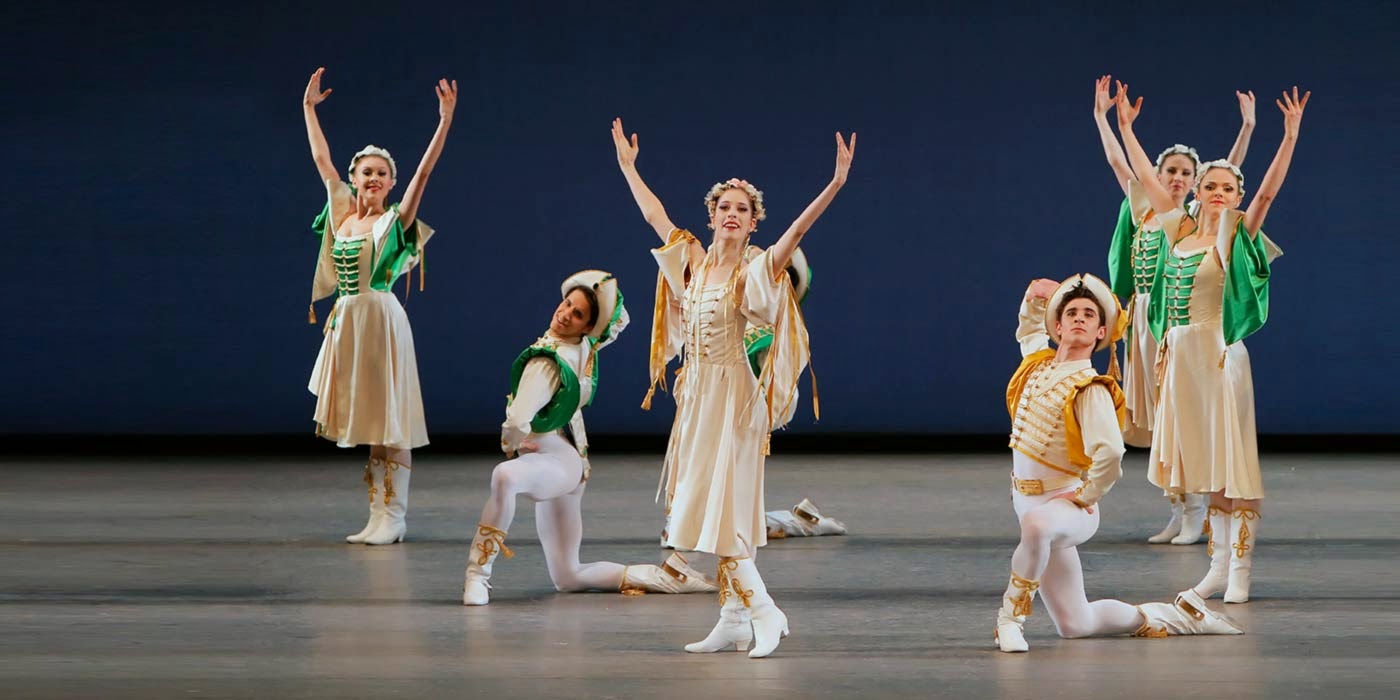
'Cortege' is for a principal classical couple (Maria Kowroski with Russell Janzen on Sunday) backed by a classical corps of eight couples; and a principal Hungarian character couple (Georgina Pazcoguin with Craig Hall) backed by a corps of eight Hungarian couples.  The costumes by Rouben Ter-Arutunian are white decorated with gold for the four principals and white decorated with gold and emerald green for the corps.  The character men wear white boots (for stomping) and puffy 'Hungarian' hats.  The overall effect is garish and somewhat silly.
Rebecca Krohn and Sean Suozzi in the ridiculous Rouben Ter-Arutunian costumes from 'Cortege Hongrois'.
Photo by Paul Kolnik for NYC Ballet
Janzen had debuted in the role on Friday evening and his partnering and solo work were still somewhat tentative.  With his height, he is an ideal partner for Kowroski and they look good together.  Kowroski was regal and cool in her solos.  Somehow, she makes the Hungarian mannerisms of her variation seem tacked on rather than integral to the choreography -- perhaps because Balanchine just tacked them on.

Pazcoguin and Hall led the stomping, heel-clicking Czardas with charisma and authority.  Brittany Pollack (a Friday evening debutant) was radiant in the first classical variation, but Megan LeCrone (also new on Friday evening) seemed distracted and pinched in the second.

'Cortege' relies for impact on its courtly parades and massing of dancers in serried ranks.  Instead of innovative choreography one settles for warmed over Petipa with half-hearted Hungarian appliques -- but done to a suite of first rate Glazunov ballet music.
Finale of 'Cortege Hongrois' with Jon Stafford and Maria Kowroski flanked by Sean Suozzi and Rebecca Krohn.
Photo by Paul Kolnik for NYC Ballet
The real pleasure of an uninspiring program like this is in seeing favorite dancers undertaking new roles.  Certainly, Russell Janzen and Brittany Pollack in 'Cortege'; Emily Kikta and Justin Peck in 'The Cage'; and Teresa Reichlen in 'Symphonic Dances' fit that description -- although they accommodated the roles with varying degrees of success.  When the choreography doesn't provide surprises, I can always search the corps for familiar faces -- Silas Farley in both 'Symphonic Dances' and 'Cortege' is always totally in the moment with his elegant, stretched lines and exceptional height; Lydia Wellington and Megan Johnson also in 'Symphonic Dances' and 'Cortege' can always be counted on for anchoring lovely moments of corps dancing; Mimi Staker with her sparkling dark eyes was vivacious in the Czardas corps of 'Cortege'. 

Silas Farley dancing the lead in 'Cortege Hongrois' in School of American Ballet's 2012 Workshop Performances.
Photo by Paul Kolnik for SAB
And it's always good to see the pros -- Bouder, Kowroski and Veyette -- in almost any context.  As an alternative to the Super Bowl this was still a super afternoon.