Showing posts with label Sergei Rachmaninoff. Show all posts

Saturday, February 7, 2015

NYCB 2/1/15 Matinee Performance

SUNDAY MATINEE, FEBRUARY 1, 3:00 PM [Conductor: Sill] 
SYMPHONIC DANCES: *Reichlen, *Catazaro 
THE CAGE: Hyltin, *Kikta, *J. Peck, Suozzi 
ANDANTINO: Bouder, Veyette [Solo Piano: Walters] 
CORTÈGE HONGROIS: Kowroski, *Janzen, *Pollack, *LeCrone, Pazcoguin, Hall

* First Time in Role on Friday, January 30th

It's hard to imagine a more disheartening New York City Ballet program on paper than the one we attended on Sunday afternoon.  Subtitled 'Hear the Dance: Russia', it consisted of second rate works by Peter Martins and George Balanchine flanking a masterpiece and a slight but glistening pas de deux by Jerome Robbins -- all to Russian music.  Fortunately, there were several dancers who had debuted in their roles on the previous Friday evening to add some novelty and hopefully some energy to the afternoon.  Super Bowl Sunday is an odd time to be at the ballet I suppose -- the theater was only about 60% filled (no-one in the fourth/fifth ring and lots of empty seats lower down).

It began with Peter Martins' energetic, but generally uninspired 'Symphonic Dances' to the music of the same name by Sergei Rachmaninoff.  Danced by a principal couple, four demi-soloist couples, and 8 corps couples, it was created in 1994 for Darci Kistler and Nicolaj Hubbe.  Teresa Reichlen and Zachary Catazaro (who had debuted in the roles on Friday, 1/30) seemed poorly matched and generally cautious.  Martins choreography for couples is often so difficult and awkward that it is impossible to say if there were actual slip-ups or just planned but ungainly partnering moves.  Kistler and Hubbe could mask such treacherous terrain, but Reichlen and Catazaro in their second performance in these roles often looked clumsy and exposed.

As usual, Martins choreographs brilliant entrances and exits for the large cast, but if they stay on stage for any length of time the moves and patterns become repetitious and unexceptional.  Especially, the four demi-soloist men (Harrison Ball, Joseph Gordon, Spartak Hoxha and Peter Walker) are given some wonderful, explosive entrances.  

Santo Loquasto's costumes are problematic.  The demi-soloist couples are beautifully dressed in teal and rust outfits that look like Russian nobility masquerading as serfs -- although why two of the four men had differently patterned tunics is a mystery.
Demi-soloist couples in Santo Loquasto's costumes for Peter Martins' 'Symphonic Dances'.
Photo by Paul Kolnik
The corps is similarly attired in slightly less brilliant shades of aqua and peach -- the women with less elaborate Russian style headdresses.  The principal couple wears the palest aqua and peach costumes with little decoration and only a few jeweled clips holding up Reichlen's hair.  Near the end she suddenly appears with a ponytail -- looking almost as if she's getting ready for bed.  She and Catazaro just fade into the background when the entire ensemble comes on stage for the finale.


Jerome Robbins' 'The Cage' is danced to Igor Stravinsky's 'String Concerto in D'.  Robbins created 'The Cage' in 1951 for the great dramatic ballerina Nora Kaye as The Novice.  The scenario is clearly derived from the second act of 'Giselle' -- a band of female creatures led by a queen with two henchwomen is initiating a novice when their precinct is invaded by two male intruders in succession and the queen and her band encourage the novice to dispatch them.

Emily Kikta was sensational as The Queen.  Probably the tallest woman in the company, Kikta has long arms and legs and an incredible extension which give her commanding authority in The Queen's opening solo.  Sterling Hyltin was intense and predatory as The Novice -- emphasizing the weirdly nonhuman aspects of a creature learning to tantalize and victimize her prey.  She makes quick work of the first intruder, Sean Suozzi, barely giving Sean time to make an impact.  By the time she gets to the second intruder, Justin Peck, Hyltin has learned to entice and toy with her victim. There is a wonderfully angular and lustful pas de deux before he too is killed.


Justin Peck and Sterling Hyltin in Jerome Robbins' 'The Cage'.  Photo by Paul Kolnik for NYC Ballet
Kikta and Peck had debuted in their roles on Friday evening.  Both made a considerable impact and the audience reacted with an extended ovation for the entire cast.

After a pause, Ashley Bouder and Andrew Veyette danced Jerome Robbins' 'Andantino'.  Robbins created 'Andantino' to the Second Movement (Andantino-semplice--Prestissimo) of Tschaikovsky's First Piano Concerto in 1981 for the Company's Tschaikovsky Festival.  Susan Walters played the solo piano part which is mostly contemplative, unlike the more bombastic outer movements of that concerto.

Ashley Bouder and Andrew Veyette danced this pas de deux with refinement and attention to detail.  There is little opportunity for technical bravado, but their well-honed technical skills were put in service of elegance and beautifully controlled unison passages and partnering.  This brief (8-minute) work was like a refreshing shot of ice-cold premium vodka in the midst of a long, heavy Russian banquet.

Balanchine created 'Cortege Hongrois' in 1973 as a parting gift for Melissa Hayden who retired at the end of the 1973 Spring season.  It was also a sort of apology for having ignored Ms. Hayden in favor of younger ballerinas, particularly Suzanne Farrell, for much of the previous decade.  It is not among Balanchine's finest work -- it is mainly a rehash of Petipa's 1898 choreography from the original 'Raymonda'. 

The music is from the third act of 'Raymonda' by Alexander Glazunov -- a melodious score that Balanchine turned to frequently throughout his career ('Pas de Dix' in 1955 and 'Raymonda Variations' from 1961 which is still in the active repertory).  The ballet that Petipa choreographed in 1898 is about Raymonda, a countess loved by a Hungarian crusader knight, who is seduced by a Saracen but ultimately stays faithful to the knight.  The third act celebrates Raymonda's wedding to the knight.  

'Cortege' is for a principal classical couple (Maria Kowroski with Russell Janzen on Sunday) backed by a classical corps of eight couples; and a principal Hungarian character couple (Georgina Pazcoguin with Craig Hall) backed by a corps of eight Hungarian couples.  The costumes by Rouben Ter-Arutunian are white decorated with gold for the four principals and white decorated with gold and emerald green for the corps.  The character men wear white boots (for stomping) and puffy 'Hungarian' hats.  The overall effect is garish and somewhat silly.
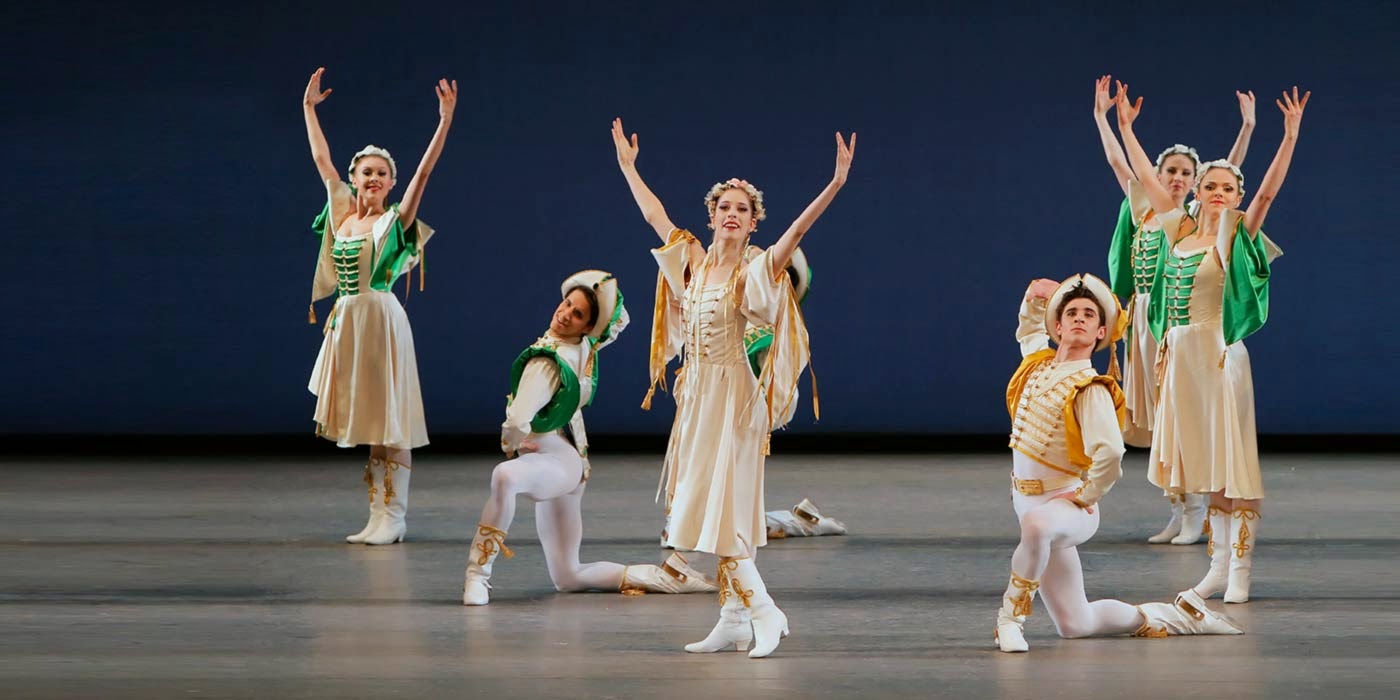
Rebecca Krohn and Sean Suozzi in the ridiculous Rouben Ter-Arutunian costumes from 'Cortege Hongrois'.
Photo by Paul Kolnik for NYC Ballet
Janzen had debuted in the role on Friday evening and his partnering and solo work were still somewhat tentative.  With his height, he is an ideal partner for Kowroski and they look good together.  Kowroski was regal and cool in her solos.  Somehow, she makes the Hungarian mannerisms of her variation seem tacked on rather than integral to the choreography -- perhaps because Balanchine just tacked them on.

Pazcoguin and Hall led the stomping, heel-clicking Czardas with charisma and authority.  Brittany Pollack (a Friday evening debutant) was radiant in the first classical variation, but Megan LeCrone (also new on Friday evening) seemed distracted and pinched in the second.

'Cortege' relies for impact on its courtly parades and massing of dancers in serried ranks.  Instead of innovative choreography one settles for warmed over Petipa with half-hearted Hungarian appliques -- but done to a suite of first rate Glazunov ballet music.
Finale of 'Cortege Hongrois' with Jon Stafford and Maria Kowroski flanked by Sean Suozzi and Rebecca Krohn.
Photo by Paul Kolnik for NYC Ballet
The real pleasure of an uninspiring program like this is in seeing favorite dancers undertaking new roles.  Certainly, Russell Janzen and Brittany Pollack in 'Cortege'; Emily Kikta and Justin Peck in 'The Cage'; and Teresa Reichlen in 'Symphonic Dances' fit that description -- although they accommodated the roles with varying degrees of success.  When the choreography doesn't provide surprises, I can always search the corps for familiar faces -- Silas Farley in both 'Symphonic Dances' and 'Cortege' is always totally in the moment with his elegant, stretched lines and exceptional height; Lydia Wellington and Megan Johnson also in 'Symphonic Dances' and 'Cortege' can always be counted on for anchoring lovely moments of corps dancing; Mimi Staker with her sparkling dark eyes was vivacious in the Czardas corps of 'Cortege'. 

Silas Farley dancing the lead in 'Cortege Hongrois' in School of American Ballet's 2012 Workshop Performances.
Photo by Paul Kolnik for SAB
And it's always good to see the pros -- Bouder, Kowroski and Veyette -- in almost any context.  As an alternative to the Super Bowl this was still a super afternoon.

Wednesday, November 5, 2014

American Ballet Theatre -- Sunday, October 26, 2014

On Sunday at the unlikely hour of 1pm we went to New York State Theater to see a performance by American Ballet Theater.  The theater was only about half-to-two-thirds full.

Sunday, October 26th, at 1:00 pm

With a Chance of Rain (Liam Scarlett World Premiere/Rachmaninoff)
H. Seo, M. Copeland, G. Bond, D. Teuscher, M. Gomes, J. Whiteside, J. Gorak, S. Baca
E. Wong (piano soloist)

Jardin aux Lilas (Tudor/Chausson)
M. Hamrick, T. Forster, L. Underwood, A. Hammoudi
D. LaMarche (conductor), B. Bowman (violin soloist)

Thirteen Diversions (Wheeldon/Britten)
S. Lane, I. Boylston, G. Murphy, C. Shevcheko, C. Salstein E. Tamm, C. Stearns, T. Forster, B. Hoven
O. Wilkins (conductor), B. Bilach (piano soloist)

'With a Chance of Rain' choreographed by Liam Scarlett to seven Sergei Rachmaninoff piano pieces had premiered at the Company's opening night gala on Wednesday, October 22nd.  The Rachmaninoff pieces were played beautifully by Emily Wong, providing musical support from the pit.

Scarlett costumed the eight dancers in various shades of grey with varying amounts of skin displayed -- Marcelo Gomes bare-chested with ankle length tights; James Whiteside in long sleeves, short shorts, and bare legs; Hee Seo in a long-sleeved leotard; Misty Copeland's arms, shoulders and legs bare.  Maybe Scarlett gave them a choice of what parts of their bodies they wanted to expose.
Cast of Liam Scarlett's 'With a Chance of Rain' in costumes by Scarlett.  Photo by Andrea Mohin for NYTimes
After an introductory section for the full cast, there is a much discussed pas de deux for Misty Copeland and James Whiteside.  After several minutes of a quite lovely adagio he places his hands on her breasts and massages them.  A bit later he puts his hand on her butt twice and she slaps it away both times.  Later she puts her hands on his chest and 'twerks'.  The pdd ends with his hands back on her breasts.


James Whiteside and Misty Copeland in Liam Scarlett's 'With a Chance of Rain'.  Photo by Marty Sohl

Misty backs away and Marcelo Gomez walks up to Whiteside's hands which are now on Marcelo's bare chest.  Startled, Whiteside stiffens, but then the two men engage in a short 'buddy' pas de deux.  The audience tittered nervously at the various sexual references.

The two secondary couples have some lovely dancing and there is a beautiful pas de deux for Hee Seo and Marcelo Gomez.  
Marcelo Gomez and Hee Seo in Liam Scarlett's 'With a Chance of Rain'.  Photo by Marty Sohl


Near the end there is a wonderful solo for Marcelo Gomez.  The only thing more beautiful than his body is the technical control he displays in this dance.

The choreography throughout is athletic and often off-balance and relates nicely to the music.  Scarlett has some interesting ideas, but they are unfortunately marred by too much bare skin and too many tasteless, juvenile and irrelevant antics.

'Jardin aux Lilas' (Lilac Garden) was choreographed for Ballet Rambert in 1936 by Anthony Tudor to 'Poeme' for violin and orchestra by Ernest Chausson.  It entered ABT's repertory in its first season in 1940 when Tudor was one of the founding members of the Company as both a dancer and the resident choreographer.
Hugh Laing, Maude Lloyd, Anthony Tudor, and Peggy van Praagh in the original 1936 production by Ballet Rambert.  Laing and Tudor were long-term domestic partners and moved on together to ABT in 1940.
Photo from the Dance Division of The New York Public Library for the Performing Arts.

The ballet is set in a lilac garden where a party is being held for a newly engaged couple.  On Sunday, the bride-to-be, Caroline, was danced by Melanie Hamrick.   Thomas Forster was Her Lover, Alexandre Hammoudi was The Man She Must Marry, and Leann Underwood was An Episode in His Past.  There is a corps of eight Friends and Relations.

We have seen this work many times.  The introduction of fresh, young corps dancers (Hamrick, Forster and Underwood) doesn't keep it from seeming tired and stale.  The shabby set doesn't help either.  Hamrick as the central figure hasn't found a way to integrate her character's mimed emotions of longing and despair into her dancing.  Forster and Underwood do better at incorporating the mime into their performances, but they remain too subtle to convey their characters' emotions.  Hammoudi is priggish and withholding in a role that has always seemed thankless to me -- maybe Tudor himself was able to humanize it.

'Thirteen Diversions' by Christopher Wheeldon to Benjamin Britten's 'Diversions for Piano (left hand) and Orchestra' closed the program.  There is a large cast -- four principal couples and eight corps couples -- costumed by Bob Crowley (the principals in dove grey with flashes of violet at the hems of the women's knee-length skirts and the corps in black with flashes of yellow for the women's skirts).  Frankly, these costumes with hints of bustles on the women and tail coats on the men seemed rather dowdy.

The action occurs behind a black scrim which contains the stage smoke that hangs in the air, reflecting the changing colors and shapes of the harshly effective lighting design by Brad Fields.

As usual, Wheeldon deploys his large cast in complex and interesting patterns -- there is a large wheeling circle for the corps couples that left a vivid after image.  The couples start out together moving in a clockwise circle.  As each couple nears the front of the stage the man spins out and joins an outer circle of men moving counter-clockwise to the women's circle.  It's like a scene from a Busby Berkeley musical juxtaposed with one from Fritz Lang's 'Metropolis' -- brilliant.

Wheeldon's choreography for the four principal couples varies.  I was disappointed by Sarah Lane with Thomas Forster and Isabella Boylston with Cory Stearns.  Gillian Murphy seemed mismatched with Eric Tamm in a role that she had created with David Hallberg in 2011.
David Hallberg and Gillian Murphy in Christopher Wheeldon's 'Thirteen Diversions'.  Photo by Rosalie O'Connor
Christine Shevchenko and Blain Hoven danced well, primarily in pas de quatres with one of the other three principal couples.  This was certainly the best of the three works on the program, but we've seen better Wheeldon works and Wheeldon works danced better elsewhere.

Ormsby Wilkins conducted the orchestra and piano soloist, Barbara Bilach, in a nuanced performance of the Britten score.