Showing posts with label Jerome Robbins. Show all posts

Saturday, January 30, 2016

New York City Ballet Tuesday Evening, January 19th: 'Music Director's Choice'

TUESDAY EVENING, JANUARY 19, 7:30 PM [Conductor: Litton]

CANDIDE OVERTURE
    pause
BARBER VIOLIN CONCERTO: Mearns, M. Fairchild, J. Angle, la Cour Jansen [Solo Violin: Nikkanen]

FANCY FREE: De Luz, T. Angle, Ramasar, Pazcoguin, Hyltin, Chrosniak, Prottas

WHO CARES?: R. Fairchild, T. Peck, Lowery, Scheller [Solo Piano: Chelton]

Although Andrew Litton, New York City Ballet's new music director, had conducted a few programs last fall and a week of Nutcracker performances in December, this program was apparently his official introduction to the NYCB audience.

Maestro Litton opened the program with a bracing performance of the overture from Leonard Bernstein's 'Candide'.  For the piece the orchestra -- augmented by six additional players -- ascended on the (infrequently used) pit elevator.  Their sound was rich -- almost too loud at times -- and the tempi were fast.  The descent of the orchestra back into the pit and the removal of percussion instruments from the stage apron made for an awkward transition from orchestral concert to ballet performance.

Peter Martins created 'Barber Violin Concerto' for the Company's American Music Festival in 1988.  The score is Samuel Barber's gorgeous 'Concerto for Violin and Orchestra, Opus 14' composed in 1941.  The original 1988 cast was Merrill Ashley and Adam Luders from NYCB with guest artists Kate Johnson and David Parsons from the Paul Taylor Dance Company.  Martins' original concept was to compare and contrast classical ballet and modern dance.
  
Russell Jansen, Sara Mearns, Jared Angle and Megan Fairchild in 'Barber Violin Concerto'.
Photo by Andrea Mohin for NY Times

In more recent revivals, the modern dancers have been replaced by dancers from the Company performing in a more grounded style that is alien to their ballet training.  This has led to a dilution of the contrast between the 'classical' and 'modern' dancers.  Jared Angle discusses the challenges of dancing the 'modern' roles in a short video from the Company that you can find here:

https://www.youtube.com/watch?v=4OLFKXVc6SA

In the opening movement Russell Jansen partnered the radiant Sara Mearns with great elegance in Martins' difficult adagio -- where the 'classical' dancers perform together.  Jared Angle and Megan Fairchild as the barefoot 'modern' dancers struggled to invest their parts with the necessary earthiness.  Sara's encounter with Jared in the central movement lacked the sexual edginess that made it feel almost like a rape with the original cast in 1988. 


Jared Angle and Sara Mearns in Peter Martins' 'Barber Violin Concerto'.  Photo by Paul Kolnik for NYC Ballet
In the final movement Megan's annoying 'modern' gnat contrasted nicely with Russell's aloof 'classical' danseur, but the humor in their encounter has long since dissipated for most of the audience.

The orchestra under Maestro Litton -- with Kurt Nikkanen as violin soloist -- played the haunting Barber score beautifully.

In 1944 Jerome Robbins collaborated with Leonard Bernstein on 'Fancy Free' for American Ballet Theatre.  It was Robbins' first ballet.  Of course, later that year Robbins and Bernstein collaborated with Betty Comden & Adolf Green (book and lyrics) to expand the ballet into the legendary musical 'On the Town'. 

Robbins staged 'Fancy Free' for New York City Ballet in 1980 with Peter Martins, Bart Cook, and Jean-Pierre Frohlich as the three sailors and Delia Peters, Stephanie Saland, and Florence Fitzgerald as their romantic interests.  The set, then and now, is based on Oliver Smith's iconic original design for ABT.

Here's a video of the entire NYC Ballet production (31 minutes) from 1986 with Joseph Duell, Jean-Pierre Frohlich, Kipling Houston, Lourdes Lopez, Stephanie Saland and Florence Fitzgerald:

https://www.youtube.com/watch?v=3Ou-O9Awkzo

And here's also a video from NYC Ballet with Tyler Angle discussing the current revival 'Fancy Free':

https://www.youtube.com/watch?v=ZGZfevOhKo0

After seeing 'Fancy Free' for years, there's nothing terribly exciting about it, no matter how well it is danced or how well the score is played (as it was on Tuesday evening).  The work shows just how keenly Robbins observed the interactions of people around him and incorporated them into his ballets from the very beginning.  

Joaquin De Luz, Tyler Angle, Amar Ramasar and Georgina Pazcoguin in Jerome Robbins' 'Fancy Free'.
Photo by Michael P. Farrell for (Albany) TimesUnion
Tyler Angle, Joaquin De Luz and Amar Ramasar were convincing as the three sailors on shore leave in NYC.  Gina Pazcoguin was suitably saucy as the girl with the red purse, but Sterling Hyltin's 40's hairdo was grotesque and completely distracting from her otherwise winsome girl in purple.  It's hard to find much redeeming value in this work, which hasn't aged particularly well.  Maybe the Company should give it a rest for the next ten years.

George Balanchine's 'Who Cares?' to the music of George Gershwin as (over-)orchestrated by Hershy Kay was created in 1970.  Kay, who created scores for other Balanchine ballets, including 'Stars and Stripes' and 'Western Symphony', gives this score too much punch and I always spend the ballet hearing better versions of these familiar tunes in my head.  


The first cast in 1970 included Jacques d'Amboise, Patricia McBride, Karin von Aroldingen, and Marnee Morris plus five demi-soloist couples and a corps of ten women.  It was the first major work that Balanchine created after his muse, Suzanne Farrell, left the Company in the spring of 1969 and it is not considered one of his finest works -- although it is danced all over the world these days and has always been a personal favorite.

The costumes by Santo Loquasto for the current production of 'Who Cares?' are particularly unfortunate.  The five demi-soloist men wear something akin to short-sleeved royal blue track suits; the five women are in nondescript hot pink wrap dresses and the ten corps women are in ruffled teal wrap dresses with pink head scarves.  The three female leads are in shiny satin dresses of pink, turquoise and lavender with black lace appliques -- reminding me of models from an old Frederick's of Hollywood catalogue.  Only the male lead escapes relatively unscathed.
                                                                                                            The opening sections are always an opportunity to see young members of the corps step out and show off in necessarily brief snippets.  Among the demi-soloists, I was particularly taken by Emilie Gerrity dancing with Cameron Dieck -- Ms. Gerrity's arms seemed to embrace the whole audience.  Lars Nelson and Ralph Ippolito -- new to me in their roles -- also conveyed the right panache.


Rob Fairchild in the 'Liza' solo of Balanchine's 'Who Cares?'.  Photo by Paul Kolnik for NYC Ballet
For this performance -- the opening night of the Company's Winter Season -- Robert Fairchild took an evening off from his starring role in the Broadway (Gershwin) musical 'An American in Paris' to dance the leading male role in 'Who Cares?' with his wife, Tiler Peck, and Ana Sophia Scheller and Savannah Lowery.  Rob and Tiler's entrance for 'The Man I Love' duet was greeted by the NYCB audience with an affectionate ovation.
  
Tiler Peck and Rob Fairchild in 'The Man I Love' pas de deux from 'Who Cares?'.
Photo by Paul Kolnik for NYC Ballet

Rob's dancing throughout seemed a little more earthbound than I had recalled -- perhaps the result of dancing on Broadway for over a year -- but he provided wonderful support for all three ballerinas in their individual duets and was a louche song-and-dance man in his solo to 'Liza'.  Tiler was sensational in both 'The Man I Love' duet with Rob and in her 'Fascinatin' Rhythm' solo -- she has become one of the Company's indispensable ballerinas ranging over an ever-expanding variety of the Company's repertory. 

Ana Sophia Scheller and Rob Fairchild in the 'Embraceable You' pas de deux from Balanchine's 'Who Cares?'.
Photo by Paul Kolnik for NYC Ballet
Ana Sophia danced the 'Embraceable You' duet with Rob and her 'My One and Only' solo with steely bravado -- and not much personality.  Savannah seemed unusually subdued --  even with the title duet to 'Who Cares?' and the insouciant solo to 'I'll Build a Stairway to Paradise' to dance.


The full cast of George Balanchine's 'Who Cares?' in the final moment of the ballet.
Photo by Paul Kolnik for NYC Ballet
The cast received thunderous applause which continued when Maestro Litton was brought onto the stage -- he even received a solo bow in front of the curtain.  Although the Hershy Kay orchestrations detract from the charm of the Gershwin originals, Litton brought a great deal of character and vitality to the score.  I am suddenly hopeful that we will have a Music Director who adds distinction and a point of view to the music emanating from the pit which will compliment the always wonderful dancing on stage. 


Tuesday, June 2, 2015

School of American Ballet Workshop Performances on May 30th

We attended both the matinee and evening performances of the School of American Ballet's 2015 Workshops on Saturday, May 30th.  I also attended the final dress rehearsal on Friday afternoon when the cast for the Tuesday evening gala performance danced.  These performances are always a highlight of our ballet calendar (as they are for many other New York City ballet lovers).  

The Peter Jay Sharp Theater in the Julliard School provides a comfortable venue for the SAB workshop every year.  It seats nearly 1,000 people and has wonderful sightlines for ballet from most seats.  We always sit in the same seats -- seats I refer to as the 'Miriam Pellman memorial seats' since we sort of inherited them after Miriam passed away.

I wrote about the program for this year's Workshops in my post of March 16th which you can read here:

http://zylopho.blogspot.com/2015/03/the-program-for-2015-sab-workshops.html 

What I did not realize when I published that post was that the 2015 Workshop Performances would be celebrating the 20th year of Rudolf Nureyev Scholarships for young male dancers at SAB.  Hence, the emphasis on male dancers in this program -- where they outnumbered the young women for the first time in the 51 year history of the Workshops.

While these (mostly positive) remarks concentrate on the execution of this program, the 'dance recital' format of the first half makes it nearly impossible to completely ignore the flaws (there's nowhere else to look when there are so few dancers on stage).  My apologies for any negative remarks to the students and faculty members who have worked hard over the last several months to perfect these performances.

'Harlequinade':
Thirty-two students, ages 9 to 14, perform as Polichinelles, Harlequins, Pierrettes and Pierrots, and Scaramouches -- all stock characters from Italian commedia dell'arte

Music by Riccard Drigo, choreography by George Balanchine
Staged by Dena Abergel and Arch Higgins 

Balanchine was well-known for choreographing dances for children that challenged their capabilities while still recognizing their limitations.  Ms. Abergel and Mr. Higgins have prepared these adorable young students beautifully and they were warmly received by an audience that included many adoring parents, siblings and other family members.  

The only gaffe came from Andrews Sill, the conductor, who failed to cue the students for their final bows at the matinee -- leaving them stranded in the spotlight and unsure just how to proceed.  Fortunately, there were enough youthful leaders in the group to prevent total chaos -- and by the evening performance Maestro Sill remembered that his duties on this piece don't end with the last note from the orchestra.

'William Tell' Pas de Deux:
Alston Macgill & Christopher Grant (Saturday matinee & Friday dress rehearsal)

Larisa Nugent & Kennard Henson (Saturday evening)

Music by Giacomo Rossini and choreography by August Bournonville
Staged by Darci Kistler

Alston Macgill (17, Savannah, GA) is something of protoge of Darci Kistler -- who coached her in Balanchine's 'Swan Lake' for the 2014 Workshops as well as in this work.  Ms. Macgill and Christopher Grant (19, New York, NY) are somewhat mismatched for this work.  Christopher -- who won a Wien award in 2014 -- is an ebullient and out-going performer who lights up in front of an audience, while Alston is more reserved and reticent as a performer.  They executed the steps of the difficult Bournonville choreography beautifully, but their respective efforts to modulate their inherent performing personalities undermined their efforts to convey the flirtatious courtship at its heart to the audience.


Christopher Grant and Alston Macgill in the pas de deux from Bournonville's 'William Tell'.
Photo by Paul Kolnik for The School of American Ballet

Larisa Nugent (16, Ellicott City, MD) and Kennard Henson (17, Baltimore, MD) were better matched in the evening.  Larisa has a flirtatious sparkle that played off Kennard's inherent courtliness.  Their choreographed courtship was delightful and brought out the meaning of Bournonville's steps while making their difficulty look effortless.

'The Sleeping Beauty' Wedding Pas de Deux:
Clara Ruf-Maldonado* & Dammiel Cruz* (Saturday matinee & Friday dress rehearsal)

Sasohan Huttenbach & Alec Knight (Saturday evening)

Music by Peter Ilyitch Tschaikovsky and choreography by Peter Martins after Marius Petipa
Staged by Yvonne Borree* and Jonathan Stafford

*  Recipients of 2015 Mae L. Wien Awards

This pas de deux is a minefield of difficult adagio partnering and bravura solo passages -- not for the faint of heart.  Clara Ruf-Maldonado (18, New York, NY) and Dammiel Cruz (17, Woodhaven, NY) have both studied at the School since they were children and are among the finest dancers in this year's Workshop (witness their 2015 Wien Awards).  Ms. Ruf-Maldonado dances Princess Aurora with grave authority and natural radiance.  Mr. Cruz is strong and confident as Prince Desire.  They have tendency to clench up for the difficult partnered moves and then show (too much) relief after they are completed.  Clara stumbled slightly on the pirouette at the end of her long menage of chaine turns and jetes (at the same spot at both the dress rehearsal and matinee performance) and one of their fish dives went awry at the matinee -- but they recovered quickly and went on to beautifully danced solos in the coda.  Overall their performances were tremendously exciting.


Dammiel Cruz and Clara Ruf-Maldonado rehearsing 'The Sleeping Beauty' pas de deux.
Photo by Rosalie O'Connor for The School of American Ballet
Sasonah Huttenbach (17, Brooklyn, NY) and Alec Knight (19, Brisbane, Australia) displayed a different stage presence in the evening.  They are both tall and slender and they make this pas de deux seem light and celebratory.  Mr. Knight expresses his love for his bride through his joy in dancing.  Ms. Huttenbach shows a bit too much tension in the most difficult passages, but is lovely elsewhere and assured in her solo passages.  Sasonah and Alec struggled through the treacherous fish dives, but they displayed great rapport with each other and a shared determination to recover and move on to their radiant coda.
 
Alec Knight and Sasonah Huttenbach rehearsing 'The Sleeping Beauty' pas de deux with Yvonne Borree.
Photo by Rosalie O'Connor for The School of American Ballet

It's obvious that Ms. Borree and Mr. Stafford had prepared these dancers with great care.  Both student couples presented themselves beautifully and proved they could rise from small mishaps to prevail with dignity and grace.

Valse Fantaisie:
Emma Von Enck & Ethan Fuller with Misses Kaitlyn Casey, Audrey Lawrence, Lucy Nevin & Gianna Reisen (Saturday matinee & Friday dress rehearsal)

Leah Christianson & Thomas Davidoff with Misses Constance Doyle, Rachel Hutsell, Courtney Nitting & Samantha Riester (Saturday evening)

Music by Mikhail Glinka, Choreography by George Balanchine
Staged by Suki Schorer

'Valse Fantaisie' is one of those short, 'huffy' ballets that tests the stamina of all six dancers even though it is only a little over eight minutes long.  All of these dancers proved to have both the energy, the technical dexterity and the musicality for this exhilarating work.

Selected and coached by Suki Schorer, both casts are exceptionally strong.  Emma Von Enck (17, Brecksville, OH), partnered by Ethan Fuller (17, Indialantic, FL) at the matinee, is an exquisite ballerina -- obviously with a core of steel.  Her slowly rotating pirouettes with beautifully articulated arms and deeply arched back are a treasured after-image and her perfectly executed menage of bourrees and jetes done at lightning speed with supreme musicality was a highlight of the afternoon.  Mr. Fuller has wonderfully articulated beats and high, airy jumps.  Their partnered passages were short, but lovely.

Emma Von Enck and Ethan Fuller rehearsing Balanchine's 'Valse Fantasie'.
Photo by Rosalie O'Connor for The School of American Ballet
The evening performance lead by Leah Christianson (18, Batavia, IL) and Thomas Davidoff (16, Marietta, GA) was only slightly less spectacular -- marred by a slight bobble on a supported pirouette done at breakneck speed.  Mr. Davidoff has wonderful elevation and Ms. Christianson dances with great energy.  The four corps ladies of both casts danced with precision and musical acuity in some of Balanchine's trickiest and most exposed choreography.  Suki Schorer must be extremely proud of the work of all twelve students in this demanding work.

'Stars and Stripes', Third Regiment-Thunder and Gladiator:
Aaron Hilton with Messrs. Sam Ainley, Darius Black, Gilbert Bolden III, Josiah Cook, Christopher D'Ariano, Dallas Finley, Alec Knight, Marc LaPierre, Wilson Livingston, Marc LaPierre, Wilson Livingston, Luke Potgieter, Xhosa Scott & Saxon Wood (Saturday matinee & Friday dress rehearsal) 

Xhosa Scott with Messrs. Ainley, Black, Bolden, Nathan Compiano, Cook, D'Ariano, Finley, Hilton, Livingston, Alexandros Pappajohn, Potgieter & Wood (Saturday evening)

Music by John Philip Sousa adapted & arranged by Hershy Kay, choreography by George Balanchine
Staged by Jock Soto

I worried in March that this excerpt from Balanchine's patriotic John Philip Souza ballet would not have the military precision that it should and in part that proved true.  Lines were sometimes slightly askew and air turn landings wandered from the formation.  Jock Soto wisely dropped the white gloves, which would have accentuated these issues.  Overall, though, this work provided a wonderful showcase some for some of the talented young men who are current beneficiaries of the Nureyev scholarships.

Josiah Cook and Christopher D'Andrea rehearsing for Balanchine's 'Stars and Stripes'.
Photo by Rosalie O'Connor for The School of American Ballet

Aaron Hilton (18, Washington, DC) was exemplary as the regimental leader at the matinee -- dancing with elevation and elan.  His slightly wandering pirouettes a la second were cleverly disguised (by Balanchine) amidst a circle of the surrounding troops executing a menage of rotating jetes -- to deserved applause from the audience. 

Aaron Hilton with Messrs. Saxon, Scott, D'Ariano, Pappajohn, Bolden and Potgieter.
Photo by Rosalie O'Connor for The School of American Ballet

Xhosa Scott (16, Baltimore, MD) -- performing the leader in the evening performance -- is an extraordinary jumper. Lithe and wiry, he executes jetes, beats and air turns with enormous elevation and seeming nonchalance.  

I must also express delight with Darius Black (16, Voorhees, NJ) anchoring the back left corner of the formation at both the matinee and evening performances with great solemnity and concentration as he performed the final phrases of a canon that has swept diagonally across the regiment from right to left -- alone.

Fanfare:
Thirty-four students portraying instruments of the orchestra -- a total of at least 50 students performed in the Saturday matinee and evening performances and the Friday dress rehearsal

Music by Benjamin Britten based on a theme by Henry Purcell, choreography by Jerome Robbins
Staged by Susan Pilarre and Christine Redpath

'Fanfare' is the 'go out there and have fun' ballet of this program.  Susan Pilarre is well-known for staging these pieces for each Workshop program and Christine Redpath is a highly regarded ballet master for the Robbins repertory at NYC Ballet.  It's possible in this work to single out special performances while enjoying the entire group for their energy and enthusiasm.

One of the best performances on Saturday came from Joscelyn Dolson (19, Superior Township, MI, also a 2015 Mae L. Wien award recipient) as the Harp at the matinee.  Ms. Dolson dances with an inner radiance and outward calm.  Her performance seems to say 'I'm dancing for myself, but it's all right if you want to watch'.  I'd love to see her take on the Violette Verdi role in 'Emeralds' some day.  That luminous introspective quality is seldom achieved these days.


Joscelyn Dolson as the Harp in Jerome Robbins' "Fanfare'.
Photo by Paul Kolnik for The School of American Ballet
Darius Black and Xhosa Scott were excellent as the 'Alphonse and Gaston' of Bassoons.  Their deadpan -- but with a twinkle in their eyes --routine brought a chuckle at each performance.  Eric Beckham (19, Columbia, SC) and Thomas Davidoff as the dueling Trumpets in both Saturday performances also brought a laugh.  On the other hand the 3-man Percussion section -- often the high point of hilarity in 'Fanfare' -- seemed a bit tired.  Alicia Holloway (18, Morgantown, WV) was an effectively morose Oboe in the evening and Christopher D'Ariano (17, New York, NY) was the shamelessly self-important Double Bass at both performances on Saturday.


* * * * * * * * * * * *

Bravo to all of the students and faculty members of the School of American Ballet who have worked tirelessly to prepare and perfect this 2015 Workshop program.  Watching these performances over the years we often tend to forget that these are ballet students, not (yet) professional dancers.  We wish them all great success as they pursue the next challenges of their lives -- whether it's further training at SAB, going on to dance on the ballet stages of the world, or trying completely different endeavors.    

Saturday, February 7, 2015

NYCB 2/1/15 Matinee Performance

SUNDAY MATINEE, FEBRUARY 1, 3:00 PM [Conductor: Sill] 
SYMPHONIC DANCES: *Reichlen, *Catazaro 
THE CAGE: Hyltin, *Kikta, *J. Peck, Suozzi 
ANDANTINO: Bouder, Veyette [Solo Piano: Walters] 
CORTÈGE HONGROIS: Kowroski, *Janzen, *Pollack, *LeCrone, Pazcoguin, Hall

* First Time in Role on Friday, January 30th

It's hard to imagine a more disheartening New York City Ballet program on paper than the one we attended on Sunday afternoon.  Subtitled 'Hear the Dance: Russia', it consisted of second rate works by Peter Martins and George Balanchine flanking a masterpiece and a slight but glistening pas de deux by Jerome Robbins -- all to Russian music.  Fortunately, there were several dancers who had debuted in their roles on the previous Friday evening to add some novelty and hopefully some energy to the afternoon.  Super Bowl Sunday is an odd time to be at the ballet I suppose -- the theater was only about 60% filled (no-one in the fourth/fifth ring and lots of empty seats lower down).

It began with Peter Martins' energetic, but generally uninspired 'Symphonic Dances' to the music of the same name by Sergei Rachmaninoff.  Danced by a principal couple, four demi-soloist couples, and 8 corps couples, it was created in 1994 for Darci Kistler and Nicolaj Hubbe.  Teresa Reichlen and Zachary Catazaro (who had debuted in the roles on Friday, 1/30) seemed poorly matched and generally cautious.  Martins choreography for couples is often so difficult and awkward that it is impossible to say if there were actual slip-ups or just planned but ungainly partnering moves.  Kistler and Hubbe could mask such treacherous terrain, but Reichlen and Catazaro in their second performance in these roles often looked clumsy and exposed.

As usual, Martins choreographs brilliant entrances and exits for the large cast, but if they stay on stage for any length of time the moves and patterns become repetitious and unexceptional.  Especially, the four demi-soloist men (Harrison Ball, Joseph Gordon, Spartak Hoxha and Peter Walker) are given some wonderful, explosive entrances.  

Santo Loquasto's costumes are problematic.  The demi-soloist couples are beautifully dressed in teal and rust outfits that look like Russian nobility masquerading as serfs -- although why two of the four men had differently patterned tunics is a mystery.
Demi-soloist couples in Santo Loquasto's costumes for Peter Martins' 'Symphonic Dances'.
Photo by Paul Kolnik
The corps is similarly attired in slightly less brilliant shades of aqua and peach -- the women with less elaborate Russian style headdresses.  The principal couple wears the palest aqua and peach costumes with little decoration and only a few jeweled clips holding up Reichlen's hair.  Near the end she suddenly appears with a ponytail -- looking almost as if she's getting ready for bed.  She and Catazaro just fade into the background when the entire ensemble comes on stage for the finale.


Jerome Robbins' 'The Cage' is danced to Igor Stravinsky's 'String Concerto in D'.  Robbins created 'The Cage' in 1951 for the great dramatic ballerina Nora Kaye as The Novice.  The scenario is clearly derived from the second act of 'Giselle' -- a band of female creatures led by a queen with two henchwomen is initiating a novice when their precinct is invaded by two male intruders in succession and the queen and her band encourage the novice to dispatch them.

Emily Kikta was sensational as The Queen.  Probably the tallest woman in the company, Kikta has long arms and legs and an incredible extension which give her commanding authority in The Queen's opening solo.  Sterling Hyltin was intense and predatory as The Novice -- emphasizing the weirdly nonhuman aspects of a creature learning to tantalize and victimize her prey.  She makes quick work of the first intruder, Sean Suozzi, barely giving Sean time to make an impact.  By the time she gets to the second intruder, Justin Peck, Hyltin has learned to entice and toy with her victim. There is a wonderfully angular and lustful pas de deux before he too is killed.


Justin Peck and Sterling Hyltin in Jerome Robbins' 'The Cage'.  Photo by Paul Kolnik for NYC Ballet
Kikta and Peck had debuted in their roles on Friday evening.  Both made a considerable impact and the audience reacted with an extended ovation for the entire cast.

After a pause, Ashley Bouder and Andrew Veyette danced Jerome Robbins' 'Andantino'.  Robbins created 'Andantino' to the Second Movement (Andantino-semplice--Prestissimo) of Tschaikovsky's First Piano Concerto in 1981 for the Company's Tschaikovsky Festival.  Susan Walters played the solo piano part which is mostly contemplative, unlike the more bombastic outer movements of that concerto.

Ashley Bouder and Andrew Veyette danced this pas de deux with refinement and attention to detail.  There is little opportunity for technical bravado, but their well-honed technical skills were put in service of elegance and beautifully controlled unison passages and partnering.  This brief (8-minute) work was like a refreshing shot of ice-cold premium vodka in the midst of a long, heavy Russian banquet.

Balanchine created 'Cortege Hongrois' in 1973 as a parting gift for Melissa Hayden who retired at the end of the 1973 Spring season.  It was also a sort of apology for having ignored Ms. Hayden in favor of younger ballerinas, particularly Suzanne Farrell, for much of the previous decade.  It is not among Balanchine's finest work -- it is mainly a rehash of Petipa's 1898 choreography from the original 'Raymonda'. 

The music is from the third act of 'Raymonda' by Alexander Glazunov -- a melodious score that Balanchine turned to frequently throughout his career ('Pas de Dix' in 1955 and 'Raymonda Variations' from 1961 which is still in the active repertory).  The ballet that Petipa choreographed in 1898 is about Raymonda, a countess loved by a Hungarian crusader knight, who is seduced by a Saracen but ultimately stays faithful to the knight.  The third act celebrates Raymonda's wedding to the knight.  

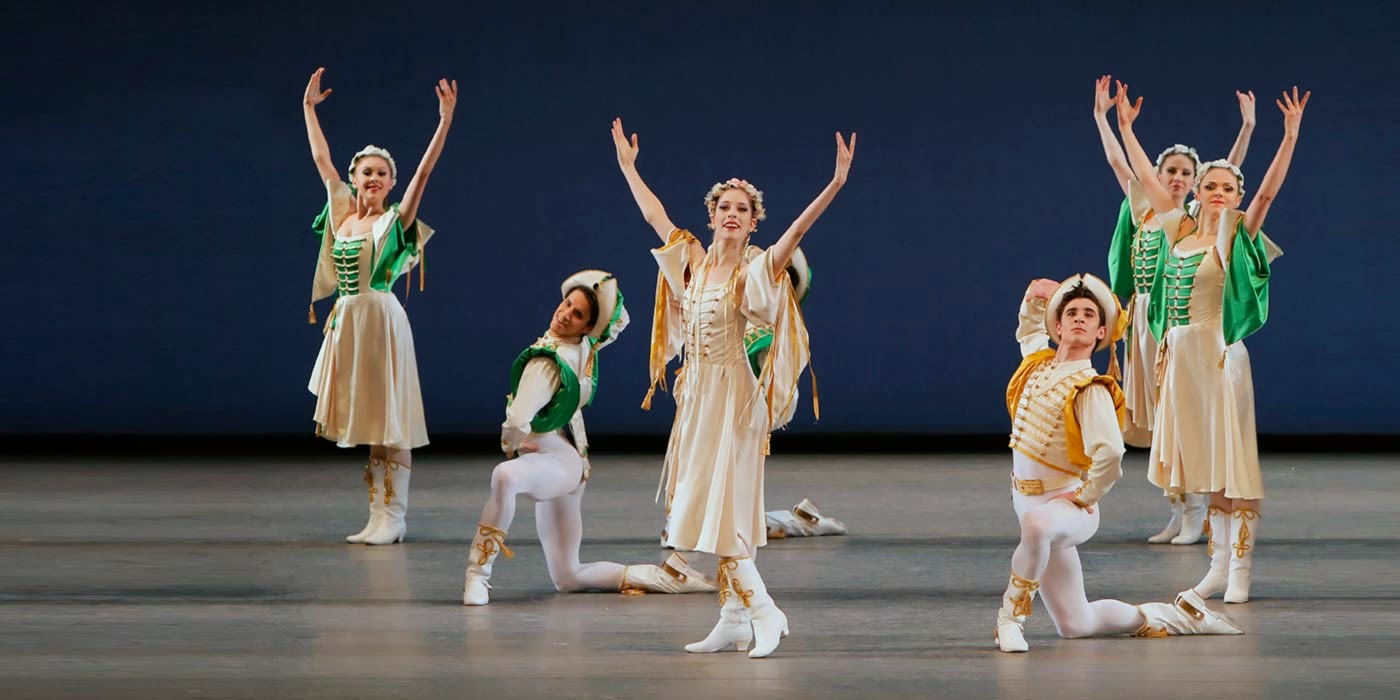
'Cortege' is for a principal classical couple (Maria Kowroski with Russell Janzen on Sunday) backed by a classical corps of eight couples; and a principal Hungarian character couple (Georgina Pazcoguin with Craig Hall) backed by a corps of eight Hungarian couples.  The costumes by Rouben Ter-Arutunian are white decorated with gold for the four principals and white decorated with gold and emerald green for the corps.  The character men wear white boots (for stomping) and puffy 'Hungarian' hats.  The overall effect is garish and somewhat silly.
Rebecca Krohn and Sean Suozzi in the ridiculous Rouben Ter-Arutunian costumes from 'Cortege Hongrois'.
Photo by Paul Kolnik for NYC Ballet
Janzen had debuted in the role on Friday evening and his partnering and solo work were still somewhat tentative.  With his height, he is an ideal partner for Kowroski and they look good together.  Kowroski was regal and cool in her solos.  Somehow, she makes the Hungarian mannerisms of her variation seem tacked on rather than integral to the choreography -- perhaps because Balanchine just tacked them on.

Pazcoguin and Hall led the stomping, heel-clicking Czardas with charisma and authority.  Brittany Pollack (a Friday evening debutant) was radiant in the first classical variation, but Megan LeCrone (also new on Friday evening) seemed distracted and pinched in the second.

'Cortege' relies for impact on its courtly parades and massing of dancers in serried ranks.  Instead of innovative choreography one settles for warmed over Petipa with half-hearted Hungarian appliques -- but done to a suite of first rate Glazunov ballet music.
Finale of 'Cortege Hongrois' with Jon Stafford and Maria Kowroski flanked by Sean Suozzi and Rebecca Krohn.
Photo by Paul Kolnik for NYC Ballet
The real pleasure of an uninspiring program like this is in seeing favorite dancers undertaking new roles.  Certainly, Russell Janzen and Brittany Pollack in 'Cortege'; Emily Kikta and Justin Peck in 'The Cage'; and Teresa Reichlen in 'Symphonic Dances' fit that description -- although they accommodated the roles with varying degrees of success.  When the choreography doesn't provide surprises, I can always search the corps for familiar faces -- Silas Farley in both 'Symphonic Dances' and 'Cortege' is always totally in the moment with his elegant, stretched lines and exceptional height; Lydia Wellington and Megan Johnson also in 'Symphonic Dances' and 'Cortege' can always be counted on for anchoring lovely moments of corps dancing; Mimi Staker with her sparkling dark eyes was vivacious in the Czardas corps of 'Cortege'. 

Silas Farley dancing the lead in 'Cortege Hongrois' in School of American Ballet's 2012 Workshop Performances.
Photo by Paul Kolnik for SAB
And it's always good to see the pros -- Bouder, Kowroski and Veyette -- in almost any context.  As an alternative to the Super Bowl this was still a super afternoon.

Monday, October 27, 2014

New York City Ballet -- Tuesday, October 14, 2014

We attended the New York City Ballet performance on Tuesday evening, October 14th.  It was our first chance to see Justin Peck's 'Everywhere We Go' -- which was first seen during the Spring 2014 season.  The program also featured several debuts (*) in Balanchine's 'Chaconne' and Robbins' 'Interplay'.

TUESDAY EVENING, OCTOBER 14, 7:30 PM
[Conductor: Capps]
CHACONNE: Kowroski, T. Angle, *King, *Huxley, *Kikta, *Kretzschmar, *Sanz, *Woodward, *Hod, *Alberda, *Phelan, *Prottas
INTERPLAY: Pollack, *Wellington, *Mann, *Villwock, Walker, Alberda, Hoxha, *Coll (replaces Villarini-Velez)
[Solo Piano: Walters]
pause
AFTER THE RAIN PAS DE DEUX: Whelan, Hall [Solo Piano: Moverman, Solo Violin: Delmoni]
EVERYWHERE WE GO: Krohn, Isaacs, Hyltin, Reichlen, Danchig-Waring, Ramasar, Veyette

George Balanchine staged 'Chaconne' for Suzanne Farrell and Peter Martins in 1976.  
Peter Martins and Suzanne Farrell, the original cast in Balanchine's 'Chaconne'.
Photo by Max Waldman
The score is ballet music from Christoph Willibald von Gluck's opera 'Orphee et Euridice'.  Balanchine had worked with Gluck's score before.  First, in 1936 
he staged the opera for the Metropolitan Opera with decor by Pavel Tchelitchew.  The singers were in the pit with the orchestra and his American Ballet dancers were on stage   It lasted for two performances.  In 1963 he composed all of the dances for a production of the opera by the Hamburg State Ballet.  This production was mounted by the Paris Opera a decade later with some adjustments by Balanchine.  In 1975, a somewhat different version was performed by the Chicago Lyric Opera with dances by Balanchine.  'Chaconne' is based primarily on the ballets he created for the Hamburg State Opera version with adjustments, of course, for the special gifts of Farrell and Martins.

The ballet is divided into two distinct sections.  The first section (the Elysian Fields) begins with an ensemble of nine women with loose hair and long flowing beige costumes walking slowly about the stage in simple patterns.  As they exit the stage the principal couple (Maria Kowroski and Tyler Angle) in simple white costumes enter on a diagonal.  Their first moves are beautiful calm mirroring arabesques which they sustain joined only by one hand.  In recent seasons Maria and Tyler have formed a wonderful partnership which was fully displayed in this first pas de deux with its low, skimming lifts and off-kilter promenades to Gluck's 'Dance of the Blessed Spirits'.

As Tyler carried Maria off stage in a last series of low lifts, the stage brightens and the large cast entered for the divertissements and chaconne that end the opera -- a secondary couple (Lauren King and Anthony Huxley); a trio (Emily Kikta, Gretchen Smith and Aaron Sanz); five women (led by Indiana Woodward); two demi-soloist couples (Ashley Hod with Devin Alberda and Unity Phelan with David Prottas); and a corps of 15 (9 women and 6 men).  The Karinska costumes are white and pale blue; the background is a blue sky with wispy white clouds.  

Kikta, Smith and Sanz were making their debuts in the pas de trois.  The man is a troubadour plucking on an imaginary lute while his ladies strut in courtly fashion.  This new trio were astonishingly accomplished and conveyed the Baroque spirit of the piece.

The tricky pas de deux that follows was danced with sunny assurance by King and Huxley, also making their role debuts.  It is a tricky dance that relies on bent arms and legs as a recurring motif.  Anthony, sometimes an insecure partner, showed new confidence in the complex partnering with Lauren and between them there is a nice contrast of stage personalities -- Anthony dark and reserved, Lauren vivacious and fair.

The pas de cinq was lead by Indiana Woodward, another debutant, with twinkle.

Kowroski and Angle re-emerged in more formal white costumes to dance the final pas de deux.  The entrance is elegant, but with a cheeky swagger.  Balanchine brought out the high Baroque elegance in the music, which Farrell and Martins embellished with self-confident showmanship.  Maria Kowroski has always been a worthy heiress of the roles Balanchine created for Farrell, absorbing the style without all of the mannerisms.  Maria's long slender arms and legs and easy hyperextension were deployed here with grace and wit. 
Maria Kowroski in the second principal pas de deux from Balanchine's 'Chaconne'.
Photo by Paul Kolnik for NYC Ballet
Here Tyler proved himself an able interpreter of Martins' skillful, but not subservient, partnering.  Tyler shared the stage with natural nobility and elegantly understated style.


Following their pas de deux, there is a passage -- the actual chaconne -- for the 15 members of the corps with the two demi-soloist couples (Hod with Alberda and Phelan with Prottas, all in debuts).  They are then joined by the principal couple.  Balanchine loved the resolving the challenges posed by odd numbers of dancers on stage.  The patterns and combinations he devised for first 19 and then 21 dancers display his clever solutions.  Then, the entire ensemble gathers for the final courtly menage.
Maria Kowroski and Tyler Angle in the chaconne from Balanchine's 'Chaconne'.
Photo by Paul Kolnik for NYC Ballet

Jerome Robbins' 'Interplay' to the music of Morton Gould is the better of his 'kids just having fun' ballets.  It was first done in 1945 for Billy Rose's Concert Varieties and was staged for NYC Ballet in 1952.  Four of the eight dancers were making their debuts, but somehow I wasn't convinced that they were having all that much fun.  Their camaraderie seemed more calculated than spontaneous. 

The pas de deux from Christopher Wheeldon's 'After the Rain' followed.  It was on many programs over the last two weeks of the fall season -- as a vehicle for Wendy Whelan to bid farewell to her adoring audience.  I'll say it again -- Wendy Whelan is remarkable and nothing shows off her special magic better than Wheeldon's ethereal pas de deux of departure and impending loss.  For the past several years, Craig Hall, has been her sensitive, supportive partner.
Craig Hall and Wendy Whelan in the pas de deux from Wheeldon's 'After the Rain'.  Photo by Erin Baiano
The audience gave Wendy (and Craig) a standing ovation -- much deserved after her indelible 30-year career with the company.


The final work of the evening was Justin Peck's 'Everywhere We Go' which premiered during the Spring 2014 season.  Choreographed to nine 'musical movements' commissioned from Sufjan Stevens by NYC Ballet with a cast of 25 -- a mixture of principals, soloists and corps dancers.  The 13 women all wear leotards with black and white striped tops and white bottoms separated by a single red band above the waist; the 12 men all wear leotards with grey tops and black bottoms separated by a single red band.  The costumes are by  Janie Taylor, the former NYCB principal dancer.
Andrew Veyette and Sterling Hyltin with cast in Justin Peck's 'Everywhere We Go'.
Photo by Paul Kolnik for NYC Ballet
The backdrop by Karl Jensen is a backlit honeycomb of overlapping hexagons that changes shapes between each of the nine sections.    

There are two prominent motifs that occur throughout the piece.  One is a large group of dancers lying on their backs with one leg pointed straight into the air.  Often this is accompanied by other dancers touching the raised feet as they circle the prone dancers.  The second is some dancers going limp and being caught by other dancers and gently laid on the floor.

As usual with Peck's choreography, there is no specific hierarchy to the piece with individuals emerging from the group for solos and duets and then merging back in.  Teresa Reichlen has dazzling solo passages and Ashley Isaacs paired with Amar Ramasar particularly catches the eye.
Teresa Reichlen jetes past three men from the cast (Taylor Stanley, Daniel Applebaum and Andrew Scordato).
Photo by Andrea Mohin for the NY Times
Peck needs to learn to edit his work, so that he doesn't fall into the Jerome Robbins trap of leaving the audience begging for less.  Six or seven 'musical moments' would probably have been better than nine and might have resulted in less repetition.  The whole cast succumbing to the plague once is interesting -- twice it's redundant and frankly rather tiresome at the end of a long evening.

Could Peck's ballet be about honeybees (the backdrop) and the unexplained collapses of bee colonies?  Is Reichlen the queen bee?


Wednesday, March 5, 2014

Janie Taylor & Sebastien Marcovici Farewell Performance

SATURDAY EVENING, March 1, 8 PM
JANIE TAYLOR AND SÉBASTIEN MARCOVICI FAREWELL PERFORMANCE
AFTERNOON OF A FAUN: Taylor, Marcovici [Guest Conductor: Christensen]
pause
LA VALSE: Taylor, Marcovici, J. Angle, Kayali, Segin, Schumacher, Pollack, Applebaum, Arthurs, Scordato, Smith, Muller, Anderson [Guest Conductor: Christensen]

The Taylor/Marcovici farewell performance featured them in two works -- Robbins' 'Afternoon of a Faun' and Balanchine's 'La Valse' -- created by the two great choreographers for their shared muse, Tanaquil LeClercq. 

Tanaquil LeClercq with Francisco Moncion, the original cast of 'Afternoon of a Faun', photo by Melton

Janie has been a dancer of fragile, almost tenuous grace, most comfortable in the repertory's romantic roles -- the Sleepwalker in 'La Sonambula', the 'waltz girl' in 'Serenade', the ballerina in 'Scotch Symphony' come to mind.  Illness and injuries have sapped her technique, but never her uniquely ethereal stage beauty.

Sebastien has been known primarily for his roles in Balanchine's 'leotard' ballets like 'Four Temperaments', 'Stravinsky Violin Concerto', and 'Agon'.  His stage persona is astringent, angular and muscular -- and though he has been a dependable partner he has never had great on-stage rapport with his ballerinas.

Paired in performance, they are yin and yang -- vulnerability and strength; delicacy and power.  Their most successful pairing was probably in Balanchine's 'Liebeslieder Walzer'.  A performance of 'Liebeslieder' became the occasion for Sebastien's marriage proposal.
 
Sebastien Marcovici and Janie Taylor at their August, 2012 wedding, photo by Wendy Whelan
Unfortunately, their 'Faun' on Saturday evening didn't emit much of the heat and sensuality that can make this work so appealing.  You'd think as a married couple Janie and Sebastien would exude the romantic chemistry that should develop here between Robbins' two ballet students alone in a ballet studio.  Instead they seemed more comfortable emphasizing the work's balletic narcissism and downplaying it's sexual tension.  The work sagged as a result.


Janie Taylor & Sebastien Marcovici in 'La Valse', photo by Yana Paskova for NYTimes
In the weirdly sinister world of 'La Valse' Janie and Sebastien dance together in a fairly brief section in the middle of the ballet, but just as they are beginning to build an intense relationship it is cut short by 'fate'. 
  
Janie Taylor & Sebastien Marcovici in Balanchine's 'La Valse',
photo from NYC Ballet website probably by Paul Kolnik
Jared Angle, as the death figure, lures Janie with foreboding gifts (black necklace, black gloves, black frock) and then sweeps her into a dance of death. It's rather odd that the couple who first came to our attention as the leads in the 1998 SAB workshop performances of Balanchine's 'Gounod Symphony' -- Janie and Jared -- should be the couple that danced the last waltz of Janie's ballet career.  Jared made his debut in the role this week.  He is chilling and implacable. Janie is covetous and vulnerable.  
Janie dies, Jared disappears, Sebastien despairs.


Sebastien Marcovici (left), Janie Taylor and the company in final moments of 'La Valse',
photo from NYC Ballet website, probably by Paul Kolnik
The white-gloved arms and hands of the soloists and corps are so important in setting the creepy mood for this work. The entire company provided a wonderful framework for the two principals' farewell.  I single out Kristin Segin & Troy Schumacher, Faye Arthurs & Andrew Scordato, and Gwyneth Muller for special praise for their work in establishing the ominous atmosphere in the early sections of this ballet.   


Between the two farewell ballets we had the new work, 'Acheron', by the British choreographer Liam Scarlett to Poulenc's 'Organ Concerto'  and Balanchine's 'Walpurgisnacht Ballet' to Gounod's ballet score from the opera 'Faust' (which I'll discuss in separate posts).


The guest conductor for these two works was Henrik Vagn Christensen.  Here he kept the players together, but offered no special insights on these iconic, well-known scores.  I would characterize his approach as generic rather than inspired.

Janie and Sebastien are off to Los Angeles where Sebastien will become the ballet master of L.A. Dance Project, Benjamin Millipied's West Coast company.  I wish them well in their new endeavors.  Their special gifts will be missed at NYC Ballet.