Showing posts with label Tyler Angle. Show all posts

Saturday, December 12, 2015

NYCB 'Nutcracker' 12/9/2015

WEDNESDAY EVENING, DECEMBER 9, 7:00 PM (Conductor: Capps)

SUGARPLUM: Reichlen Mearns
CAVALIER: T. Angle; 
DEWDROP: M. Fairchild; 
HERR DROSSELMEIER: La Fosse+; 
MARZIPAN: Lovette; 
HOT CHOCOLATE: Muller, Applebaum; 
COFFEE: Krohn; TEA: Villarini-Velez; 
CANDY CANE: Ball; 
MOTHER GINGER: Sanz; 
FLOWERS: Mann, Adams; 
DOLLS: Von Enck, MacKinnon; 
SOLDIER: Kayali;
MOUSE KING: Thew; 
FRAU & DR STAHLBAUM: Anderson, Catazaro

We saw New York City Ballet perform 'George Balanchine's The Nutcracker' on the evening of our 49th anniversary.  We've probably seen this production over 70 times and it is always a high point of our holidays.  Of course the Company has been performing it since February, 1954, well before either of us had arrived in New York City. 

At this performance the orchestra, conducted by Stuart Capps, was merely adequate.  This was a small-scaled, conventional reading of Tschaikovsky's famous and familiar score that would not be out of place in any elevator in town. It lacked the grand sweep and subtle nuance that this production requires to be its very best.

Despite these musical reservations, it was a unique performance filled with wonderful dancing and special theatrical felicities.  Marika Anderson and Zachary Catazaro presided over the opening party scene with warmth and grace.  The guests and their children (students from the School of American Ballet) were just at the sweet spot in this 46-performance run where they become comfortable in their roles, but are not yet bored.  Aaron Plous as Fritz was gleefully mischievous, Natalie Glassie wavered between solemn and sweet as Marie (and later as The Little Princess) and F. Henry Berlin as Drosselmeier's nephew (later The Nutcracker and The Little Prince) was suitably handsome, polite and aloof.

Robert LaFosse as Herr Drosselmeier reveals the nutcracker in the Party Scene.
Photo by Andrea Mohin for NYTimes
As Drosselmeier, Robert LaFosse, a guest artist and former principal dancer with the Company, enchanted the party guests with his antics and his mechanical dolls -- Olivia MacKinnon and Claire Von Enck as Harlequin and Columbine, and Ghaleb Kayali as the Soldier.  When Drosselmeier returns to repair the nutcracker which Fritz had broken during the party, LaFosse made him mysterious and quite mad without letting him become too creepy or sinister.

The giant mice arrived to menace Marie, the tree grew, the army of toy soldiers assembled to defend her, and the Nutcracker was awakened to do battle with the multi-headed Mouse King.  Then the Nutcracker was transformed into the Little Prince who crowned Marie his Little Princess and lead her into the Land of Snow.

Snowflakes in the blizzard.  Photo by Andrea Mohin for NYTimes
Balanchine's choreography for the sixteen Snowflakes is pure crystalline perfection -- swirling, multifaceted shapes coalesce and fragment in a blizzard of invention.  The corps -- including four apprentices from the School of American Ballet -- was beautifully prepared, crisp and incisive.

Corps of sixteen Snowflakes.  Photo by Paul Kolnik for NYC Ballet
As the curtain rose on Act II we were in The Land of Sweets -- the domain of Teresa Reichlen's regal and gracious Sugarplum Fairy.  We were greeted by 12 tiny Angels (from SAB, of course) performing one of Balanchine's great dances for children.  The palpable concentration on these tiny faces as they criss-cross the stage is always the sweetest moment in the ballet for me.  They were joined by Ms. Reichlen's Sugarplum.  Bonding with her young subjects is always the first test of an authentic Sugarplum -- Reichlen passed with flying colors -- beckoning each little Angel to cross in front of her and then leading them in a circular tour of the stage before dancing her variation under their adoring gaze.

Teresa Reichlen as the Sugarplum Fairy.   Photo by Paul Kolnik for NYC Ballet
Then we were introduced to the Sugarplum's entire court -- Hot Chocolate, Coffee, Tea, Candy Canes, Marzipan Shepherdesses, Polichinelles, and Dewdrop with her corps of Flowers -- before The Little Prince and Princess arrived in their walnut shell boat.  Prompted by the Sugarplum, F. Henry Berlin as the Little Prince described his triumph over the Mouse King in very precise and expansive mime**.  Delighted by his account of the battle, the Sugarplum escorted the Little Prince and Princess to a place of honor where they watched the divertissements unfold.

Among the dancers in the divertissements, I was particularly impressed by the stretch and snap Gwyneth Muller's Hot Chocolate; by the crisp swagger of Harrison Ball's Candy Cane; and by the delicacy and clear articulation of Lauren Lovette (newly returned from surgery) as the Marzipan Shepherdess.  The voluptuous sensuality of Rebecca Krohn's Coffee was nearly undone by the intransigent tempo from the pit, but she prevailed.
Rebecca Krohn as Coffee.  Photo by Paul Kolnik for NYC Ballet

Emerging from her garden of fourteen lovely Flowers, Megan Fairchild's Dewdrop was a revelation.  After a year on Broadway in 'On the Town', Megan's dancing seems to have acquired both larger scale, greater attack and hints of Broadway bravura.  She has always been a superb technician, but here technique was coupled with both nuanced musical phrasing and knowing theatricality that soared over and around the four-square music from the pit.  We truly saw the music at its best while hearing it at its most banal. 

Megan Fairchild as Dewdrop in Waltz of the Flowers.  Photo by Paul Kolnik for NYC Ballet
Of course, the SAB students that populate the second act (as in the first act) -- The Little Prince and Princess, the Angels, the Candy Canes, and the Polichinelles -- are all adorable and well-prepared by Children's Ballet Master Dena Abergel and Assistance Children's Ballet Master Arch Higgins.  And for a change, the Polichinelles weren't completely upstaged by the outrageous behavior of Mother Ginger as played by Aaron Sanz.  

Children's Ballet Master Dena Abergel rehearsing the children from the School of American Ballet.
Photo by Agaton Strom for Wall Street Journal
Five SAB apprentices scattered throughout the ensembles added notes of eager spontaneity to Hot Chocolate and Waltz of the Flowers as well.

The grand pas de deux for the Sugarplum and her Cavalier is usually the crest of this enormous swell of dance invention.  Since Ms. Reichlen stepped in to replace Sara Mearns -- who was injured when her shoe split apart on her first entrance as Dewdrop earlier in the season -- I assume that Reichlen and Tyler Angle had limited rehearsal time together.  Both are gifted dancers -- who may even have danced these roles together in previous seasons -- but here they were missing the ultimate polish that makes this piece truly unforgettable. They were fine, but the arc of dance perfection had crested a few moments earlier with Megan Fairchild's exquisite (and show-biz savvy) Dewdrop.

*  *  *  *  *  *  *  *  *


** One year we attended a seminar at the School of American Ballet where Peter Boal (then a member of SAB's faculty) taught The Little Prince's mime scene to one of the student candidates for the part of The Little Prince.  Peter's explanation of the gestures always comes back to mind whenever we watch this mime scene unfold.
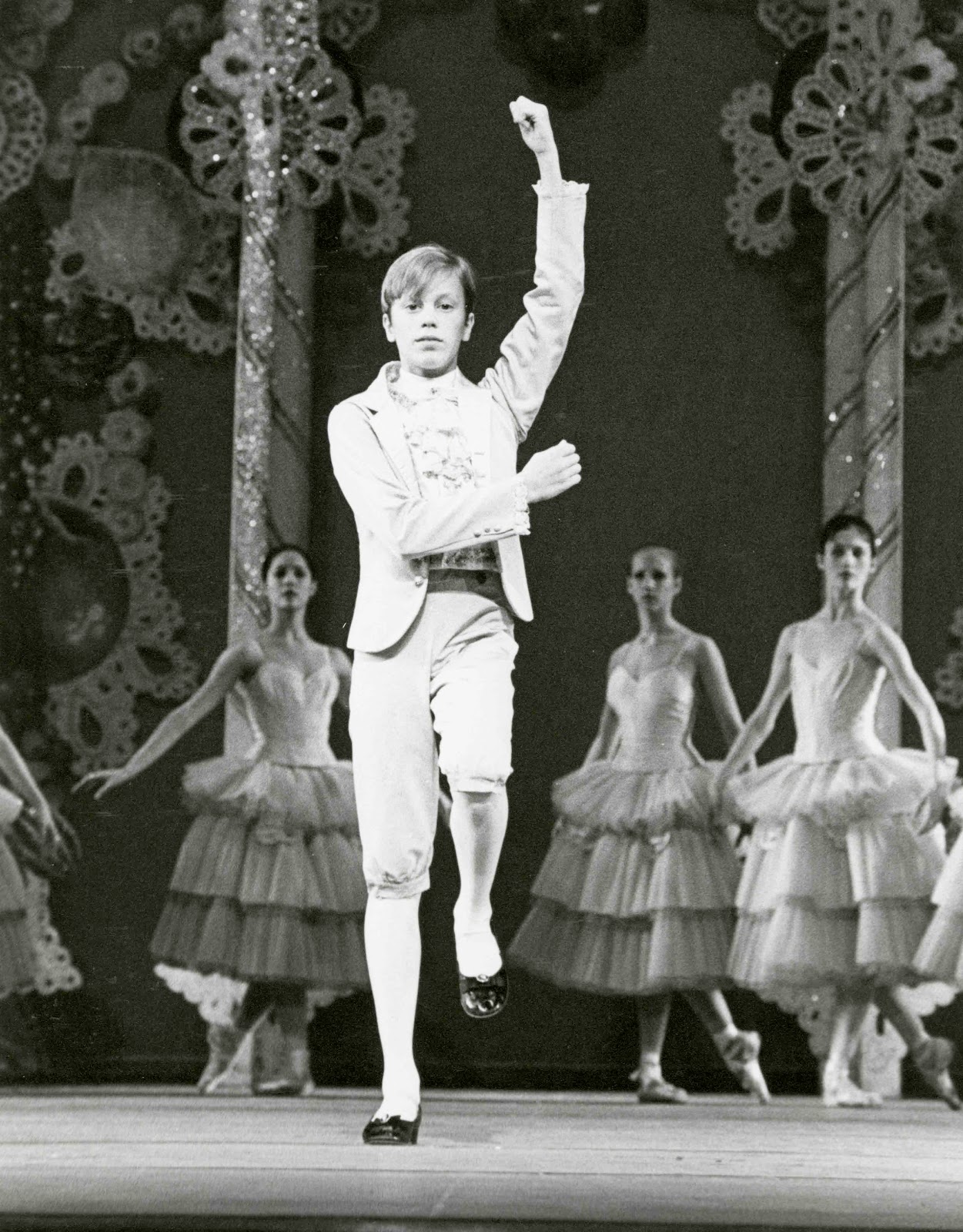
Peter Boal as The Little Prince in 1975.  Photo by Martha Swope

As a young student Peter Boal first danced in Balanchine's Nutcracker as a party guest, before undertaking the role of Drosselmeier's Nephew/The Nutcracker/The Little Prince at age ten in 1975 -- when George Balanchine was still alive and actively involved in staging the ballet.  A few years later Peter was the teen-age boy who crouches under the bed and provides its locomotion.  He went on to dance most of the adult roles in the ballet culminating with The Sugarplum Fairy's Cavalier.  In 2014 he even made one guest appearance with NYC Ballet as Herr Drosselmeier.  

As the Artistic Director of Pacific Northwest Ballet, Peter has just unveiled his own staging of Balanchine's Nutcracker for that company.  He will play the role of Herr Drosselmeier at several PNB performances this season.

The Little Prince has been the launching pad for several distinguished ballet careers in addition to Peter Boal's -- including those of Eliot Feld (who originated the role) and Jacques d'Amboise. 
Jacques d'Amboise as The Little Prince.  Photo by Martha Swope

And don't forget that as a student in St. Petersburg, George Balanchine played The Little Prince himself.  In the early days of this production Balanchine also played Herr Drosselmeier -- including in the first television production of the ballet.


Monday, June 15, 2015

NYC Ballet's (Mis)Adventures with Bournonville: Part One, 'Bournonville Divertissements'

Before we saw the all-Bournonville program at NYC Ballet on Sunday, May 24th, I had attended a dress rehearsal of 'La Sylphide' on May 5th and together we went to the NYCB Seminar on " Peter Martins' 'La Sylphide' and the Bournonville Style" on May 18th.  This is the first of four posts about these events.

August Bournonville (1805 to 1879) was a Danish dancer, ballet master and choreographer who studied ballet in Denmark and later in Paris, then danced briefly with the Paris Opera Ballet before returning to Copenhagen where he was a principal dancer and ballet master at the Royal Theater.  For over 45 years he shaped the Danish ballet tradition.  Several of the full-evening works he created for the Royal Danish Ballet remain in their active repertory including 'La Sylphide', 'Napoli', and 'Flower Festival in Genzano'.  In addition, there are lots of surviving excerpts from other ballets that he choreographed for the RBD.


Bournonville traveled extensively and brought back folk dances and settings from many regions he visited and included them in his works for the Royal Danish Ballet.


Bournonville Divertissements:

SUNDAY MATINEE, MAY 24, 3:00 PM [Conductor: Capps]
BOURNONVILLE DIVERTISSEMENTS: Pereira, Peiffer, Reichlen Mearns, T. Angle, Adams, Pollack, Mann, Isaacs, Janzen, Scordato, Gordon

George Balanchine was a guest ballet master at the Royal Danish Ballet for a brief period in 1929 and greatly admired the Danish style.  In 1964 Balanchine invited Stanley Williams, the great Danish ballet dancer and teacher, to teach at the School of American Ballet.  He was a revered member of the SAB faculty until his death in 1997.  In 1977, Balanchine asked Williams to stage several excerpts from Bournonville's ballets for New York City Ballet and the result became 'Bournonville Divertissements'.  


'Bournonville Divertissements' has been out of the Company's repertory for many years.  It was restaged for this all-Bournonville program by Nilas Martins, Peter Martins' son.  Nilas studied at the school of the Royal Danish Ballet and at SAB before joining NYCB, where he rose to principal dancer, retiring in 2010.  Since 2013 Nilas and his wife, former NYCB principal and ABT soloist Monique Meunier, have been co-directors of the Academy of Nevada Ballet Theater in Las Vegas.  


The costumes (by Ben Benson) and sets (by Alain Vaes and David Mitchell) for the revival are from the original 1977 production.  The current production omitted the pas de deux from 'The Kermesse in Bruges' and the pas de trois from 'La Ventana' that were part of Williams' original staging.


Airborne corps of 'Ballabile' from 'Napoli, Act I' by Bournonville.  Photo by Paul Kolnik for NYC Ballet
The divertissements begin with the 'Ballabile' from Act I of Bournonville's 'Napoli' (1842) set in a fishing community on the Bay of Naples.  (We saw the Royal Danish Ballet perform the entire three-act work a few years ago at the Kennedy Center in Washington.)   With Erica Pereira and Allen Peiffer plus a corps of 12, it introduces the light, airy Bournonville style danced here to music by Simon Paulli.  The (very unattractive) costumes are similar to the costumes from the RDB's current production including 'pedal pushers' and shorts over bare legs for the men and 'do rags' for the corps women.


Erica Periera and Allen Peiffer in the 'Ballabile' from Bournonville's 'Napoli'.  
Photo by Paul Kolnik for NYC Ballet
The pas de deux from 'Flower Festival in Genzano' (1858) to music of Edvard Helsted followed.  It was beautifully danced by Teresa Reichlen (replacing Sara Mearns) and Tyler Angle.  They nicely captured the flirtatious interactions of Bournonville's choreography and the crisp lightness of the Danish style.  I had glimpsed Tess rehearsing this piece with Ask la Cour in an SAB studio and was pleased to see her in the finished product at this performance.
Teresa Reichlen in the pas de deux from 'Flower Festival in Genzano'.  Photo by Paul Kolnik for NYC Ballet

Tyler Angle in 'Flower Festival in Genzano' pas de deux from 'Bournonville Divertissements'.
Photo by Paul Kolnik for NYC Ballet


Next came a pas de six with an amalgam of dances from Bournonville's 'Napoli, Act III' with music by Paulli and 'Abdallah' (1855) with music by Helsted.  The seven dancers were Sara Adams, Ashly Isaacs, Meagan Mann, Brittany Pollack, Russell Janzen, Andrew Scordato and Joseph Gordon.  They dance beautifully in solos, duos, trios, etc.  Ms. Pollack, Mr. Scordato and Mr. Janzen looked especially elegant dancing in the Danish style, which requires both precision and naturalness.

The pas de six segued into the 'Tarantella' from 'Napoli, Act III' danced by the entire cast with several additional corps dancers thrown in for good measure.  It went on ad infinitum, ad nauseam.  Surely, these divertissements are more than enough of the Bournonville style for one program.  And personally, I would cut the entire tarantella and replace it with the pas de deux from 'Kermesse in Bruges' -- which I remember fondly from the 1977 production danced by Patricia McBride and Helgi Tomasson.


Monday, October 27, 2014

New York City Ballet -- Tuesday, October 14, 2014

We attended the New York City Ballet performance on Tuesday evening, October 14th.  It was our first chance to see Justin Peck's 'Everywhere We Go' -- which was first seen during the Spring 2014 season.  The program also featured several debuts (*) in Balanchine's 'Chaconne' and Robbins' 'Interplay'.

TUESDAY EVENING, OCTOBER 14, 7:30 PM
[Conductor: Capps]
CHACONNE: Kowroski, T. Angle, *King, *Huxley, *Kikta, *Kretzschmar, *Sanz, *Woodward, *Hod, *Alberda, *Phelan, *Prottas
INTERPLAY: Pollack, *Wellington, *Mann, *Villwock, Walker, Alberda, Hoxha, *Coll (replaces Villarini-Velez)
[Solo Piano: Walters]
pause
AFTER THE RAIN PAS DE DEUX: Whelan, Hall [Solo Piano: Moverman, Solo Violin: Delmoni]
EVERYWHERE WE GO: Krohn, Isaacs, Hyltin, Reichlen, Danchig-Waring, Ramasar, Veyette

George Balanchine staged 'Chaconne' for Suzanne Farrell and Peter Martins in 1976.  
Peter Martins and Suzanne Farrell, the original cast in Balanchine's 'Chaconne'.
Photo by Max Waldman
The score is ballet music from Christoph Willibald von Gluck's opera 'Orphee et Euridice'.  Balanchine had worked with Gluck's score before.  First, in 1936 
he staged the opera for the Metropolitan Opera with decor by Pavel Tchelitchew.  The singers were in the pit with the orchestra and his American Ballet dancers were on stage   It lasted for two performances.  In 1963 he composed all of the dances for a production of the opera by the Hamburg State Ballet.  This production was mounted by the Paris Opera a decade later with some adjustments by Balanchine.  In 1975, a somewhat different version was performed by the Chicago Lyric Opera with dances by Balanchine.  'Chaconne' is based primarily on the ballets he created for the Hamburg State Opera version with adjustments, of course, for the special gifts of Farrell and Martins.

The ballet is divided into two distinct sections.  The first section (the Elysian Fields) begins with an ensemble of nine women with loose hair and long flowing beige costumes walking slowly about the stage in simple patterns.  As they exit the stage the principal couple (Maria Kowroski and Tyler Angle) in simple white costumes enter on a diagonal.  Their first moves are beautiful calm mirroring arabesques which they sustain joined only by one hand.  In recent seasons Maria and Tyler have formed a wonderful partnership which was fully displayed in this first pas de deux with its low, skimming lifts and off-kilter promenades to Gluck's 'Dance of the Blessed Spirits'.

As Tyler carried Maria off stage in a last series of low lifts, the stage brightens and the large cast entered for the divertissements and chaconne that end the opera -- a secondary couple (Lauren King and Anthony Huxley); a trio (Emily Kikta, Gretchen Smith and Aaron Sanz); five women (led by Indiana Woodward); two demi-soloist couples (Ashley Hod with Devin Alberda and Unity Phelan with David Prottas); and a corps of 15 (9 women and 6 men).  The Karinska costumes are white and pale blue; the background is a blue sky with wispy white clouds.  

Kikta, Smith and Sanz were making their debuts in the pas de trois.  The man is a troubadour plucking on an imaginary lute while his ladies strut in courtly fashion.  This new trio were astonishingly accomplished and conveyed the Baroque spirit of the piece.

The tricky pas de deux that follows was danced with sunny assurance by King and Huxley, also making their role debuts.  It is a tricky dance that relies on bent arms and legs as a recurring motif.  Anthony, sometimes an insecure partner, showed new confidence in the complex partnering with Lauren and between them there is a nice contrast of stage personalities -- Anthony dark and reserved, Lauren vivacious and fair.

The pas de cinq was lead by Indiana Woodward, another debutant, with twinkle.

Kowroski and Angle re-emerged in more formal white costumes to dance the final pas de deux.  The entrance is elegant, but with a cheeky swagger.  Balanchine brought out the high Baroque elegance in the music, which Farrell and Martins embellished with self-confident showmanship.  Maria Kowroski has always been a worthy heiress of the roles Balanchine created for Farrell, absorbing the style without all of the mannerisms.  Maria's long slender arms and legs and easy hyperextension were deployed here with grace and wit. 
Maria Kowroski in the second principal pas de deux from Balanchine's 'Chaconne'.
Photo by Paul Kolnik for NYC Ballet
Here Tyler proved himself an able interpreter of Martins' skillful, but not subservient, partnering.  Tyler shared the stage with natural nobility and elegantly understated style.


Following their pas de deux, there is a passage -- the actual chaconne -- for the 15 members of the corps with the two demi-soloist couples (Hod with Alberda and Phelan with Prottas, all in debuts).  They are then joined by the principal couple.  Balanchine loved the resolving the challenges posed by odd numbers of dancers on stage.  The patterns and combinations he devised for first 19 and then 21 dancers display his clever solutions.  Then, the entire ensemble gathers for the final courtly menage.
Maria Kowroski and Tyler Angle in the chaconne from Balanchine's 'Chaconne'.
Photo by Paul Kolnik for NYC Ballet

Jerome Robbins' 'Interplay' to the music of Morton Gould is the better of his 'kids just having fun' ballets.  It was first done in 1945 for Billy Rose's Concert Varieties and was staged for NYC Ballet in 1952.  Four of the eight dancers were making their debuts, but somehow I wasn't convinced that they were having all that much fun.  Their camaraderie seemed more calculated than spontaneous. 

The pas de deux from Christopher Wheeldon's 'After the Rain' followed.  It was on many programs over the last two weeks of the fall season -- as a vehicle for Wendy Whelan to bid farewell to her adoring audience.  I'll say it again -- Wendy Whelan is remarkable and nothing shows off her special magic better than Wheeldon's ethereal pas de deux of departure and impending loss.  For the past several years, Craig Hall, has been her sensitive, supportive partner.
Craig Hall and Wendy Whelan in the pas de deux from Wheeldon's 'After the Rain'.  Photo by Erin Baiano
The audience gave Wendy (and Craig) a standing ovation -- much deserved after her indelible 30-year career with the company.


The final work of the evening was Justin Peck's 'Everywhere We Go' which premiered during the Spring 2014 season.  Choreographed to nine 'musical movements' commissioned from Sufjan Stevens by NYC Ballet with a cast of 25 -- a mixture of principals, soloists and corps dancers.  The 13 women all wear leotards with black and white striped tops and white bottoms separated by a single red band above the waist; the 12 men all wear leotards with grey tops and black bottoms separated by a single red band.  The costumes are by  Janie Taylor, the former NYCB principal dancer.
Andrew Veyette and Sterling Hyltin with cast in Justin Peck's 'Everywhere We Go'.
Photo by Paul Kolnik for NYC Ballet
The backdrop by Karl Jensen is a backlit honeycomb of overlapping hexagons that changes shapes between each of the nine sections.    

There are two prominent motifs that occur throughout the piece.  One is a large group of dancers lying on their backs with one leg pointed straight into the air.  Often this is accompanied by other dancers touching the raised feet as they circle the prone dancers.  The second is some dancers going limp and being caught by other dancers and gently laid on the floor.

As usual with Peck's choreography, there is no specific hierarchy to the piece with individuals emerging from the group for solos and duets and then merging back in.  Teresa Reichlen has dazzling solo passages and Ashley Isaacs paired with Amar Ramasar particularly catches the eye.
Teresa Reichlen jetes past three men from the cast (Taylor Stanley, Daniel Applebaum and Andrew Scordato).
Photo by Andrea Mohin for the NY Times
Peck needs to learn to edit his work, so that he doesn't fall into the Jerome Robbins trap of leaving the audience begging for less.  Six or seven 'musical moments' would probably have been better than nine and might have resulted in less repetition.  The whole cast succumbing to the plague once is interesting -- twice it's redundant and frankly rather tiresome at the end of a long evening.

Could Peck's ballet be about honeybees (the backdrop) and the unexplained collapses of bee colonies?  Is Reichlen the queen bee?


Saturday, October 25, 2014

New York City Ballet -- Sunday, October 19, 2014

How disheartening to walk home from the performance by New York City Ballet last Sunday afternoon!  We had just seen four works by Balanchine choreographed to the music of Tschaikovsky -- Balanchine's company performing four works to the music of one of his favorite composers.   And yet, the fall season had just ended for us with a dull thud.  

SUNDAY MATINEE, OCTOBER 19, 3:00 PM
[Conductor: Capps]
SERENADE: Mearns, Lowery, Reichlen, J. Angle, Danchig-Waring
MOZARTIANA: Kowroski, T. Angle, Huxley
pause
TSCHAIKOVSKY PAS DE DEUX: Bouder, Garcia
TSCHAIKOVSKY SUITE NO. 3: ELEGIE: Krohn, la Cour; WALTZ: A. Stafford, J. Peck;
SCHERZO: Pazcoguin, Schumacher; THEME & VARIATIONS: Hyltin, Veyette

Sure, the company had celebrated the retirement of an iconic ballerina (Wendy Whelan) after a storied 30-year career with the company the night before.  Sure, they were just finishing a season packed with premieres of four new works.  Sure, three of its principals have gone on sabbatical to perform in Broadway shows.  Sure, the company's ranks have been depleted by illness and injury. Sure, sure, sure there are excuses to be made for this bloated, dull performance.

The most egregious reason for this lackluster performance, is the continuing erosion of the standards of the orchestra.  It is now nearly three years since the former music director, Faycal Karoui, announced his decision to leave the company.  Since his departure in the Spring of 2012, the company has not succeeded in securing a competent replacement and has struggled along with an inadequate 'interim music director',  two associate conductors of good-to-indifferent quality, and a collection of so-so guest conductors who may have been auditioning for the music directorship.

The failure of Peter Martins and the Board of Directors to find and engage a music director of the stature of Andrea Quinn and Faycal Karoui for the house of Balanchine is a disgrace.  Having allowed the orchestra to deteriorate in the years prior to Maestra Quinn's arrival in 2001, one would think that management had already learned the lesson that inadequate attention to the pit can have a disastrous impact on the artistic merit of what is presented on stage.

It is interesting to note that three of the four new works this season were performed to solo piano music or small chamber ensembles.  Are the choreographers choosing not to entrust their new pieces to an interim music director and his deficient orchestra?

Instead of just complaining about the lousy music making, let me propose a long-term solution.  Together, New York City Ballet, the Julliard School and Career Transitions for Dancers should establish a joint fellowship/apprenticeship program that identifies dancers reaching the end of their stage careers who have the interest and aptitude to become conductors -- specifically ballet conductors.  Julliard provides formal training and mentorship in music and conducting; City Ballet, the Julliard Dance Division and the School of American Ballet provide apprentice conducting opportunities; individuals who understand ballet from the perspective of dancers gain the technical skills to become ballet conductors and music directors; meaningful career transitions for dancers are facilitated; and the pool of qualified candidates for music director is expanded. 

On Sunday, the orchestra's playing under Daniel Capps wasn't awful, merely indifferent, rote and plodding.
NYC Ballet corps in the opening image of the Balanchine/Tschaikovsky 'Serenade'.
Photo by Paul Kolnik for NYC Ballet
In 'Serenade' to Tschaikovsky's 'Serenade in C for Strings' it seemed that the dancers were given no incentive to listen to the music and respond to it.  When dancers of the stature of Sara Mearns, Teresa Reichlen and Jared Angle appear lethargic and unmotivated something is quite wrong.  Reichlen's 'dark angel' barely completed the manipulated rotations in arabesque above Mearns and left out the final stretched arabesque pose that usually makes this moment so striking.  Adrian Danchig-Waring flubbed a lift with Reichlen.  The final tableau with Mearns carried by the four men looked perilously shakey. 


The closing image of the Balanchine/Tschaikovsky 'Mozartiana' with Tyler Angle, Maria Kowroski and 
Daniel Ulbricht.  Photo by Paul Kolnik for NYC Ballet
Balanchine created 'Mozartiana' in 1981 for Suzanne Farrell, Ib Anderson and Christopher d'Amboise -- to Tschaikovsky's 'Suite No. 4', his arrangement and orchestration of four short works by Mozart.  Balanchine had used the music before -- first for Les Ballets 1933 and then in 1945 for the Ballet Russe de Monte Carlo.

Maria Kowroski looked calm and poised in the opening 'Preghiera' which Balanchine stages as a kind of prayer.  Unfortunately, the four young students from the School of American Ballet looked ragged and undone by the lack of musical pulse coming from the pit.  The elegant Anthony Huxley, new in the 'Gigue' this season, gave a surprisingly uninspired performance.  The four tall women (Marika Anderson, Megan Johnson, Emily Kikta, Gwyneth Muller) looked gorgeous in the 'Menuet' but the pit undermined their precision.    Tyler Angle joined Kowroski for the 'Theme et Variations'.  They danced beautifully despite the orchestra's failure to adequately differentiate one variation from another.


Ashley Bouder and Gonzalo Garcia in Balanchine's 'Tschaikovsky Pas de Deux'
Photo from (Albany) Daily Gazette
Ashley Bouder and Gonzalo Garcia brought the requisite dazzle to Balanchine's 'Tschaikovsky Pas de Deux'.  They looked great together.  Gonzalo turns the opposite direction from most male principals in the variations, which is a little disconcerting, but doesn't detract from the clarity of his execution.  Bouder's bravura was on full display -- without the smugness that can often undermine her performances.


Corps and demi-soloists in 'Tema con Variazioni' from Balanchine's 'Tschaikovsky Suite No. 3'.
Photo by Paul Kolnik for NYC Ballet
In 1970 Balanchine created 'Tschaikovsky Suite No. 3' by choreographing the first three movements of the Tschaikovsky suite and tacking them onto the front of 'Theme and Variations' -- a ballet he had created for American Ballet Theatre in 1947 using the final movement from the suite, 'Tema con Variazione'.  The first three sections take place behind a scrim in a hazy, dimly lit, 'ghost' ballroom. The women are in long flowing gowns in shades of lavender with unbound hair and the men are in loose silk trousers with ruffled shirts.  

The opening 'Elegie' was lead by Ask la Cour and Rebecca Krohn.  Ms. Krohn seems uncomfortably miscast as the passionate, romantic 'ideal' woman to Mr. la Cour searching dreamer.  Abi Stafford and Justin Peck could not do much with the lackluster Balanchine choreography for 'Valse Melancolique'.  Georgina Pazcoguin and Troy Schumacher took the spins and leaps of the 'Scherzo' with dare devil speed.  Their final jetes into opposite wings lead to a blackout accompanied by the raising of the scrim (which coupled with the dim lighting always seems like an annoyance by this point in the work).

When the lights blaze on for the 'Tema con Variazioni', we are in a magnificent ballroom with Sterling Hyltin, Andrew Veyette, the four demi-soloist women, and eight corps women symmetrically arrayed in glittering costumes of white, gold and turquoise.  The two principals state the theme, followed by the women.  Variations follow, alternating between the ballerina and her cavalier with support from the demi and corps women.  Unfortunately, Hyltin does not have the technique and strength for this demanding role.  Her footwork and beats are blurred and indistinct and her energy flags noticeably.

The polonaise and finale for the full 26-member cast are always glorious and uplifting.  But they couldn't erase the memories of inadequacies earlier in the performance.  Perhaps an all-Balanchine/Tschaikovsky program looks better on paper than the reality -- nearly three hours in their company with inadequate musicianship and spotty casting.  Perhaps the season should just have ended with Wendy Whelan's farewell performance instead.


Saturday, October 11, 2014

New York City Ballet -- October 6, 2014 -- Wendy Whelan Farewell

On Monday, October 6th, we went to New York State Theater for a NYCB Association seminar devoted to Wendy Whelan's 30-year career with the Company.  It was really a chat between Wendy and Tyler Angle -- one of her regular partners over the last few years.
Wendy Whelan & Tyler Angle in Christopher Wheeldon's 'Polyphonia'.  Photo by Paul Kolnik for NYC Ballet
Wendy was part of the first generation of dancers to join the Company following Balanchine's death in April of 1983 -- Wendy became an apprentice in 1984 and joined the Company in 1986.  In discussing her earliest days with the Company, she noted that she didn't miss Balanchine's presence, because he had never been around when she joined the Company, but that she missed his approval of how she danced the roles he had created for others.
Wendy Whelan in the studio with the choreographer Christopher Wheeldon
She only realized how much this could mean when she started working with living choreographers on new works.  She was particularly inspired by working with Christopher Wheeldon (first on 'Polyphonia' which premiered in early 2001) and Alexei Ratmansky (first on 'Russian Seasons' which premiered in mid-2006).  Wheeldon created roles in seven more ballets for Wendy; Ratmansky created roles in three more.  The two choreographers are working on a piece d'occasion for Wendy's farewell performance on October 18th which she will dance with Tyler Angle and Craig Hall.


Wendy Whelan and Craig Hall in 'After the Rain' by Christopher Wheeldon, photo by Paul Kolnik for NYC Ballet
When the subject of mentoring was raised, Wendy laid out the lineage of her special relationships with her fellow dancers:  Heather Watts who danced under Balanchine had mentored the young Jock Soto; Jock in turn mentored Wendy; and Wendy has mentored both Craig Hall and Tyler Angle who have been her primary partners following Jock's retirement.  Wendy says that she's always open to other colleagues asking for advice and assistance, but 'they have to ask'.    

Recently, she has been teaching advanced girls at Ballet Academy East and looks forward to continuing that mentorship role as time permits.  An audience member asked why she was teaching at Ballet Academy East rather than at the Company's official school, The School of American Ballet.  She answered, 'that's not up to me'.  I would only add, that's SAB's loss.

Among her favorite roles: the final waltz in Balanchine's 'Liebeslieder Waltzer' and the last movement of Balanchine's 'Brahms-Schoenberg Quartet'; Robbins' 'The Cage', 'Dances at a Gathering' (especially the Grand Waltz), and 'In Memory Of . . .'; plus all of the works created for her by Wheeldon and Ratmansky.

Roles she would have liked to dance (it seems she's danced every role in the Company's repertoire):  Balanchine's 'La Valse' and Robbins' 'Afternoon of a Faun'.

Next steps in her career: Wendy takes her show 'Restless Creature' on the road for six months starting in January.  It features four works by four young, male choreographers who are also her partners in their works.
Wendy Whelan and Joshua Beamish in his piece from 'Restless Creature' .  Photo by Christopher Duggan.
Next summer an evening of new works created for Wendy and Edward Watson of the Royal Ballet at Covent Garden which will transfer to City Center in New York in 2016.  Wendy has been named Artistic Associate at City Center for two years beginning next month.  In other words, when she leaves City Ballet on October 18th, Wendy will not be resting on her considerable laurels.  
Wendy Whelan preparing toe shoes in her dressing room at Lincoln Center.
Photo by Beatrice de Cea for the New York Times 
You can go to Wendy's web page (www.wendywhelan.org) to keep up with her.  It includes a schedule of 'Restless Creature' dates and a wonderful 11 minute video about her life to date.