Showing posts with label Jock Soto. Show all posts

Saturday, June 25, 2016

Wrap-Up to the SAB 2015-16 Winter Term

Workshop Gala Dinner at David Geffen Hall following
the performance on Tuesday evening, June 7th. 
The last day of The School of American Ballet's 2015-16 Winter Term was Friday, June 17th.  Following the successful Workshop Performances on Saturday, June 4th, and the Workshop Performance Gala Benefit on Tuesday, June 7th, the students in the advanced division were back in the SAB studios again on Wednesday, June 8th, refining what had already seemed perfect at the performances.
2016 Mae L. Wien Award winners with Kay Mazzo, Co-Chairman of the SAB faculty
were (left to right): Jon Stafford (faculty award), Ms. Mazzo, Ethan Fuller,
Emma Von Enck, and Christopher D'Ariano
Photo by Paul Kolnik for SAB


Advanced students at the end of the last class on June 17th.  Jon Stafford is at left.

Of the Capstone students (those that aged out of the School's programs this June) 18 have accepted offers of apprenticeships, second company positions and traineeships.  Look for these students (now SAB alumni) on professional ballet stages during the years ahead:

New York City Ballet apprentices:
  • Eliza Blutt
  • Christina Clark
  • Ethan Fuller
  • Jennifer Hackbarth
  • Kennard Henson
  • Emma Von Enck
Pacific Northwest Ballet professional division trainees:
  • Christopher D'Ariano
  • Hailey Dupont
  • Dallas Finlay
  • Marie Millard
Other companies around the U.S. and the world:
  • Lillian Casscells, apprentice at Dresden Semperoper Ballett
  • Lucia Connelly, apprentice at Joffrey Ballet
  • Rachel Costin and Wilson Livingston, apprentices at Sarasota Ballet
  • Gabriela Schiefer, member of Boston Ballet II
  • Marc LaPierre, apprentice at LA Ballet
  • Taylor Ayotte, trainee at Carolina Ballet
  • Lucy Nevin, trainee at Washinton Ballet
In addition, four students have elected to go on to universities and colleges:
  • Ana Maria Del Mar, Harvard University plus London University of the Arts
  • Trevor Dines, Columbia University
  • Michael Garcia, The Julliard School
  • Xhosa Scott, University of Virginia
Thirty students graduate(d) from high school this spring.  Twelve of them received a total of 37 acceptances from 31 different colleges and universities.

Capstone students with Suzy Pilarre (second from left), Suki Schorer (third from right) and Kay Mazzo (far right).
Obviously, Jonathan Stafford's efforts as Professional Placement Manager (one of the three positions Jon fills at SAB and NYC Ballet) and the Student Life staff directed by Kelly Novitski have done another wonderful job this year in assisting students as they move along their paths toward professional careers or other opportunities.

Most of the remaining advanced division students will be attending summer programs at ballet companies and schools around this country and the world, before returning to SAB in September for the 2016-17 Winter Term.  And SAB will be hosting 200 students from around the world during its own 5-week Summer Session and then several more students at its 2-week summer workshop for younger dancers in southern California.

We wish them all further successes as they move forward now and anticipate learning more about their future achievements both on ballet stages and in the wider world. 

On a Sadder Note:

The SAB 2015-16 Winter Term has had some sad moments as well.
Jock Soto with Luis Fuentes and their dog Bandit in near their home in Eagles Nest, NM this June.
Photo from Laura Ortman's Hair Today on Tumblr
Jock Soto, a highly regarded member of the SAB faculty, retired at the end of 2015 to pursue his interests in the culinary world.  Jock hopes to write more cookbooks (he co-authored 'Our Meals' in 1997 with Heather Watts -- his long time partner at NYC Ballet).  He and his spouse, Luis Fuentes, also hope to open a restaurant and catering business.  Jock had been a teacher at SAB since 1996.  His Adagio (Partnering) classes were widely admired in the ballet world and produced a long line of superb male partners for New York City Ballet -- including Jared Angle, Craig Hall, Amar Ramasar, Tyler Angle, Chase Finlay and Taylor Stanley.


Violette Verdy teaching an Advanced Division class at SAB.
Photo from 
http://www.bigouden.tv/ obituary (probably by Rosalie O'Connor)
Violette Verdy, the School's first permanent guest teacher, died in early February 2016 after a short illness.  Her regular visits to the School were always highly anticipated by SAB's advanced students.  As one of George Balanchine's favorite ballerinas during her years with New York City Ballet (1958 thru 1977), Ms. Verdy had danced in a wide variety of the company's repertory and creating memorable roles in Mr. B's 'Liebeslieder Waltzer', 'Emeralds', 'Tschaikovsky Pas des Deux', 'La Source' and 'Sonatine' and in Jerome Robbins' 'Dances at a Gathering'.   Following her retirement from the stage, Ms. Verdy had a distinguished career as artistic director of the Paris Opera Ballet and Boston Ballet and as a dance educator at Indiana University.  During her brief residencies at SAB her students were privileged to have both a link to the great ballet creators of the 20th century and an inspiring and caring teacher.

Friday, August 7, 2015

Still More Ballet Quibbles & Bits. . .

NYCB's Program for Children with Disabilities:

This spring New York City Ballet launched a program specially designed for families with disabled children.  It's extremely moving to watch principal dancers Maria Kowroski and Adrian Danchig-Waring work with 19 youngsters with cerebral palsy and their families as they experience the joy of dancing in this short video:

https://www.youtube.com/watch?v=wp6LeOIkUuQ&utm_source=wordfly&utm_medium=email&utm_campaign=FY16SummerCerebralPalsyAppeal&utm_content=version_A

"I didn't want to treat them differently from a normal child.  I didn't want to make them feel disabled, " Maria says in the video.  "I was worried that I was going to get emotional watching them because it's difficult to see someone struggle."


Maria Kowroski and Adrian Danchig Waring in Ulysses Dove's 'Red Angels'.  Photo by Paul Kolnik for NYC Ballet

City Ballet partnered with a cerebral palsy specialist, Joseph Dutkowsky, M.D., who helped Maria and Adrian design and lead the workshop -- a total of four sessions ending with a 'performance' where their young students donned purple tutus and red super-hero capes to perform the movements they had worked on in earlier sessions for an audience of parents and family members.
The final 'performance' of NYC Ballet's workshops for disabled children.
Photo is a still from the video filmed by Upworthy.


Of the 'performance' Adrian says " it was a really emotional day.  Maria and I had not been prepared for how connected we would feel immediately with the group of kids that we had.  In fact, we had underprepared for how energetic, enthusiastic, and physically capable these kids turned out to be."  Watch the video -- it will make you proud of New York City Ballet and Maria and Adrian for undertaking this project, which became a labor of love.


SAB's Summer Choreography Showing:

On Thursday, July 30th, we attended School of American Ballet's Summer Choreography Showing.  Toward the end of every Summer Session the School offers two choreographers the chance to create a work for the most advanced summer students.  This summer, Alec Knight and Jock Soto were the choreographers (Jock stepped in when Sasonah Huttenbach, who was originally selected, dropped out for health reasons).

Alec Knight has choreographed works for the past two Student Choreography Workshops.  For this Summer Choreography Showing, Alec created a work for 16 advanced students to a piece of music called 'Ēvolūtiō' by Break of Reality -- a cello rock band that consists of three cellists and a percussionist.
 
Break with Reality, the American cello rock band
Break of Reality was formed in 2003 by four freshman at the Eastman School of Music in Rochester, NY.  Two of the original founders, Patrick Laird and Ivan Trevino, are still with the band.  The other two current members are Laura Metcalf and Adrian Daurov.

'Ēvolūtiō' consists of four movements:  'Intactus' (untouched, pure, to one's self); 'Exordium' (the start, an introduction, or to have curiosity about another being); 'Amare & Luctus' (love and heartbreak); and 'Recomminiscor' (to reinvent, rebuild).  It is an adventurous choice of music for a budding choreographer and Alec Knight used the four sections to portray the transition from often lonely adolescence to adulthood.  Using 16 advanced students dressed in black leotards (the women) and black T-shirts and tights (the men) Alec portrayed in often quirky, abstracted movements and interactions between dancers the evolution he had described in his introductory remarks.

'Ēvolūtiō' begins with a single woman alone in the center of the studio and then moves groups of dancers on and off the performing space.  Interactions are fragmentary and the sense of isolation -- both of the individual and of smaller groups -- permeates the first movement.  In the second movement, interaction becomes more frequent as individuals break through their isolation.  In the third movement an infatuation between two of the dancers emerges, but ends in disappointment.  And in the final movement, the dancers have become a community from which individuals and couples emerge and retreat.

In SAB's Studio One the audience is spread along one long wall adjacent to the performing space which can make watching a performance (or even a class) seem like watching tennis from a front row seat.  Many neophyte choreographers struggle to help observers focus on the important elements of their dance design.  Alec was largely successful with groupings that attract the eye and canonical movements that lead the audience from one 'important' element to the next.


Jock Soto chose 'Valse' from  Alexander Glazunov's 'Raymonda' (beautifully played by Ala Reznik) for his piece, 'The Waltz', for 26 advanced students.  The music was familiar to New York City Ballet followers since it is used by Balanchine in 'Raymonda Variations'.  Jock decided to present the rest of the summer course advanced students (and to round out his design -- two of the women from Alec's work) so all got the opportunity to dance in the showing.


Jock used a female soloist, three male demi-soloists (the Cuban triplets) and an ensemble of eleven couples.  His answer to the 'tennis match' problem of Studio One was to employ symmetrical patterns for the ensemble and also for the triplets -- though I thought they were spaced too far apart.  


The overall look of 'The Waltz' was traditional (the women in white leotards and tutus and the men in white T-shirts and black tights) and the choreography was lyrical.  The triplets were given several bravura passages and the female soloist had a long passage of intricate pointe work.  The 11 couples in the ensemble showcased the impressive results of Mr. Soto's (with Darci Kistler or Yvonne Borree) Adagio classes during the summer session.


The showcase was a wonderful evening of ballet potential -- with student dancers, a budding choreographer and another one too seldom seen exploring new horizons together.


New York City Ballet's 2015-16 Season Artwork:

I'm not wild about the cartoony artwork the Company is using for it's 2015-16 Season brochures, posters and other advertising/PR materials.  
Art by Jamie Lee Reardin from NYC Ballet's 2015-16 Season Subscription Brochure.

It's by Jamie Lee Reardin, who has worked primarily in fashion illustration.  Anyhow, here's a short video which provides a translation from the Company's outstanding repertory and superb dancers to Ms. Readin's caricatured interpretations:

https://video-lga1-1.xx.fbcdn.net/hvideo-xta1/v/t43.1792-2/11774942_10155916651600529_1243611289_n.mp4?efg=eyJybHIiOjE1MDAsInJsYSI6MTAyNH0%3D&rl=1500&vabr=626&oh=2d42d309de7e6f4b810639ae590d3a61&oe=55C2BD1E

I really can't imagine Reardin's art blown up to gigantic proportions on the Columbus Avenue side of the Koch Theater!
Jamie Lee Reardin's interpretation of 'Swan Lake' for New York City Ballet.

Friday, July 24, 2015

Ever More Ballet Quibbles and Bits . . .

Seeing Triple at SAB This Summer:

With much of the School of American Ballet's fifth floor studios a construction zone this summer, it's easy to think that you're seeing triple in the maze of plastic drop cloths and the cacophony of sledge hammers and nail guns.  You're not!
Marcos, Cesar and Angel Ramirez Castellano.  Photo by Ramon Espinosa for AP
I was doing double-takes as I encountered first one dark-haired, dark-eyed young man . . . then another . . . and another coming down the hall toward the back studios about 30 paces apart.  They're Angel, Cesar and Marcos Ramirez Castellano, 15-year-old identical triplets from Cuba who are attending SAB's Summer Session.  Here's a 2013 video profiling them that was produced by the BBC when they were just 13:

https://www.youtube.com/watch?v=ePjRF9oBhrw

You can think of their attendance at the five-week Summer Session as SAB's contribution to the recent thaw in U.S.-Cuban relations. 

SAB Founders Society Picnic:

Every summer, the School of American Ballet invites the members of its Founders Society -- a group of individuals who have made provisions for SAB in their estate plans -- to a 'picnic' followed by an opportunity to observe a Summer Session class.  

The 'picnic' has usually been held in the Student Lounge adjacent to the School's studios.  This summer the picnic -- a lovely buffet lunch of sandwiches, wraps, salads, cookies and fresh fruits (I missed the brownies this year) -- was held in rooms at the back of the Rose Building cafeteria because the areas around the student lounge on the 5th floor are under construction.  During the lunch, we heard from members of the School's Development Staff --  Cheryl Kohn, Chief Development Officer; Kristen Barrett, Director of Institutional Giving; and Giulia Gabrielli, Individual Giving Membership Coordinator -- about the renovation of the 5th floor and about various aspects of this year's Summer Session (including the Ramirez Castellano triplets).

Following the luncheon, Founders Society members were given a choice of watching Susan Pillare teach a girls toe class or Jock Soto teach the Intermediate Men.  We selected Jock's class.  There were 18 students in the class varying in age, height, ethnicity and ability.

While they were still at the barre, Jock taught them a complicated series of arm movements to accompany some fairly routine steps.  Then he divided them into two teams of nine and asked each team to select one representative to demonstrate the combination, and another to 'judge' the other team's choice in a competition.  Each judge was then asked for the number of 'errors' committed by the other team's man.  Jock took the two numbers and combined them into the number of push-ups that everyone had to do.

Over the course of the hour and a quarter class, the observers get a sense of which students have both the ability and drive to continue at SAB in the Winter Term or perhaps return for another Summer Term in 2016.  I had my eye on four out of the 18 that I'd like to see back at SAB again -- two that seem to be quite young and still quite short and two that seem more mature and more developed.  I felt that the other 14 lacked either the focus or the natural ability to succeed at SAB in the future.

Three Promotions at New York City Ballet:

Anyone who's been following this blog knows that I enthusiastically favor the three promotions that New York City Ballet announced at the end of their Spring season on June 7th:  Anthony Huxley and Lauren Lovette to principal dancers and Ashly Isaacs to soloist.


Anthony Huxley blossomed this spring from his naturally introspective elegance into a more expansive dancer in roles like James in Bournonville's 'La Sylphide' and Oberon in Balanchine's 'Midsummer Night's Dream'.  He still needs to work on his partnering skills, but his technical finesse and newly assured stage presence make him a valued addition to the top of the Company's roster.

Lauren Lovette and Anthony Huxley in Balanchine's 'Raymonda Variations'.
Photo by Andrea Mohin for NY Times

Lauren Lovette is one of the Company's most sunny and vivacious ballerinas -- plus she is drop dead gorgeous.  Since joining the Company as an apprentice in 2009 Lauren has essayed a wide variety of iconic roles in the NYCB repertory and brings a special sparkle to everything she dances.  This spring she was a spritely Sylph in Peter Martins' staging of Bournonville's 'La Sylphide'.

Ashly Isaacs struggled with injuries during her transition from SAB to NYCB -- she accepted SAB's Mae L. Wien Award in a cast and on crutches at the 2009 Workshop Gala -- but has since blossomed into an extraordinary dancer -- fleet, daring and musically adventurous.  Among her recent roles have been Dewdrop in 'The Nutcracker', Hippolyta in 'Midsummer Night's Dream' and the pas de deux from Bournonville's 'Flower Festival at Genzano'.


Ashly Isaacs as Hippolyta in Balanchine's 'A Midsummer Night's Dream'.
Photo by Andrea Mohin for the NY Times
Congratulations to all three dancers on these promotions which recognize both their achievements and their potential.

Tuesday, November 4, 2014

Halloween Open House at the School of American Ballet

The School of American Ballet holds an open house for members of its Association (donors) every year on Halloween.  Most students in the Advanced Division (and a few faculty members and accompanists) dress in costume for the occasion.  Association members are invited to observe classes from 10:30am to 4pm.
  
I arrived around 11:15am and was able to look in on the three classes in progress:

  • Suki Schorer was teaching the D women's class in Studio. Suki, of course, is a legend and always seems to inspire her students with her attention to detail and extensive knowledge of Balanchine technique.  She has been on the School's faculty since 1972, but was already a well-respected guest teacher at SAB by the mid-60's.

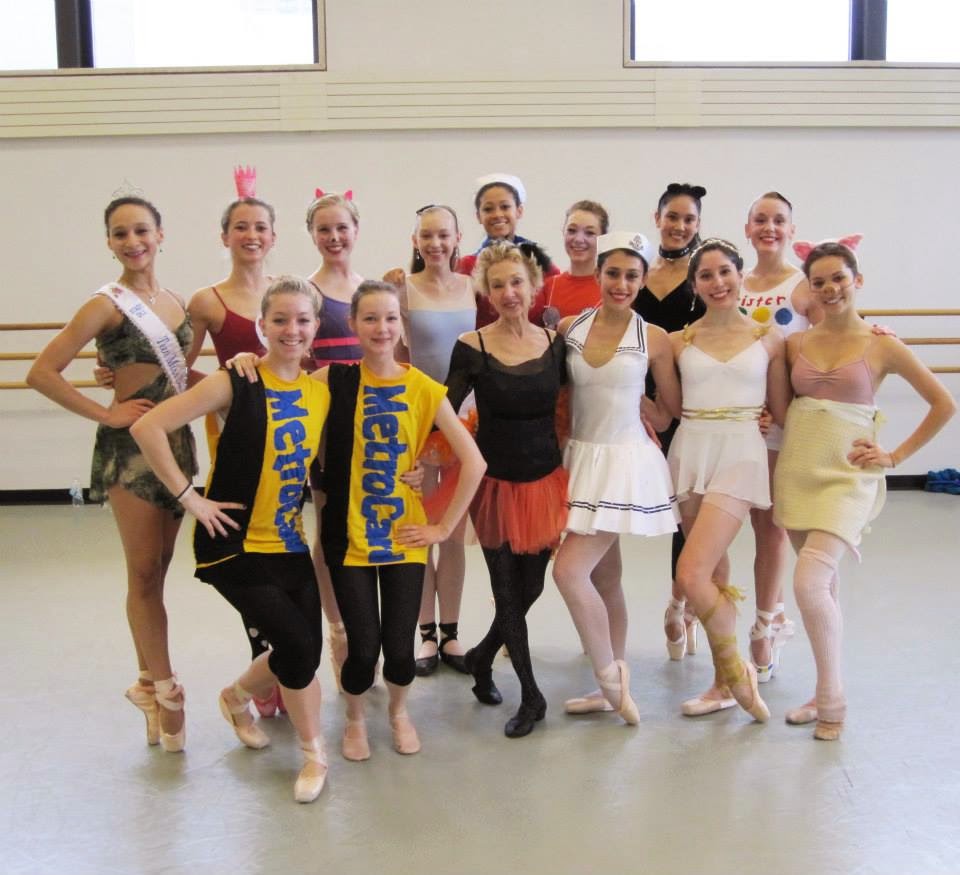
D Women's Class with Suki Schorer front and center,
 plus two Metrocards, a Sailor, a Greek Goddess and a Pig-in-a-Blanket in the front row.
Photo from SAB Facebook page

  • Jonathan Stafford was teaching the C-2 girls in Studio 4.  Jon is a more recent addition to the SAB faculty (2007) and I had not seen him teaching a girls class before.  He offers lots of corrections and encouragement and knows the technique from many years of performing at NYCB and training at SAB and earlier at Central Pennsylvania Youth Ballet under Marcia Dale Weary, a legendary teacher of students who have moved on to SAB and then to careers with New York City Ballet.

C2 Women including (seated) Glinda and Dorothy from Oz, 3 Pop Tarts (front row standing), 2 'Do Not Disturb' in nighties (center of second row standing), a Ladybug and a Captain Hook among others.
Photo from SAB Facebook page
  
  • Darci Kistler was teaching the C-1 girls in Studio 5.  As Balanchine's last ballerina, Darci is also carrying on his tradition.  She was teaching the C-1 girls a very difficult section of the Dewdrop solo from Balanchine's 'The Nutcracker'.  Darci would stop after each student performed and make corrections.  You could see each of them improve as they repeated the passage incorporating Darci's suggestions.

C1 Girls Class with 2 Rabbits, 2 Cats, Wonder Woman, a Witch, and a Footballer in the crowd.
Photo from SAB Facebook page

All three are amazing teachers and I'm sorry that I couldn't see all of their classes from start to finish. 

At noon, I moved back to Studio 1 to watch Jock Soto teach the Advanced Men.  It was a smaller group than usual, and I learned later that several of these students were participating in the New York Choreographic Institute program up on the seventh floor.

Jock was in fine form, offering something for the students and something for the observers.  He gave the class a very fast combination at the barre that involved legs and arms moving on different beats two six-count phrases.  None of the students seemed to get it right, but Jock's point was that choreographers and composers can throw these things at dancers and expect them to learn them quickly.  On center combinations he urged them to use the whole space -- even chasing some across the floor.  In order to illustrate taking off from a tight fifth position on double tours he used four men to surround the 'victim' (my word not Jock's).  Jock's classes are never dull.
From the Advanced Men's Class -- Mr. B's Cat (Mourka), a Convict/Mummy and a Construction Worker.
Photo from SAB Facebook page
Following a half hour break for brownies in the Student Lounge (for the adults, not the students), we were treated to an Adagio Class taught by Darci Kistler and Jock Soto for the Advanced Men with D Women from 2pm to 3pm and with C2 Women from 3pm to 4pm.  They were teaching both groups the opening section of the Sugarplum's grand pas de deux from Balanchine's 'The Nutcracker'.  Last year at the 2013 Halloween Open House, I had watched Darci and Jock teach a different passage from the same pas de deux.  It's amazing how much insight these studio deconstructions provide when I see actual performances at NYC Ballet.
D Women and Advanced Men in Adagio Class with a couple of Top Guns on the left, a Baby in a diaper with a giant pacifier (right of center).  Photo from SAB Facebook page
More photos of the students in their Halloween costumes are on the SAB Facebook page:

www.facebook.com/media/set/?set=a.10152463363738870.1073741848.36603863869&type=1


Saturday, October 11, 2014

New York City Ballet -- October 6, 2014 -- Wendy Whelan Farewell

On Monday, October 6th, we went to New York State Theater for a NYCB Association seminar devoted to Wendy Whelan's 30-year career with the Company.  It was really a chat between Wendy and Tyler Angle -- one of her regular partners over the last few years.
Wendy Whelan & Tyler Angle in Christopher Wheeldon's 'Polyphonia'.  Photo by Paul Kolnik for NYC Ballet
Wendy was part of the first generation of dancers to join the Company following Balanchine's death in April of 1983 -- Wendy became an apprentice in 1984 and joined the Company in 1986.  In discussing her earliest days with the Company, she noted that she didn't miss Balanchine's presence, because he had never been around when she joined the Company, but that she missed his approval of how she danced the roles he had created for others.
Wendy Whelan in the studio with the choreographer Christopher Wheeldon
She only realized how much this could mean when she started working with living choreographers on new works.  She was particularly inspired by working with Christopher Wheeldon (first on 'Polyphonia' which premiered in early 2001) and Alexei Ratmansky (first on 'Russian Seasons' which premiered in mid-2006).  Wheeldon created roles in seven more ballets for Wendy; Ratmansky created roles in three more.  The two choreographers are working on a piece d'occasion for Wendy's farewell performance on October 18th which she will dance with Tyler Angle and Craig Hall.


Wendy Whelan and Craig Hall in 'After the Rain' by Christopher Wheeldon, photo by Paul Kolnik for NYC Ballet
When the subject of mentoring was raised, Wendy laid out the lineage of her special relationships with her fellow dancers:  Heather Watts who danced under Balanchine had mentored the young Jock Soto; Jock in turn mentored Wendy; and Wendy has mentored both Craig Hall and Tyler Angle who have been her primary partners following Jock's retirement.  Wendy says that she's always open to other colleagues asking for advice and assistance, but 'they have to ask'.    

Recently, she has been teaching advanced girls at Ballet Academy East and looks forward to continuing that mentorship role as time permits.  An audience member asked why she was teaching at Ballet Academy East rather than at the Company's official school, The School of American Ballet.  She answered, 'that's not up to me'.  I would only add, that's SAB's loss.

Among her favorite roles: the final waltz in Balanchine's 'Liebeslieder Waltzer' and the last movement of Balanchine's 'Brahms-Schoenberg Quartet'; Robbins' 'The Cage', 'Dances at a Gathering' (especially the Grand Waltz), and 'In Memory Of . . .'; plus all of the works created for her by Wheeldon and Ratmansky.

Roles she would have liked to dance (it seems she's danced every role in the Company's repertoire):  Balanchine's 'La Valse' and Robbins' 'Afternoon of a Faun'.

Next steps in her career: Wendy takes her show 'Restless Creature' on the road for six months starting in January.  It features four works by four young, male choreographers who are also her partners in their works.
Wendy Whelan and Joshua Beamish in his piece from 'Restless Creature' .  Photo by Christopher Duggan.
Next summer an evening of new works created for Wendy and Edward Watson of the Royal Ballet at Covent Garden which will transfer to City Center in New York in 2016.  Wendy has been named Artistic Associate at City Center for two years beginning next month.  In other words, when she leaves City Ballet on October 18th, Wendy will not be resting on her considerable laurels.  
Wendy Whelan preparing toe shoes in her dressing room at Lincoln Center.
Photo by Beatrice de Cea for the New York Times 
You can go to Wendy's web page (www.wendywhelan.org) to keep up with her.  It includes a schedule of 'Restless Creature' dates and a wonderful 11 minute video about her life to date. 


Saturday, August 2, 2014

SAB Summer Session Class Visit

Every summer, the School of American Ballet has a 'picnic' for the members of its Founders Society, a special group named for the School's founders, George Balanchine and Lincoln Kirstein.  Members of the Society have made planned gifts (often as part of their estate plans) to help ensure SAB's long-term financial viability.  Last month, we brought our friend, Bonnie, and niece, Julie, who were in town from Chicago, to the event.

In addition to the informal buffet lunch, attendees are invited to observe an SAB Summer Session class -- the only class visit by outsiders during the five-week summer program -- except for parents of the students who can observe classes during the final week.  

This summer, the School accepted students as young as 12 for the first time.  There were over 280 students attending this year's Summer Session -- the most ever.  They were selected from over 2,200 young dancers who auditioned during the School's National Audition Tour last winter or (for international students) through video auditions submitted to the School.  This summer there were nine girls divisions (Groups I thru IX) and two boys divisions (Intermediate Men and Advanced Men).  (The designation of 'girls' and 'men' comes from the School's website and from the common usage around the School.)
   
The class that we observed was an Adagio (partnering) Class taught by Jock Soto and Yvonne Borree for Intermediate Men and Girls IV.  This meant that boys as young as 12 were learning to partner girls who were most likely somewhat older and quite often taller (especially en pointe).  For many of the students, this was their first opportunity to partner or be partnered.  Certainly, it was their first chance to study Adagio with these two amazing teachers.

Jock Soto is a wonderful teacher.  The exceptional partnerships that he formed during his performing career -- first with Heather Watts, then after Heather retired in 1995, with Kyra Nichols, Miranda Weiss and penultimately Wendy Whelan -- are the foundation for his partnering classes.  Jock retired from the stage in 2005, but had become a full-time member of SAB's faculty in 1996. 
Jock Soto and Wendy Whelan in Christopher Wheeldon's 'Polyphonia'.
Photo by Paul Kolnik for NYC Ballet
Yvonne Borree also had a distinguished performing career -- super-charged when she was plucked from the corps in 1992 to dance with Mikhail Baryshnikov in Balanchine's 'Duo Concertant'.  Among her well-known partners were Nikolaj Hubbe and Jared Angle.  Though Yvonne and Jock were never a notable partnership, they did occasionally dance together at NYCB.  Yvonne retired from NYC Ballet in 2010, but had already begun teaching at SAB in 2008.
Yvonne Borree and Jared Angle in Balanchine's 'Duo Concertant'.  Photo by Erik Tomasson.

Jock teaches the men that the weight, height, and center of gravity of each partner must be understood and utilized in executing partnered moves.  Most importantly, both Yvonne and Jock know that great partnerships are based on mutual trust and rapport between the ballerina and her partner.  In teaching these concepts to their young students they are gentle, but firm.  Jock will often use humorous metaphors -- like 'chicken wings' (for bent elbows) -- to get the best results from the students.

Jock and Yvonne first demonstrated a combination.  Then the students tried those moves.  Jock stopped the class occasionally to demonstrate with a student, often exaggerating to make his point.  This might involve having the boy assume the female role so that he understood the impact he was having on his partner; or demonstrating with the girl what a partnered move should feel like to her.  In addition to demonstrating combinations with Jock, Yvonne helped the girls maintain elegant ballet positions even when they ceded a measure of control to their young partners.  Both teachers were constantly making sure that their young charges absorbed the finer points of Balanchine's adagio technique and engaged in appropriate stage decorum.

To avoid students becoming too comfortable with a single partner, Jock and Yvonne insisted that the male students worked with several different female students (there were about 7 or 8 more girls than boys in the class) on each repetition of the combinations.
   
After teaching several fairly rigorous adagio combinations, Jock and Yvonne let their charges loosen up with a waltz, although one with a tricky change in direction.  The waltz was followed by a grand polonaise around the studio.  The students had obviously already learned to organize themselves by height -- from shortest to tallest -- so the leaders of snaking line were the shortest boy partnering the two shortest girls.

About half way through the class Kay Mazzo, the co-chairman of SAB's faculty, appeared near the studio doorway with a student roster in hand.  She was joined a few minutes later by Amy Bordy, SAB's Director of Public Relations, Recruiting and Outreach.  They were watching the class -- and probably comparing notes on which ones to invite back for the Winter Term in September or possibly to consider for places in the 2015 Summer Session.  Since this was near the end of the fourth week of the five-week 2014 Summer Session, decisions had to be made so that invitations could be extended during the final week (when many of the student's families would be in town).

In addition to being a wonderful opportunity for students intent on professional ballet careers, SAB's Summer Sessions are also the primary chance for the SAB faculty to identify students to continue their training at SAB.  It's sad, but true, that less than 10% of the summer students will be asked to return in September.  While most of those invited will accept, there are always good reasons why they may not -- finances, emotions, maturity, dedication, proximity.

Bonnie, Julie and I each picked students that we hope will be invited back.  Who knows if we were selecting future ballet stars  -- or just students having a particularly good day in Adagio class.

Here are a couple of links to SAB's Facebook page which show the 2014 summer students enjoying some of the non-class events that they attended:
  
https://www.facebook.com/SABNYC/photos/a.10152266845303870.1073741845.36603863869/10152266845378870/?type=1&theater

https://www.facebook.com/SABNYC/photos/a.10152232440748870.1073741844.36603863869/10152232440963870/?type=1&theater

It looks like they had great fun -- but as we observed that day, they also worked very hard when they were in class.

Friday, March 28, 2014

Class Visit at SAB

A good friend, Jean McC, was visiting from Wisconsin last week.  She and her good friend and former NYC neighbor, Anne McC, are Jock Soto groupies.  So the three McC's took in one of Jock's classes at SAB last Wednesday.  It was a two-hour Adagio (partnering) Class for the Intermediate Men and C1 Girls.


School of American Ballet, Adagio Class with C1 Girls and Intermediate Men,
photo by Rosalie O'Connor for School of American Ballet

Many of the C1 Girls have already gone through a growth spurt and emerged as tall (especially en pointe), lithe young women, usually between 13 and 16 years old.  Some of the Intermediate Men, sometimes as young as 12, are already quite tall and strong, but many are still growing and gaining strength.  In general, these girls are taller than these boys. 

In previous weeks, Jock had apparently taught this class the full wedding pas de deux from the final act of 'Sleeping Beauty'.  Needless to say, this is a very difficult piece of choreography and a challenge for the most accomplished professional dancers in the world.  Jock had modified the choreography only slightly to account for the technical level of these students -- a slight modification of the fish dives being the most obvious change.


Tyler Angle and Katherine Morgan in the Wedding Pas de Deux  from the final Act of 'The Sleeping Beauty',
as staged by Peter Martins (after Petipa), photo by Paul Kolnik for NYC Ballet
(in August, 2012, Katherine took a leave from NYC Ballet to deal with serious health issues)
There were more than twice as many healthy C1 girls as healthy Intermediate Men.  (There were several boys and one girl on the sidelines with injuries or illness -- students are required to attend classes unless they are bed-ridden or have something contagious).  So all of the men danced the pdd at least twice during the class while each girl danced just once.

Two couples danced at a time, except for the final run through when there were three couples remaining.  As with other Adagio classes I have watched, the first couples to dance receive more of Jock's attention than those who dance later.  In essence, though, all of the students waiting to dance are observing and learning from all of Jock's corrections and suggestions.  They are often practicing the corrections at the back of the studio as they await their turn to dance.  Jock delivers his suggestions and corrections with a light, often funny touch.  He has no problem assuming either the male or female role in order to demonstrate the point he is making. (Yvonne Borree is scheduled to join Jock for this class, but was unavailable on the day of the visit.)

In the early rounds, it is obvious that the couples have sought each other out and are comfortable dancing together -- a kind of balletic version of Darwin's theory of natural selection. Sometimes that's because they are a couple, or at least good friends, outside of the studio.  Hopefully, it's also because they complement each other dancing together.  In latter rounds, Jock intervenes a bit to make the best pairings among the remaining students.

Dancing the complete pdd, including the male and female variations and the coda, is a real effort for these still-growing young students.  Centers of gravity change from one partner to another and the young men struggle to adapt to different height and centering.  Some of the girls are less willing to trust their partners which can look more like wrestling than ballet at some points.  But at the end of each run-through these students are glowing with satisfaction and basking in Jock's praise.

Jock Soto is an extraordinary teacher.  He had a long and illustrious performing career, forming notable partnerships with several ballerinas including Heather Watts and Wendy Whelan, and becoming a muse for numerous choreographers including Christopher Wheeldon. 

Jock Soto & Wendy Whelan in Balanchine's 'Symphony in Three Movements',
photo by Paul Kolnik for NYC Ballet

Long before he retired from the stage in 2005, Jock began teaching at SAB.  When Stanley Williams (the revered SAB teacher who was recruited by Balanchine from the Royal Danish Ballet in 1964) became sick in the mid-90's and then died in 1997, several principals from New York City Ballet (including Soto, Peter Boal and Nikolai Hubbe) who had studied with Stanley agreed to teach Stanley's classes at SAB to fill the enormous gaps in the schedule.


Not only was Jock an outstanding partner during his performing career, but he knows how to convey the concepts of partnering to his SAB students, both male and female. Under his guidance a whole roster of exemplary male partners have emerged from the School into New York City Ballet and many other companies. The Angle brothers, Robert Fairchild, Adrian Danchig-Waring, Chase Finlay, Amar Ramasar, Craig Hall and Zachary Catazaro are among the exemplary partners at City Ballet who have emerged under Jock's tutelage. Seth Orza, a principal at Pacific Northwest Ballet, also comes readily to mind.  I hesitate to guess how many of today's ballerinas have learned to be partnered in Jock's adagio classes.


Tuesday, February 18, 2014

Valentine's Day at School of American Ballets

I would normally avoid writing about classes I've observed at the School of American Ballet, but this is a place I love and the Valentine's Day open house is a wonderful event.  Both the students and the faculty are by every measure extraordinary.  This year, I observed the Adagio Classes taught by Darci Kistler and Jock Soto to the advanced men and D and C-2 girls (i.e., the top students at the school -- I use the School's terminology of 'girls' for the advanced women and 'men' for the advanced boys which I believe is an anachronism carried over from the early days of the School).

Darci and Jock have been teaching these students Balanchine's pas de deux from the Act II divertissement of 'A Midsummer Night's Dream' which was first staged in 1962.
Wendy Whelan & Philip Neal in the Act II Divertissement from Balanchine's 'A Midsummer Night's Dream'
photo probably by Kolnik for NYC Ballet
This is a pinnacle of Balanchine choreography, an idealized love duet performed as part of an entertainment at the wedding of the three dysfunctional couples reconciled at the conclusion of Act I (which contains virtually all of the action of Shakespeare's play).  It was created for Violette Verdy and Conrad Ludlow. Ludlow was a rather stolid performer, but a terrific partner and Verdy was a beloved French ballerina who had joined the company in 1958 at the height of her powers.  After her retirement from NYC Ballet in 1977, she went on to a distinguished career as artistic director of the Paris Opera Ballet and the Boston Ballet and as a teacher.  In recent years she has been a frequent guest teacher at the School of American Ballet.


The duet that Balanchine created for Verdy and Ludlow to the Andante from Mendelssohn's  'Symphony #9 for Strings' looks deceptively simple, filled with promenades, bourrées, and low lifts.  It is clearly the predecessor to the duet Balanchine created for Verdy and Ludlow in 'Emeralds' in 1967.

Watching Soto and Kistler patiently coax an approximation of this pdd from the advanced students at SAB on Friday afternoon was fascinating.  The steadiness and strength required of the men is astonishing.  And the ability of the girls to trust their partners and allow themselves to be guided through the choreographic complexities seems to be an even bigger challenge.  There is no question that the students learn an immense amount from Darci and Jock in these classes.  The student couples compete eagerly to be the first to perform at the beginning of each class, knowing that they will get the most attention and hands-on coaching from the teachers.  Because they do receive so much attention during the first run through, the latter part of the class becomes more chaotic as each student couple struggles to have enough time and space to practice what they are learning.

The students will have a chance to see the finished product as part of the full 'Midsummer Night's Dream' to be performed by NYC Ballet during the final week of Spring season.

Tiler Peck & Tyler Angle in the Act II Divertissement from Balanchine's 'A Midsummer Night's Dream'
photo by Kolnik for NYC Ballet