Thursday, August 14, 2014

Italian Trip Diary -- Day #11 -- Bologna to Padua

Saturday, June 23, 2001 -- Bologna to Padua:

On Saturday morning, we met Luca at the café in the Piazza Maggiore for coffee and then a quick tour of central Bologna.
'Fountain of Neptune' in Piazza Maggiore, Bologna, by Giambologna, 1565.  Photo by Blomme-McClure
We visited the Basilica of San Petronio which has wonderful sculptural elements on the incomplete facade by Jacopo della Quercia (1425 to 1434).
The unfinished facade of the Basilica of San Petronio in Bologna.  The basilica was a project of the city of
Bologna, not the Roman Catholic Church.  It was constructed between 1390 and 1514 when it was halted
by Pope Pius IV who was worried that it would be more grand than the St. Peter's basilica  in Rome.
Photo by Blomme-McClure

Porta Magna (main doorway) with sculpture by Jacopo della Quercia.
Photo by Blomme-McClure

Bas relief on Porta Magna shows three scenes from Genesis: (from the top) 'The Creation of Eve from Adam's Rib'; 'The Temptation of Adam'; and 'The Expulsion from the Garden of Eden' all by Jacopo della Quercia.  Photo by Blomme-McClure

'The Virgin and Child with Saints Petronius and Ambrose' above the central doorway by Jacopo della Quercia.  The relief panels show New Testament scenes including 'Adoration of the Shepherds';
'Adoration of the Magi'; 'Nativity'; and 'Massacre of the Innocents'.  Photo by Blomme-McClure

Porte Minore di Sinistra, to the left of the main door.  The lunette shows Christ rising from
the tomb while two of the three Roman soldiers sleep.  Photo by Blomme-McClure
Nave of Basilica of San Petronio.  Photo by Blomme-McClure

 Luca pointed out that the south side of the basilica had been noted by Frank Lloyd Wright as early example of “organic” architecture.
South facade of Basilica of San Petronio, commended by Frank Lloyd Wright.
Photo by Blomme-McClure

We also visited Church of San Domenico, the founder of the Dominican order of priests -- 'the order of the preachers'.  
Basilica of San Domenico, Bologna.  Photo by Blomme-McClure
Nave of San Domenico as seen from the choir.  Photo by Blomme-McClure
Detail of marquetry on choir stalls by Fra Damiano da Bergamo from 1540-1549.
Photo by Blomme-McClure
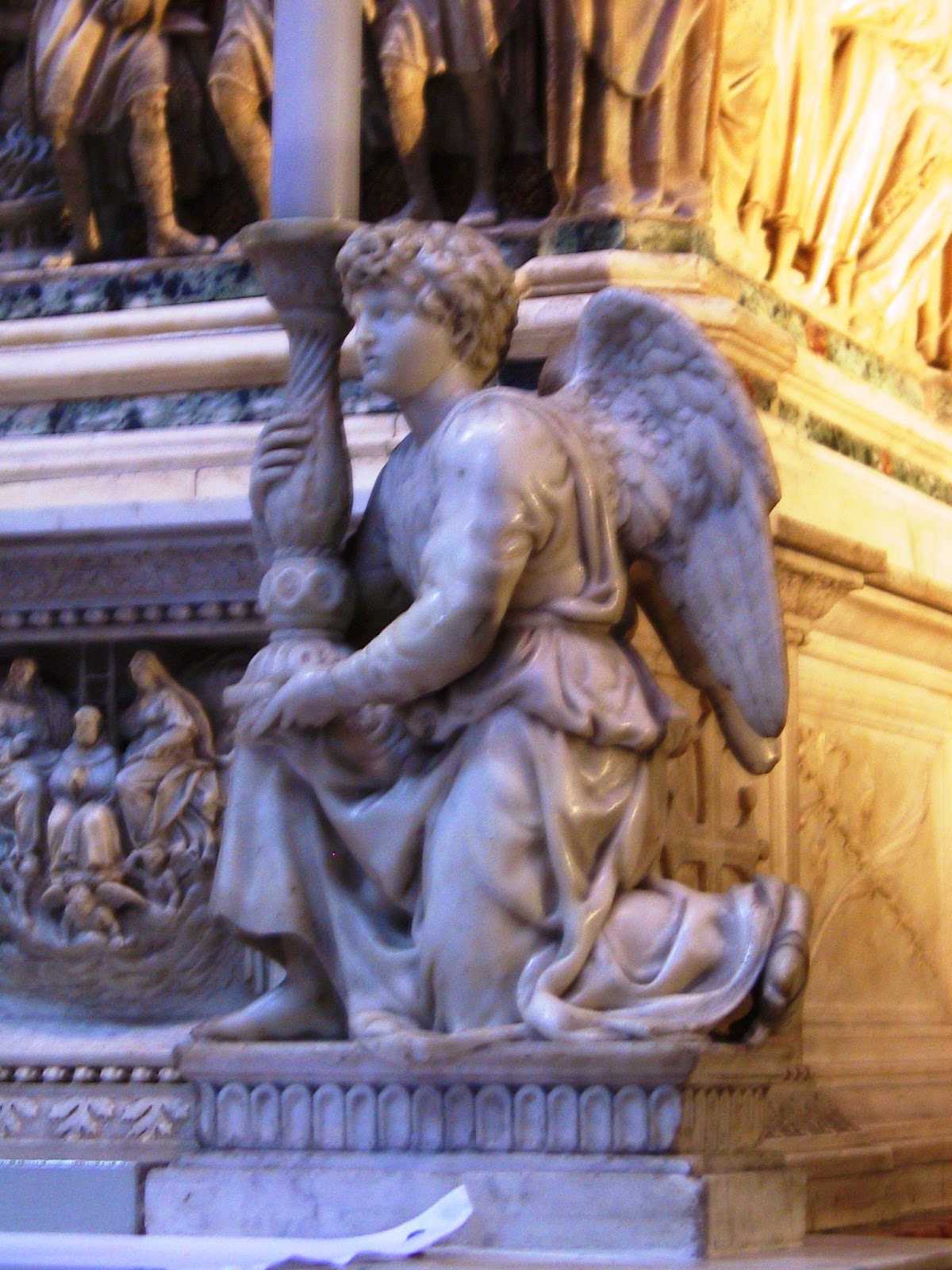
It contains a chapel with the elaborate tomb of San Domenico (Saint Domenick) with three sculptures by Michelangelo, including an angel holding a candle.
Arca di San Domenico (Tomb of Saint Domenic) by Nicollo Pisano and others.
Photo by Blomme-McClure
According to Luca, it is a test for gay men to correctly identify the Michaelangelo angel.
Kneeling Angel on Arca de San Domenico by Michelangelo.  Photo by Blomme-McClure
 
Statue of 'San Procolo' by Michelangelo, 1494.  Photo by Blomme-McClure
 

'San Petronio' begun by Nicollo Pisano and completed by Michelangelo.
Photo by Blomme-McClure
The designs and execution of the tomb which is in a chapel on the north side of the basilica won Niccolo the new name of Niccolo dell'Arca .  

We were very impressed that a custodian knew Luca and opened the locked gate to a cloister so that we could see it.
Cloister of Basilica of  San Domenico, Bologna.  Photo by Blomme-McClure

Choir and Apse of Basilica of San Dominico seen from Cloisters.  Photo by Blomme-McClure
Luca also took us into the courtyard of the old University of Bologna where the walls and ceilings are encrusted with the coats of arms of former students and intellectual societies.  
A courtyard of the University of Bologna which was founded in 1088.
Photo by Blomme-McClure
Arcade ceiling with the coats of arms of famous students of the University of Bologna.
Photo by Blomme-McClure

Statue of Louis Galvani, the noted Italian anatomist in Piazza Galvani.
Photo by Blomme-McClure
After our tour, we said 'good-bye' to Luca, returned to the Baglioni to retrieve our luggage and the car for our drive to Padua – about an hour away.

Padua is unprepossessing at best – a medium-size city of no special charm for us.  Perhaps it was our hotel, the Grand’ Italia Hotel (Corso del Popolo 81, Padova, 049 8761111, http://www.hotelgranditalia.it/) which sits above a McDonalds on a plaza where the railroad station meets the regional bus network.  It is about a 15-minute walk through a rather drab area to the old part of the city and about a 30-minute walk to the city’s main attraction, the Basilica of St. Anthony.  That evening we had dinner at Ristorante Belle Parti (Via Belle Parti 11, Padova, 049/8751822) near the old vegetable market (Piazza delle Erbe) on the south side of an old dump called the Palazzo Raggione.  There is a fruit market (Piazza della Frutta) on the north side of the same building.  Belle Parti is a very nice, traditional restaurant with a huge Parma ham sitting in the middle of an antipasta table.  The food and service were good, if unmemorable.

Monday, August 11, 2014

School of American Ballet on Videos

Many years ago, George Balanchine told Peter Martins that SAB needed a program to train more boys at the School of American Ballet (so that NYC Ballet wouldn't have to rely on imported danseurs like Peter).  Peter Martins actually started the Boys Program as it exists today in 1992.  By making the program tuition free the program attracts students from the New York metropolitan area whose families might not otherwise be able to send their sons to SAB.
SAB Boys Program students.  Photo from SAB website.
Here's a link to a wonderful new 12-minute video that explains the Boys Program, often in the words of the students, themselves:

http://vimeo.com/88763905

The School of American Ballet celebrated the 80th anniversary of its founding on January 2, 2014.  As part of the celebrations it has created an 8-minute video that features alumni talking about their experiences at the School.  Among the famous talking heads you'll hear from Jacques d'Amboise, Edward Villella, Chita Rivera, Allegra Kent, and Peter Boal.

http://vimeo.com/88204639

I recommend both of these new videos.  Although both are listed on the School's website, there was no way to get to them when I visited today. 

Sunday, August 10, 2014

Italian Trip Diary -- Day #10 -- Siena to Bologna

Friday, June 22, 2001 Siena to Bologna:

The next morning we got the car and after loading up our luggage we proceeded to get lost in Siena trying to find the autostrada north toward Florence and then on to Bologna.  The countryside north of Florence becomes even more mountainous, with deep gorges and steep mountains.  The autostrada climbs over the pass punctuated by several tunnels and high bridges soaring over breathtaking chasms and then descends as you near Bologna into a broad plain. 

We arrived in Bologna in mid-afternoon and made our way down another primarily pedestrian street to the (truly) Grand Hotel Baglioni (Via Indipendenza 8, Bologna, 051-225445) – Bologna’s answer to New York’s Plaza and St. Regis and Carlisle all rolled into one.  We were led by an assistant manager (or major domo of some sort) through the grand lobby and along a wide hallway to our rooms on the third floor.  Actually, our room wasn’t ready, so we were led to Carl’s room which would have been big enough for all three of us – a king-size bed, a sitting area, a dressing area and a huge bathroom.  Because our room wasn’t ready, the management sent us complimentary coffee while we waited.  Another major domo appeared to escort us two doors down the hall to our room when it was ready.  Both rooms looked directly across the street to the cathedral which had imposing Baroque statues just above our level.
Baroque statue of saint on facade of Cathedral in Bologna.  Photo by Blomme-McClure
Bologna is famous for its arcades which cover the sidewalks all over the center of the city.  
Covered pedestrian arcades run for blocks in Bologna.  Photo by Blomme-McClure

Each of Bologna's arcades has its own distinct architectural style.  Photo by Blomme-McClure
They provide shelter from the weather – rain, snow, sun, whatever – but can also seem rather sinister when they are too crowded or completely empty (when they seem rather like particularly suspenseful scenes from some Hitchcock movie) or when they become shelters for the homeless.  There are two very tall medieval towers in the center of the city (a la San Gimignano) which lean perilously toward each other.

That evening, our friend Luca met us at the hotel.  We went first for drinks on the Piazza Maggiore between the Palazzo Comunale (city hall) and the Basilica of San Petronio.
Palazzo Comunale (Palazzo d'Accursio) on Piazza Maggiore, Bologna.  Photo by Blomme-McClure

Entrance to Palazzo d'Accursio with bronze statue of Pope Gregory XIII.
Photo by Blomme-McClure
Palazzo del Podesta with two outdoor cafes on Piazza Maggiore, Bologna.   Photo by Blomme-McClure


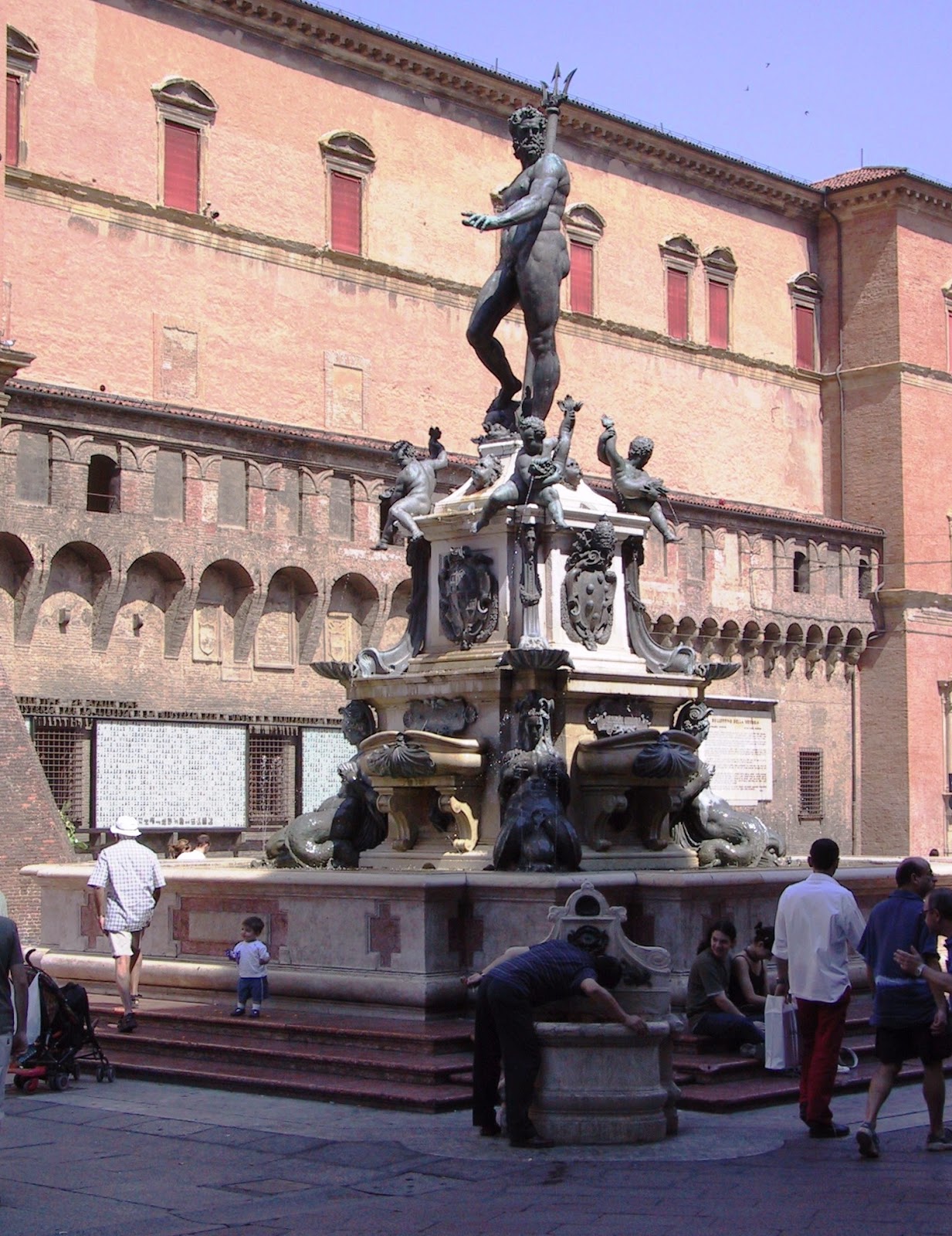
'Fountain of Neptune' in Piazza Maggiore, Bologna, by Giambologna, 1565.  
Unfinished faced of Basilica of San Petronio is in background.  Photo by Blomme-McClure 
The basilica was left unfinished when Bologna fell to the Pope and he decided that, if completed, it would rival Rome and the Vatican as a center of religion, learning and political power.  In the early evening the square was a lively spot and the cafĂ© was a great place to observe the street life of the city.

During drinks Luca told us about the city – its history and architecture and famous university – one of the oldest in the world.  Luca obviously loves Bologna and is both an enthusiastic and knowledgeable guide.
Many of the arcades in Bologna have painted ceilings with the crests of noble families.
Photo by Blomme-McClure
After sitting in the square for about an hour, we strolled down some of the arcades, past the Torri Pendenti -- the two tall medieval towers (a la San Gimignano) that lean perilously toward one another and on to Ristorante Cesarina (Via San Stefano 19b, Bologna, 051-23-20-37 or 051-23-55-43, http://www.ristorantecesarina.it/) where we sat outdoors under the arcade and enjoyed a lovely Bolognese dinner.  Luca had tortellini en brodo, lovely little meat-filled pasta dumplings served in a delicious broth, which is a local specialty.  The restaurant is on the square where the Church of San Stefano sits.  There are seven different sanctuaries within the church, each of which commemorates a different event in the passion of Christ.

After dinner Luca took us to the Bologna gay & lesbian center, which is located in one of the old gates houses in the city wall.  There are three levels which include several bars, a small disco and a performance space on the roof where we could see and hear a performance artist “performing” in a spotlight as we approached.  The crowd consisted mostly of young men traveling in cliques.  We had one drink and moved on.  Luca walked us back to the Baglioni and then he took Carl on to a gay bar.


Saturday, August 9, 2014

The Movie: 'Calvary'

We went to see 'Calvary' today -- I'd say it's great acting in search of a decent script.  

In the movie's first scene, Father James Lavelle sits in a confessional in rural Ireland while a parishioner tells him that he will kill him the following Sunday on the beach and that he has a week to 'get his affairs in order'.  Though the parishioner calls him a good priest, Father James will be killed because years earlier as a boy of six the parishioner was raped by a bad priest for several years and neither the church nor the authorities did anything about it.  Therefore, a good priest must pay for the deeds of the bad priest and the inaction of the church.
Official poster for 'Calvary'
What follows is a series of mostly one-on-one conversations between Father James and his colleague, his bishop, the police chief, his daughter (he became a priest after his wife died), and assorted members of his congregation and the rural community at large.  We learn from Father James (Brendan Gleeson) that he knows who the parishioner is, but won't tell his superiors or the authorities, but it is often unclear who knows about the threat on his life.  As the days tick by toward the fateful day, Father James becomes increasingly desperate and erratic.

Gleeson is magnificent as Father James and the supporting cast seems convincing.  But the premise and execution are perplexing and often infuriating.  The digressions into the lives of the other characters seem more like stalling tactics, sometimes almost like a series of sketch comedy routines.  Even when some of them advance the characterization of Father James as a good priest they also seem to uncover flaws in his character.  John Michael McDonagh wrote and directed this over-praised film.

Wednesday, August 6, 2014

The Movie 'A Most Wanted Man'

We went to see 'A Most Wanted Man' on Monday afternoon. The movie is a spy-thriller based on the novel of the same name by John le Carre with screenplay by Andrew Bovell directed by Anton Corbijn.  Set in present day Hamburg, it centers on a team of German spies that works outside the bounds of Germany's strict espionage laws and on their efforts to entrap a well-regarded Muslim intellectual and philanthropist they suspect is providing money to Muslim terrorists.


Movie poster for 'A Most Wanted Man'.
The team is run by Gunter Bachmann (played by Philip Seymour Hoffman), a shlubby spy whose failure on a mission in Beirut has led to this assignment in Hamburg -- the decrepit port city where terrorists connected and plotted the 9/11 attacks on New York and Washington.  Hamburg is depicted as a washed out, washed up wasteland of grim, anonymous buildings in thin, unforgiving northern light.

Gunter's team learns of a half-Chechen, half-Russian illegal immigrant, Issa Karpov (Grigoriy Dobrygin), who has appeared in Hamburg's Muslim community after stints in prison in two countries -- Russia and Turkey.  Issa soon connects with Annabelle Richter (Rachel McAdams) a lawyer working for a human rights group.  With Annabelle's help, Issa contacts Tommy Brue (Willem Dafoe) the head of a somewhat shady Hamburg bank.

Meanwhile, Gunter is confronting the legitimate German intelligence authorities, headed by Dieter Mohr (Rainer Bock), who want to arrest Issa immediately.  Gunter's wait-and-see approach is supported, at least initially, by Martha Sullivan (Robin Wright) a C.I.A. agent operating in Germany.

The rivalry between the various intelligence factions and the mystery of Issa's identity and intentions provides the framework for a story of intrigue -- and the ambivalence of defining the enemy in the 'war on terror'.  It is mostly a tale of betrayal -- children betrayed by parents, parents betrayed by children, colleagues betrayed by colleagues.  You have to stay alert to catch all of the nuances in this complex, fast moving film.

There are wonderful performances from every member of the large cast.  But the glue that keeps the complicated plot from spinning out of control is Philip Seymour Hoffman's compelling central performance.  Hoffman's Gunter is a multi-faceted, multi-layered manipulator, who is ultimately out-maneuvered by both those he trusts and those he despises.  It is a performance to be honored and cherished as one of the finest, and unfortunately the last, of Hoffman's distinguished career.

Saturday, August 2, 2014

SAB Summer Session Class Visit

Every summer, the School of American Ballet has a 'picnic' for the members of its Founders Society, a special group named for the School's founders, George Balanchine and Lincoln Kirstein.  Members of the Society have made planned gifts (often as part of their estate plans) to help ensure SAB's long-term financial viability.  Last month, we brought our friend, Bonnie, and niece, Julie, who were in town from Chicago, to the event.

In addition to the informal buffet lunch, attendees are invited to observe an SAB Summer Session class -- the only class visit by outsiders during the five-week summer program -- except for parents of the students who can observe classes during the final week.  

This summer, the School accepted students as young as 12 for the first time.  There were over 280 students attending this year's Summer Session -- the most ever.  They were selected from over 2,200 young dancers who auditioned during the School's National Audition Tour last winter or (for international students) through video auditions submitted to the School.  This summer there were nine girls divisions (Groups I thru IX) and two boys divisions (Intermediate Men and Advanced Men).  (The designation of 'girls' and 'men' comes from the School's website and from the common usage around the School.)
   
The class that we observed was an Adagio (partnering) Class taught by Jock Soto and Yvonne Borree for Intermediate Men and Girls IV.  This meant that boys as young as 12 were learning to partner girls who were most likely somewhat older and quite often taller (especially en pointe).  For many of the students, this was their first opportunity to partner or be partnered.  Certainly, it was their first chance to study Adagio with these two amazing teachers.

Jock Soto is a wonderful teacher.  The exceptional partnerships that he formed during his performing career -- first with Heather Watts, then after Heather retired in 1995, with Kyra Nichols, Miranda Weiss and penultimately Wendy Whelan -- are the foundation for his partnering classes.  Jock retired from the stage in 2005, but had become a full-time member of SAB's faculty in 1996. 
Jock Soto and Wendy Whelan in Christopher Wheeldon's 'Polyphonia'.
Photo by Paul Kolnik for NYC Ballet
Yvonne Borree also had a distinguished performing career -- super-charged when she was plucked from the corps in 1992 to dance with Mikhail Baryshnikov in Balanchine's 'Duo Concertant'.  Among her well-known partners were Nikolaj Hubbe and Jared Angle.  Though Yvonne and Jock were never a notable partnership, they did occasionally dance together at NYCB.  Yvonne retired from NYC Ballet in 2010, but had already begun teaching at SAB in 2008.
Yvonne Borree and Jared Angle in Balanchine's 'Duo Concertant'.  Photo by Erik Tomasson.

Jock teaches the men that the weight, height, and center of gravity of each partner must be understood and utilized in executing partnered moves.  Most importantly, both Yvonne and Jock know that great partnerships are based on mutual trust and rapport between the ballerina and her partner.  In teaching these concepts to their young students they are gentle, but firm.  Jock will often use humorous metaphors -- like 'chicken wings' (for bent elbows) -- to get the best results from the students.

Jock and Yvonne first demonstrated a combination.  Then the students tried those moves.  Jock stopped the class occasionally to demonstrate with a student, often exaggerating to make his point.  This might involve having the boy assume the female role so that he understood the impact he was having on his partner; or demonstrating with the girl what a partnered move should feel like to her.  In addition to demonstrating combinations with Jock, Yvonne helped the girls maintain elegant ballet positions even when they ceded a measure of control to their young partners.  Both teachers were constantly making sure that their young charges absorbed the finer points of Balanchine's adagio technique and engaged in appropriate stage decorum.

To avoid students becoming too comfortable with a single partner, Jock and Yvonne insisted that the male students worked with several different female students (there were about 7 or 8 more girls than boys in the class) on each repetition of the combinations.
   
After teaching several fairly rigorous adagio combinations, Jock and Yvonne let their charges loosen up with a waltz, although one with a tricky change in direction.  The waltz was followed by a grand polonaise around the studio.  The students had obviously already learned to organize themselves by height -- from shortest to tallest -- so the leaders of snaking line were the shortest boy partnering the two shortest girls.

About half way through the class Kay Mazzo, the co-chairman of SAB's faculty, appeared near the studio doorway with a student roster in hand.  She was joined a few minutes later by Amy Bordy, SAB's Director of Public Relations, Recruiting and Outreach.  They were watching the class -- and probably comparing notes on which ones to invite back for the Winter Term in September or possibly to consider for places in the 2015 Summer Session.  Since this was near the end of the fourth week of the five-week 2014 Summer Session, decisions had to be made so that invitations could be extended during the final week (when many of the student's families would be in town).

In addition to being a wonderful opportunity for students intent on professional ballet careers, SAB's Summer Sessions are also the primary chance for the SAB faculty to identify students to continue their training at SAB.  It's sad, but true, that less than 10% of the summer students will be asked to return in September.  While most of those invited will accept, there are always good reasons why they may not -- finances, emotions, maturity, dedication, proximity.

Bonnie, Julie and I each picked students that we hope will be invited back.  Who knows if we were selecting future ballet stars  -- or just students having a particularly good day in Adagio class.

Here are a couple of links to SAB's Facebook page which show the 2014 summer students enjoying some of the non-class events that they attended:
  
https://www.facebook.com/SABNYC/photos/a.10152266845303870.1073741845.36603863869/10152266845378870/?type=1&theater

https://www.facebook.com/SABNYC/photos/a.10152232440748870.1073741844.36603863869/10152232440963870/?type=1&theater

It looks like they had great fun -- but as we observed that day, they also worked very hard when they were in class.

Friday, August 1, 2014

Italian Trip Diary - Day #9 - San Gimignano

Thursday, June 21, 2001, Day Trip to San Gimignano:

Thursday we retrieved the car and drove to San Gimignano, the “Manhattan of the Middle Ages”, about an hour’s drive from Siena.  As we approached from the east, the 13 towers of the town rose on the hilltop -- a mini-Manhattan skyline.  
Towers of San Gimignano, the 'Manhattan of the Middle Ages'.  Photo by Blomme-McClure
There are several stories as to why these towers were built – one that they were built by noble families for prestige and that the bigger and higher the tower the more important the family, another that they were built for protection and that foot bridges connected the towers of allied families so that allies could gather in one house when enemies threatened; and yet another that the hollow towers were used to hang cloth dyed a special shade of yellow to dry and as the trade in this cloth grew they needed more and higher towers to meet the demand.
Manhattan-style street fair in San Gimignano.  Photo by Blomme-McClure
In any event, we arrived in the town to find that a street fair (no doubt the same tacky one that had been in front of our hotel in Siena the previous day) had been set up in both principal squares.  It’s kind of like being in Manhattan on weekends in spring and summer when you never know where the street fair or block festival will turn up next – always with the same T-shirt vendors and greasy food stands (maybe New Yorkers got the idea from their Italian ancestors).
Collegiate Church of Santa Maria Assunta, San Gimignano.  This church was consecrated in 1148 and contains the relics of Saint Germinianus (San Gimignano).  Photo by Blomme-McClure
We visited the church which has famous frescoes – a cycle on the old testament in the north aisle and one on the life of Christ in the south aisle.  
'Crucifixion of Christ' probably by Lippo Memmi, tempura on plaster, circa 1335-1345.
'Slaughter of the Innocents' in the lunette above.  Photo by Blomme-McClure
'Virgin Enthroned with Saints', tempura on plaster.  Some of the frescoes are in fragile condition.
Photo by Blomme-McClure
'Martyrdom of Saint Sebastian' by Benozzo Gozzoli, tempura on plaster, 1465.
Photo by Blomme-McClure 
These fresco cycles were the comic books of their day, telling the stories panel-by-panel for a generally illiterate populace.  Most of these are in particularly good shape.  The church and the town have been used in movies – “Tea with Mussolini”, “The English Patient”, etc. which makes the visit eerily familiar, but still enchanting.

Well in the center of Piazza della Cisterna, San Gimignano.  Photo by Blomme-McClure
While we were having lunch in the square with the well in the center (Piazza della Cisterna), the street fair was closing up its booths and tents and packing away the merchandise into their trucks. 
Sidewalk cafe on the Piazza della Cisterna (square of the well).  Photo by Blomme-McClure
After lunch, we went to the museum which includes a visit to the top of the highest tower in town.  Except for the last story, the stairs are modern – quite broad and steady.  The last story, however, is an almost vertical ladder that comes up under a steel grate – great!  It is tricky, but we all made it up to the viewing platform.  There are incredible views down into the town and out to the green and gold hills covered with vineyards and olive groves and dotted with monasteries and villas. 
View of the San Gimignano from Torre Grosso (highest tower).  Photo by Blomme-McClure
We could see the street sweepers in the two main squares cleaning up the last debris from the street fairs.
View of piazza from Torre Grosso.  Photo by Blomme-McClure
By the time we returned to the ground, the town was subsiding into a calm, unhurried pace.  We visited the “Torture” museum (quite disappointing) and then stopped on the square for granites before walking back through the twisting streets and under the gate in the walls to the car.
Steep, narrow streets beneath three of the 13 towers.  Photo by Blomme-McClure

Arches over the streets and on buildings.  Photo by Blomme-McClure

Tower rises at end of street with just motorbikes for transportation.
Photo by Blomme-McClure


Flowers on a terrace with a tower rising above.  Photo by Blomme-McClure
We took a different route back to Siena which took us up and down several valleys and by lots of vineyards and villas.  It was a lovely day with puffy white clouds dappling the countryside in light and shadow and several points on the road where we could look back at the San Gimignano “skyline”.

Returning to Siena, we got quite lost trying to find the hotel, ending up driving down a very narrow primarily pedestrian street which finally emerged into the square near our hotel.  We never did figure out how to navigate Siena by car, but we did appreciate the fact that most of the major streets in the center of town were reserved just for walking.

That evening, we decided to return to Antica Osteria da Divo for our final meal in Siena.  They were just inaugurating the new summer menu and while the food was delicious, it didn’t quite live up to the meal we had there two nights earlier.  On our way back to the hotel the passagietta was in full swing – lots of Italians of all ages out on the streets enjoying the balmy evening, strolling, gossiping, sipping coffee, window shopping.  It was a lovely way to end our stay in Siena.