Sunday, November 16, 2014

Ballet Odds & Ends . . .

I just wanted to share a few bits about ballet that have recently come to my attention.

Wendy Whelan's farewell evening in her own words:

Here's a slide show of photos by Henry Leutwyler from Wendy Whelan's farewell evening on October 18th along with Wendy's comments on each:

http://www.vulture.com/2014/10/wendy-whelan-last-performance.html?mid=facebook_nymag#photo=1x00012

I was really impressed with the range and depth of her thoughts on her retirement from New York City Ballet.


Wendy Whelan's shoes for her final performance.  Photo by Henry Leutwyler

Second Season of city.ballet on AOL:

The second season of city.ballet is now up on AOL at:  

http://on.aol.com/show/517887470-city-ballet/518489161

There are 12 segments, each from 5 to 9 minutes long, covering various aspects of New York City Ballet.  The clips were taken during the company's preparation for the Fall Season that ended October 19th.  They feature several dancers and cover their lives both within the company and in the outside world.  Each segment is a small gem that can enhance viewer's understanding of what it's really like to be one of the exotic creatures that we see on stage a few times each year.  Gee, they're not so different from the rest of us!

city.ballet 'logo' from AOL

SAB Workshop on PBS 'Live from Lincoln Center:

PBS has announced that it will broadcast the School of American Ballet's June Workshop Performance on Friday, December 12th, at 9:00pm (hardly live, but certainly worth the wait).  The all-Balanchine program includes 'Serenade' (to Tschaikovsky's 'Serenade for Strings in C'); excerpts from Act II of 'Coppelia'; 'Swan Lake' (Balanchine's 1-act version); and the fourth movement of 'Western Symphony' (to Hershey Kay's music based on American folk themes).  You may recall my post about this program which you can read here:


http://zylopho.blogspot.com/2014_04_01_archive.html

There's a short PBS 'tease' clip of the students in 'Serenade' here:

http://video.pbs.org/video/2365363809/

You'll recall that I wrote about the workshop performances in my posting here:

http://zylopho.blogspot.com/2014/06/school-of-american-ballet-workshop.html 

By the way that's my most popular post so far -- thanks for your support.


Addie Tapp (now a Boston Ballet corps member) and Preston Chamblee (now an apprentice at NYC Ballet)
performing George Balanchine's 'Serenade' in the School of American Ballet Workshop last June.
Photo is a still from PBS Live from Lincoln Center broadcast to be aired on 12/12/14 at 9pm.

'Ballet 422' coming to movie theaters near you:

The documentary movie 'Ballet 422', which was well-received at film festivals this fall will be opening in movie theaters in February, 6, 2015.  It provides a behind-the-scenes look at the creation of New York City Ballet's 422nd original ballet -- Justin Peck's 'Paz de la Jolla'.  You can see the movie's trailer here:

https://www.facebook.com/video.php?v=1484789521803444&set=vb.1400931226855941&type=2&theater

Look for movie theaters near you displaying this poster.

Nutcracker couples rehearse:

Finally, around the Rose Building (where both the School of American Ballet and NYC Ballet have their studios) we're starting to see George Balanchine's 'The Nutcracker' taking shape for its annual season (this year from November 28th thru January 3rd).  Ballet master Albert Evans was rehearsing with Teresa Reichlen (Sugarplum) and Ask la Cour (Cavalier) on Tuesday afternoon.  On Thursday afternoon Ashley Bouder and Joaquin De Luz were rehearsing the grand pas de deux before a studio doorway packed with rapt students plus the School's Executive Director, Marjorie Van Dercook, and me.  And many of the younger students are busy rehearsing to be guests in the Party Scene, Mice, Angels, and Candy Canes.  And the older students are learning the Dewdrop and Sugarplum variations and the grand pas de deux from the wonderful faculty -- many of whom have danced those roles themselves.


Teresa Reichlen as the Dewdrop in George Balanchine's 'The Nutcracker'.  Photo by Andrea Mohin for NYTimes
  

Friday, November 14, 2014

Italian Trip Diary -- Day #17 -- Venice to Rome

Friday, June 28, 2001, Venice to Rome:


On the last morning in Venice we took the elevator to the top of the campanile.
Campanile on Piazza San Marco with the Basilica on the left.  The tower rises 323 feet.
It was originally built in 1514, but collapsed in 1902 and was rebuilt in 1912.
Photo by Blomme-McClure


The views of the city are splendid and just as we reached the viewing platform the sun began to break through the clouds.  The domes and spires of San Marco below bathed in early morning sunlight,


Domes of the Basilica of San Marco from the top of the Campanile.
Photo by Blomme-McClure

La Salute rising across the Grand Canal,

Punta della Dogana (left) and Basilica of Santa Maria della Salute (right) at junction of the Grand Canal (foreground) and the Guidecca Canal with the Church of Santissima Rendatore in the left background.
Photo by Blomme-McClure


and San Giorgio Maggiore

San Giorgio Maggiore by Palladio was begun in 1566.  The facade was under restoration in 2001 when we were in Venice.  Photo by Blomme-McClure


perched on its own island in the lagoon

The island of San Giorgio Maggiore in the Venetian Lagoon with a corner of the Ducal Palace (left)
 and the Piazzetta with the twin columns topped by the Venetian Lion and 
St. Theodore Slaying the Dragon.
Photo by Blomme-McClure


were all splendid sights and reminders of the delightful days we spent in Venice.

Palazzo Ducal from the top of the campanile showing the rhythmic facade on the exterior 
and the more haphazard facade in the interior courtyard.  
Photo by Blomme-McClure


Piazza San Marco from the top of the campanile.
Photo by Blomme-McClure


The evangelist St. Mark preaching from the highest ogee arch of the facade of the Basilica of San Marco,
with angels climbing up the arch toward him amid the spires.  Most of the sculpture on the facade dates from 1414 to 1419 and is by  Paolo di Jacobo delle Masegne and Nicolai di Pietro Lamberti, although some that fell in an earthquake in 1511 were later replaced by Giorgio Albanese in 1618.
Photo by Blomme-McClure 


The campanile rises above the facade of a building along the Piazetta.
Photo by Blomme-McClure


Santa Maria della Salute across the Grand Canal.  Photo by Blomme-McClure

At noon we took a water taxi to the airport,

A favorite gondolier who worked from the basin near our hotel.  Photo by Blomme-McClure

Traffic jam on the way to the airport.  Photo by Blomme-McClure

crossing the lagoon along San Michelle

The cemetery island of San Michelle in the lagoon between the city and the airport.  Photo by Blomme-McClure

and arriving at a dock right next to the airport terminal.  The flight to Rome was uneventful, but then the fun began.

We took a taxi from the airport to the Jolly Hotel (where we had stayed at the start of our trip) -- but in the confusion of getting out of the taxi one bag was left in the trunk (warning to travelers #1 -- always count your luggage during transfers).  It happened to be the bag that had all of our prescription drugs in it (warning to travelers #2 -- always carry your prescription drugs in you backpack).  Frantic calls to our doctor in New York were followed by a trip to the Farmacia Internazionale (Piazza Barberini 49, Rome) where the pharmacist spoke little English and was reluctant to give us many of the prescriptions (warning to travelers #3 -- always carry copies of your prescriptions and a list of prescriptions with generic names as well as brand names).  Fortunately for us, a proctologist from Baltimore who spoke Italian was in the store and was able to intercede on our behalf.

When we got back to the hotel, there was a phone call from the taxi driver saying that he had found the bag in his trunk and that he would drive back into the city to return it -- if we would pay him for the round trip fare.  We agreed and eventually he arrived with the bag all ripped open with the contents rifled through.  We gladly paid him an excessive 'ransom' to get the prescriptions back, but then found ourselves the laughing stock of the hotel staff for paying off 'Al Capone, the bandito'.

Exhausted from the journey and subsequent events, we stumbled across the street for pizza at Il Pomodorino (Via Campania 45e, Rome, 06/42.011.356) where we requested a table served by our friend, Emmanuela.   

Sunday, November 9, 2014

Thoughts on the movie, 'Nightcrawler'. . .

On Saturday afternoon, we went to see the movie, 'Nightcrawler' the crime thriller written and directed by Dan Gilroy and starring Jake Gyllenhaal.

Movie poster for 'Nightcrawler'
'Nightcrawler' kind of got lost in the flood of mediocre horror movies released for Halloween.  But, believe me, this is not a typical Halloween chainsaw or Elm Street mayhem movie.


The movie is set in Los Angeles mostly at night and it is dominated by Gyllenhaal's jumpy, compelling performance as Lou Bloom, a loner who teaches himself to be a crime scene photo-journalist.  He starts by trading a stolen bicycle for a cheap video camera and a police scanner so he can get into the tabloid news business. 

Lou studies the methods and morals of modern business and adapts them to his enterprise -- business plan, internship opportunities, goal setting, market research, employee evaluations, positive reinforcement, product placement.  He gives new meaning to the phrase cutthroat competition and his approach to product improvement exceeds customer's expectations.

The results of Lou's efforts can be both extremely funny and excruciatingly horrible.  Jake Gyllenhaal gives a memorable,  energized performance that will leave you (but not him) breathless.

Saturday, November 8, 2014

American Ballet Theatre -- Sunday,November 2, 2014

On Sunday afternoon, November 2nd, we went to the State Theater for American Ballet Theatre's matinee.  There were some casting changes announced at the start of the program, but the p.a. system is so mushy that I couldn't catch the changes -- here's what was in the printed program:

Sinfonietta (Jiri Kylian/Leos Janacek)
       Company

Bach Partitia (Twyla Tharp/Johann Sebastian Bach)
       Misty Copeland, Gillian Murphy, Stella Abrera, James Whiteside, Marcelo Gomes,
       Calvin Royal III
       Violin Soloist: Charles Yang

Gaite Parisienne (Leonide Massine/Jacques Offenbach)
     Hee Seo, Isadora Loyola, Herman Cornejo, Marcelo Gomes

Jiri Kylian's 'Sinfonietta' choreographed to Leos Janacek's music of the same name was first staged for Nederlands Dans Theater in 1978 and premiered at ABT in 1991.  It is danced
by 14 dancers against a backdrop of a stylized landscape of a low plain surmounted by a clear blue sky.  The men wear loose shirts and tights and the women wear knee-length dresses of various colors with soft shoes.  The set and costumes for ABT's production are by Walter Nobbe.
Cast in the final moments of Jiri Kylian's 'Sinfonietta'.  Photo by MIRA from ABT website

The orchestra, conducted by Charles Barker, is augmented by a brass choir of 10 musicians on the stage aprons during the first and fifth (final) movements.  The sound was glorious and provided a strong platform for the dance.

Created nine years after Robbins' 'Dances at a Gathering', the format of this work is hardly original -- a group of dancers coming together in various combinations to interact and celebrate their connection to the earth.  Yet it is viewed as Kylian's masterpiece. 

Much of the cast swirls on and off stage in the four outer movements.  The central movement is a pas de six for three couples -- Veronika Part with Blaine Hoven, Devon Teuscher with Thomas Forster, and Isabella Boylston with Calvin Royal III (according to the printed program).  Each couple sometimes danced independently of the others; sometimes two couples danced the same steps while the third danced different steps.  Since we don't know the ABT dancers very well, it's hard to pick out any dancer for special recognition, but the overall work struck me as disappointing and the level of dancing as unexceptional.


ABT dancers in Santo Loquasto's costumes for Twyla Tharp's 'Bach Partita'.  Photo by Gene Schiavone
Twyla Tharp's 'Bach Partita' was choreographed in 1983 for ABT to Johann Sebastian Bach's 'Partita No. 2 in D Minor for Solo Violin'.  It was revived in 2013 by Susan Jones.  The Bach was played in the pit by Charles Yang -- I'm sure played very well, but solo violin music is not a great favorite of ours -- more to be endured than enjoyed. 

The costumes by Santo Loquasto are incredibly unattractive -- short skirts and sleeveless tops for the women; short shorts with sweater vests over T-shirts for the men, all in beige and dove grey; knee-length dance dresses in mouse brown for the 16-woman corps that appears in the final movement.

There are three principal couples -- Misty Copeland with James Whiteside in the first movement; Gillian Murphy with Marcelo Gomes in the second; and Stella Abrera with Calvin Royal III in the fourth.  The third movement is a pas de six for the three couples.  In the first movement Copeland and Whiteside are joined by four demi couples who also appear with Murphy and Gomes in the second movement.  In the fourth movement, Abrera and Royal are joined by three different demi couples.  In the fifth movement the three principal couples are joined by all seven demi-couples and the corps of 16 women.
Stella Abrera with Calvin Royal III, Gillian Murphy with Marcelo Gomes, and
Misty Copeland with James Whiteside in the third movement of Tharp's 'Partita'.   Photo by Darren Thoms
Tharp's choreography is less quirky and mischievous than much of her work for ABT during the Baryshnikov era (1980-1989).  The blips and squiggles that often seem so effortlessly right in her work are kept to a minimum in 'Partita'.

Copeland and Whiteside were limpid in the first movement.
Misty Copeland and James Whiteside in Tharp's 'Partita'.  Photo by Julieta Cervantes for NY Times
Murphy and Gomez danced the second movement with great technical assurance and sensual undercurrents.
Gillian Murphy and Marcelo Gomez in Tharp's 'Bach Partita'.  Photo by Gene Schiavone
Abrera and Royal bring flair and polish to their fourth movement pas de deux, but they lack rapport.

The seven supporting couples all danced with crispness and enthusiasm;  the 16-woman corps less so (maybe they were thinking 'why do I have to wear this ugly brown dress?').  It was certainly the most interesting choreography of the afternoon and was generally well-danced.

The biggest disappointment of the afternoon was 'Gaite Parisienne'.  The ballet by Leonide Massine to the music of Jacques Offenbach was created in 1938 for the Ballet Russe de Monte Carlo.  It joined the ABT repertory in 1970 (I remember that production fondly because Mimi Paul, a favorite ballerina, danced the Glove Seller).
Michael Smuin as the Peruvian and Mimi Paul as the Glove Seller in the 1970 ABT production of 'Gaite Parisienne'.
Uncredited photo from internet
Wikipedia says of the 1988 ABT production (revived last spring) that it features 'cartoonish sets by Zack Brown and extravagantly patterned and colorful costumes by French fashion designer Christian Lacroix'.  I'll add the designs are chaotic and distracting.


The set features an inner proscenium arch that is too small for the State Theater stage, cutting off views from supposedly full-view seats and adding to the overall clutter of the production. Massine was primarily a choreographer of character, creating movements that define each dancer's identity -- the gauche, antic Peruvian; the preening, supercilious officer; the grandly swanning La Lionne; the shy, insecure Baron; the pushy, competitive Flower Girl; and the confident, ardent Glove Seller -- are clearly drawn by their movements.

Unfortunately, Massine was less assured at using choreography to focus audience attention on specific characters or activities -- a severe handicap in this messy production.  Superstar dancers like Herman Cornejo as the Peruvian and Marcelo Gomes as the Baron are simply swallowed up in the visual chaos.  Cornejo may be a wonderful dancer, but as the Peruvian he just seemed silly.
Herman Cornejo as the Peruvian with the admiring Cocodettes (ladies of the evening)  in 'Gaite Parisienne.
Photo by Andrea Mohin for NY Times
Hee Seo has long, beautiful limbs and an exquisite line, but as the Glove Seller -- a role that is all about glamour and passion -- she is far too restrained and surprisingly unmusical.  She ignored crescendos and climaxes and often seemed a half beat behind the pit.  As the only character en pointe, the Glove Seller really must validate the suitability of this work for the company's repertory. 
Hee Seo as the Glove Seller and Marcelo Gomes as the Baron in 'Gaite Parisienne'.
Photo by Gene Schiavonne
Marcelo Gomes as the Baron is a strong and gallant partner, and the role requires little more.

Secondary characters and groups seemed inadequately rehearsed and danced with little panache or enthusiasm.  The Can-Can Dancers seemed particularly bland in what should be a rowdy dance of extremes.

Charles Barker lead the orchestra in a lovely, nuanced performance of the Offenbach score.  If only the dancers had responded with an equally musical performance on stage the the crazy quilt set and costumes could have been forgiven.  Alas, in their Lacroix creations and with indifferent dancing, the dancers simply added to the visual cacophony. 

Wednesday, November 5, 2014

American Ballet Theatre -- Sunday, October 26, 2014

On Sunday at the unlikely hour of 1pm we went to New York State Theater to see a performance by American Ballet Theater.  The theater was only about half-to-two-thirds full.

Sunday, October 26th, at 1:00 pm

With a Chance of Rain (Liam Scarlett World Premiere/Rachmaninoff)
H. Seo, M. Copeland, G. Bond, D. Teuscher, M. Gomes, J. Whiteside, J. Gorak, S. Baca
E. Wong (piano soloist)

Jardin aux Lilas (Tudor/Chausson)
M. Hamrick, T. Forster, L. Underwood, A. Hammoudi
D. LaMarche (conductor), B. Bowman (violin soloist)

Thirteen Diversions (Wheeldon/Britten)
S. Lane, I. Boylston, G. Murphy, C. Shevcheko, C. Salstein E. Tamm, C. Stearns, T. Forster, B. Hoven
O. Wilkins (conductor), B. Bilach (piano soloist)

'With a Chance of Rain' choreographed by Liam Scarlett to seven Sergei Rachmaninoff piano pieces had premiered at the Company's opening night gala on Wednesday, October 22nd.  The Rachmaninoff pieces were played beautifully by Emily Wong, providing musical support from the pit.

Scarlett costumed the eight dancers in various shades of grey with varying amounts of skin displayed -- Marcelo Gomes bare-chested with ankle length tights; James Whiteside in long sleeves, short shorts, and bare legs; Hee Seo in a long-sleeved leotard; Misty Copeland's arms, shoulders and legs bare.  Maybe Scarlett gave them a choice of what parts of their bodies they wanted to expose.
Cast of Liam Scarlett's 'With a Chance of Rain' in costumes by Scarlett.  Photo by Andrea Mohin for NYTimes
After an introductory section for the full cast, there is a much discussed pas de deux for Misty Copeland and James Whiteside.  After several minutes of a quite lovely adagio he places his hands on her breasts and massages them.  A bit later he puts his hand on her butt twice and she slaps it away both times.  Later she puts her hands on his chest and 'twerks'.  The pdd ends with his hands back on her breasts.


James Whiteside and Misty Copeland in Liam Scarlett's 'With a Chance of Rain'.  Photo by Marty Sohl

Misty backs away and Marcelo Gomez walks up to Whiteside's hands which are now on Marcelo's bare chest.  Startled, Whiteside stiffens, but then the two men engage in a short 'buddy' pas de deux.  The audience tittered nervously at the various sexual references.

The two secondary couples have some lovely dancing and there is a beautiful pas de deux for Hee Seo and Marcelo Gomez.  
Marcelo Gomez and Hee Seo in Liam Scarlett's 'With a Chance of Rain'.  Photo by Marty Sohl


Near the end there is a wonderful solo for Marcelo Gomez.  The only thing more beautiful than his body is the technical control he displays in this dance.

The choreography throughout is athletic and often off-balance and relates nicely to the music.  Scarlett has some interesting ideas, but they are unfortunately marred by too much bare skin and too many tasteless, juvenile and irrelevant antics.

'Jardin aux Lilas' (Lilac Garden) was choreographed for Ballet Rambert in 1936 by Anthony Tudor to 'Poeme' for violin and orchestra by Ernest Chausson.  It entered ABT's repertory in its first season in 1940 when Tudor was one of the founding members of the Company as both a dancer and the resident choreographer.
Hugh Laing, Maude Lloyd, Anthony Tudor, and Peggy van Praagh in the original 1936 production by Ballet Rambert.  Laing and Tudor were long-term domestic partners and moved on together to ABT in 1940.
Photo from the Dance Division of The New York Public Library for the Performing Arts.

The ballet is set in a lilac garden where a party is being held for a newly engaged couple.  On Sunday, the bride-to-be, Caroline, was danced by Melanie Hamrick.   Thomas Forster was Her Lover, Alexandre Hammoudi was The Man She Must Marry, and Leann Underwood was An Episode in His Past.  There is a corps of eight Friends and Relations.

We have seen this work many times.  The introduction of fresh, young corps dancers (Hamrick, Forster and Underwood) doesn't keep it from seeming tired and stale.  The shabby set doesn't help either.  Hamrick as the central figure hasn't found a way to integrate her character's mimed emotions of longing and despair into her dancing.  Forster and Underwood do better at incorporating the mime into their performances, but they remain too subtle to convey their characters' emotions.  Hammoudi is priggish and withholding in a role that has always seemed thankless to me -- maybe Tudor himself was able to humanize it.

'Thirteen Diversions' by Christopher Wheeldon to Benjamin Britten's 'Diversions for Piano (left hand) and Orchestra' closed the program.  There is a large cast -- four principal couples and eight corps couples -- costumed by Bob Crowley (the principals in dove grey with flashes of violet at the hems of the women's knee-length skirts and the corps in black with flashes of yellow for the women's skirts).  Frankly, these costumes with hints of bustles on the women and tail coats on the men seemed rather dowdy.

The action occurs behind a black scrim which contains the stage smoke that hangs in the air, reflecting the changing colors and shapes of the harshly effective lighting design by Brad Fields.

As usual, Wheeldon deploys his large cast in complex and interesting patterns -- there is a large wheeling circle for the corps couples that left a vivid after image.  The couples start out together moving in a clockwise circle.  As each couple nears the front of the stage the man spins out and joins an outer circle of men moving counter-clockwise to the women's circle.  It's like a scene from a Busby Berkeley musical juxtaposed with one from Fritz Lang's 'Metropolis' -- brilliant.

Wheeldon's choreography for the four principal couples varies.  I was disappointed by Sarah Lane with Thomas Forster and Isabella Boylston with Cory Stearns.  Gillian Murphy seemed mismatched with Eric Tamm in a role that she had created with David Hallberg in 2011.
David Hallberg and Gillian Murphy in Christopher Wheeldon's 'Thirteen Diversions'.  Photo by Rosalie O'Connor
Christine Shevchenko and Blain Hoven danced well, primarily in pas de quatres with one of the other three principal couples.  This was certainly the best of the three works on the program, but we've seen better Wheeldon works and Wheeldon works danced better elsewhere.

Ormsby Wilkins conducted the orchestra and piano soloist, Barbara Bilach, in a nuanced performance of the Britten score.


Tuesday, November 4, 2014

Halloween Open House at the School of American Ballet

The School of American Ballet holds an open house for members of its Association (donors) every year on Halloween.  Most students in the Advanced Division (and a few faculty members and accompanists) dress in costume for the occasion.  Association members are invited to observe classes from 10:30am to 4pm.
  
I arrived around 11:15am and was able to look in on the three classes in progress:

  • Suki Schorer was teaching the D women's class in Studio. Suki, of course, is a legend and always seems to inspire her students with her attention to detail and extensive knowledge of Balanchine technique.  She has been on the School's faculty since 1972, but was already a well-respected guest teacher at SAB by the mid-60's.

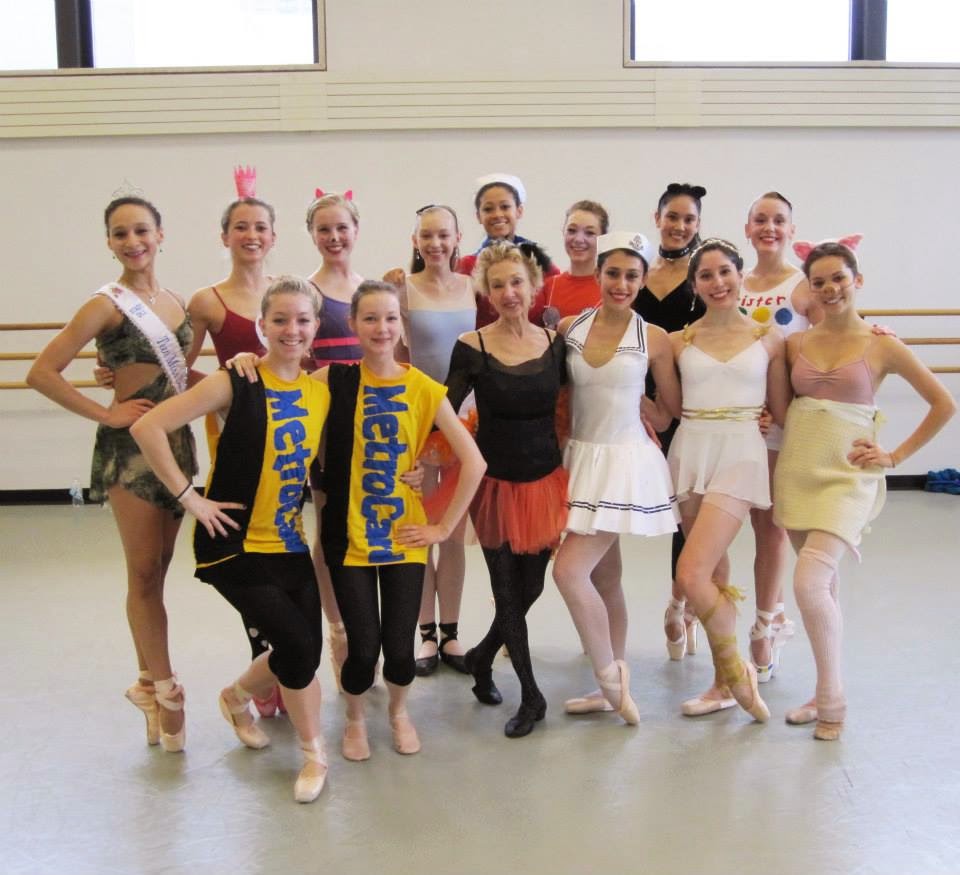
D Women's Class with Suki Schorer front and center,
 plus two Metrocards, a Sailor, a Greek Goddess and a Pig-in-a-Blanket in the front row.
Photo from SAB Facebook page

  • Jonathan Stafford was teaching the C-2 girls in Studio 4.  Jon is a more recent addition to the SAB faculty (2007) and I had not seen him teaching a girls class before.  He offers lots of corrections and encouragement and knows the technique from many years of performing at NYCB and training at SAB and earlier at Central Pennsylvania Youth Ballet under Marcia Dale Weary, a legendary teacher of students who have moved on to SAB and then to careers with New York City Ballet.

C2 Women including (seated) Glinda and Dorothy from Oz, 3 Pop Tarts (front row standing), 2 'Do Not Disturb' in nighties (center of second row standing), a Ladybug and a Captain Hook among others.
Photo from SAB Facebook page
  
  • Darci Kistler was teaching the C-1 girls in Studio 5.  As Balanchine's last ballerina, Darci is also carrying on his tradition.  She was teaching the C-1 girls a very difficult section of the Dewdrop solo from Balanchine's 'The Nutcracker'.  Darci would stop after each student performed and make corrections.  You could see each of them improve as they repeated the passage incorporating Darci's suggestions.

C1 Girls Class with 2 Rabbits, 2 Cats, Wonder Woman, a Witch, and a Footballer in the crowd.
Photo from SAB Facebook page

All three are amazing teachers and I'm sorry that I couldn't see all of their classes from start to finish. 

At noon, I moved back to Studio 1 to watch Jock Soto teach the Advanced Men.  It was a smaller group than usual, and I learned later that several of these students were participating in the New York Choreographic Institute program up on the seventh floor.

Jock was in fine form, offering something for the students and something for the observers.  He gave the class a very fast combination at the barre that involved legs and arms moving on different beats two six-count phrases.  None of the students seemed to get it right, but Jock's point was that choreographers and composers can throw these things at dancers and expect them to learn them quickly.  On center combinations he urged them to use the whole space -- even chasing some across the floor.  In order to illustrate taking off from a tight fifth position on double tours he used four men to surround the 'victim' (my word not Jock's).  Jock's classes are never dull.
From the Advanced Men's Class -- Mr. B's Cat (Mourka), a Convict/Mummy and a Construction Worker.
Photo from SAB Facebook page
Following a half hour break for brownies in the Student Lounge (for the adults, not the students), we were treated to an Adagio Class taught by Darci Kistler and Jock Soto for the Advanced Men with D Women from 2pm to 3pm and with C2 Women from 3pm to 4pm.  They were teaching both groups the opening section of the Sugarplum's grand pas de deux from Balanchine's 'The Nutcracker'.  Last year at the 2013 Halloween Open House, I had watched Darci and Jock teach a different passage from the same pas de deux.  It's amazing how much insight these studio deconstructions provide when I see actual performances at NYC Ballet.
D Women and Advanced Men in Adagio Class with a couple of Top Guns on the left, a Baby in a diaper with a giant pacifier (right of center).  Photo from SAB Facebook page
More photos of the students in their Halloween costumes are on the SAB Facebook page:

www.facebook.com/media/set/?set=a.10152463363738870.1073741848.36603863869&type=1


Saturday, November 1, 2014

Comments on the movie 'Pride'

We went to see 'Pride' Thursday afternoon at the Bow-Tie Chelsea.  For those of us who lived through the Reagan years in the U.S. and the comparable Thatcher years in the U.K. it's a vivid reminder of an era of repression for gays and for labor unions.
Poster for 'Pride'.
Written by Stephen Beresford and directed by Matthew Warchus, 'Pride' is based on the true story of the unlikely alliance between a London gay and lesbian group (Lesbians and Gays Support the Miners, or LGSM) and Onllwyn, a small mining town in Wales during the miners strike that lasted for 14 months in 1984 and 1985.  Although the strike ended with the miners returning to work in defeat (and Margaret Thatcher reaffirming her role as the 'Iron Lady'),  it also created the bond between the gay community and labour unions that would lead to the Labour Party adopting gay and lesbian rights positions that eventually enabled significant advances in British gay rights.

The cast includes a wonderful collection of British character actors including Bill Nighy and Imelda Staunton as Welsh union activists and Dominic West as an aging London disco queen.  Paddy Considine plays the head of the Onllwyn miners union who is gradually won over by the group from LGSM.  Ben Schnetzer is terrific as Mark Ashton, the chief rabble rouser spokesman for LGSM.  George MacKay plays Joe, the innocent gay observer and LGSM photographer, who during the movie finds the courage to come out.  Joe is the only major character in the movie who is purely fictional -- all of the others are based on real people who participated in the actual Onllwyn-LGSM encounters.  

As the closing credits sadly disclose, several of the LGSM characters later died of AIDS and one of the Onllwyn characters went on to become a member of Parliament.  They fail to point out that Mrs. Thatcher (and Ronald Reagan) died of dementia related to Alzheimer's disease.